
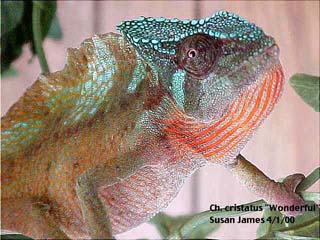
 Family: Chamaeleonidae
Common Name: Crested Chameleon
Scientific Name: Trioceros cristatus
Food: Insects
Distribution: Fernando Po, Equatorial Guinea (Mbini), Cameroon, Central African Republic, Congo, Gabon, Nigeria
Habitat:
Color Discription: Females are more of a green hue while males exhibit the browns, khaki and grays. Males have vivid blue scales outlining the head crest that particularly brighten during territorial displays. The color is uniform on the body with an irregular netlike pattern. The interstitial skin of the throat is bright red or orange.
Physical Discription: A tall pointed casque behind a flat head. The casque is formed by the lateral crests. The parietal crest is simple. The tail is relatively short in comparison with the body. Scalation is smooth with scattered, enlarged, flat scales among the regular scales. Males have high, fanlike sailfins on their backs and tails which are less developed in females.
Size: Females of this species is larger 11" and the are Males 10"
Temperatures/Humidity: Temperatures should remain constant at approximately 75ºF with only a small drop in temperature at night. This chameleon requires an extremely humid, or more plainly, a wet environment.
Breeding/Reproduction: Little is known about the reproduction. 1 CB female's gestation was 4 months, with 2 clutches in one year. 16 - 37 eggs may be laid. 3 reported hatchings from WC females put incubation at 8 - 9 months at temperatures of approximately 72ºF, with a few degrees drop at night. 1 female bred in captivity had gestation of 3.5 months and incubation of 10 months.
Cage Setup:
Water:
Special Needs: A continuously running ultrasonic humidifier that dews the cage, as well as constant dripping of daytime water help meet this need. they enjoy high UV exposure, so double UV lights can be used.
Special Note: