
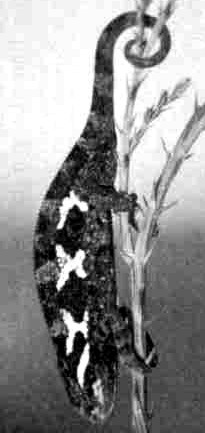
 Family: Chamaeleonidae
Common Name: Ruppell's Desert Chameleon
Scientific Name: Trioceros affinis
Food: prefers flying insects to crickets.
Distribution: Ethiopia
Habitat: dense stands of grasses, bushes and low trees. The density of the vegetation permits relatively large populations to live in an area.
Color Discription: Very light to very dark greens often with white and rust-colored markings, especially in females and in the more excited states. Yellows and blues may also be present.
Physical Discription: The casque is poorly developed. A small dorsal crest of enlarged conical scales continues from the cervical region through the rostral part of the tail. The gular crest is a unique arrangement of two parallel rows of enlarged, soft scales. A small ventral crest of enlarged white scales is present. Scalation is largely homogeneous.
Size: 7"
Temperatures: Temperatures in its home range vary from highs of 85ºF to lows of 32ºF but more commonly between 15 and 75ºF. Trioceros affinis is often erroneously thought of as a resident of an arid habitat. However, humidity is typically near or above 50% and often much higher.
Breeding/Reproduction:
Cage Setup:
Water: Both misting and drip systems are recommended.
Special Needs:
Special Note: They have rarely been kept in captivity and the details of their husbandry remains sketchy.
12 - 19 live young are typically born.
Lifespan in captivity may be as long as 5 years.