
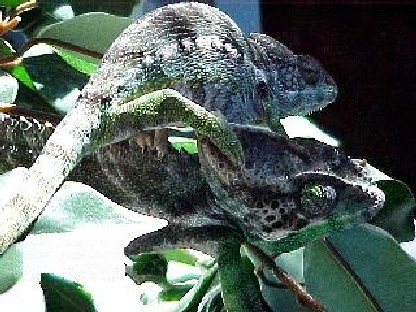
 Family: Chamaeleonidae
Common Name: Madagascar Giant Spiny Chameleon
Scientific Name: Furcifer verrucosus
Food: Large quantities of crickets, flies, moths, superworms, mealworms
Distribution: Madagascar (except in the East and North )
Habitat: semi-desert coastal environments
Color Discription: 3 color morphs have been described in males: 1) A green-blue morph, 2) A red-headed morph (with dark green underbelly and light green or blue dorsal region). 3) a darker olive green morph with longer dorsal crest spines. Adult coloration varies between sexes; females are variable in color between morphs. Nonreceptive females can be gray, taupe, rust or beige with a light or white lateral band. When receptive/gravid, females will display various orange/red coloration with the gravid redheaded morph displaying a bright rust color or dark brown with purple.
Physical Discription: The spectacular dorsal crest spines in males give this species its nickname. Males have large tubercles in a line along the middle of the sides and smaller tubercles in oblique rows on the upper side of body. The male's head appears large in proportion to the body when compared to that of the female. Males are bigger than the females (at maturity generally twice as long and even larger by weight). Males have a raised parietal crest (casque) and hemipenal bulges are clearly visible. The dorsal crest in males runs to half the tail. There may be up to 40 spines on the dorsal crest of males that can reach 4 mm in height. The female's dorsal crest has 4 - 5 smaller, 1 mm spines.
Size: There are unconfirmed reports of males reaching up to 2 feet in length. However, it is exceedingly rare to see a specimen of 22". Most adult animals are in the range of 16" - 20".
Temperatures: Furcifer verrucosus generally occupies semi-desert coastal environments where day time temperatures may reach 110ºF. Daytime temperatures should range from the low 80'sºF to the 90'sºF at the basking spot. A 10 - 15ºF drop at night is recommended. A winter cooling period (found in native Malagasy regions) for two months may help in the acclimation of wild caught animals and regulate the breeding cycle.
Breeding/Reproduction: Females deliver 1 - 2 clutches of 30 - 50 eggs a year. With a pronounced winter cooling period, 1 clutch is typically laid. If the climate remains temperate all year, 2 clutches maybe laid in a year. Maturity for breeding is reached at 9 - 12 months although they achieve sexually mature at 6 - 10 months. Breeding is initiated by introducing a receptive female to the male's cage. The female's receptivity is indicated by a deepening of the cinnamon to a reddish tint in her coloration. If female rejects the male's advances remove her and re-introduce her at a later time. If the female does not reject the male, breeding may take place over the course of days or weeks. Remove the bred female when her darkening color is accompanied by threat displays directed toward the male. When the female is gravid then she needs to be isolated. Expect an increase in her food consumption. Gestation lasts from 4 - 6 weeks. She will lay eggs in a large area with potting soil. Eggs should be incubated at 68ºF - 74ºF for 9 - 12 months in moist (but almost dry) vermiculite (2" deep). At 9 months water may be added to the vermiculite to simulate the rainy season. Eggs will swell and the thick shell will be thin enough for the neonate to break out. Raise neonates in high humidity (60 - 80%). The babies are relatively easy to raise. Males can be sexed at birth by the pronounced spines on the dorsal crest. Females have fewer and smaller spines. Crossing color morphs when breeding is not recommended.
Cage Setup: Screen caging requirements are on a larger scale, especially for males. Minimum cage size for males is 4' x 2' x 2'. Females: 3' x 2' x 2'. Individuals should be raised apart and only put together for breeding. Be sure to include branches of various thickness, and live plants.
Water: Must be supplied by a drip system and misting.
Special Needs: Outdoor direct sunlight is recommended
Special Note: The vast majority of animals found for sale are WC (Wild Caught) because of limited breeding programs of this species.
Deparasitizing and (de)worming are highly recommended. Although shy, F. verrucosus adapts well to captivity after initial acclimation.
Because of their shyness, this species will often fail to eat or move if it is being watched.
They will hide by hugging the side of larger branches with their slender bodies. Visual, as well as physical isolation is especially important.
Their habitat should be kept quite dry.