
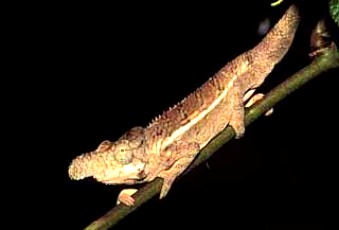
 Family: Chamaeleonidae
Common Name: Rhinoceros Chameleon
Scientific Name: Furcifer rhinoceratus
Food:
Distribution: NW Madagascar
Habitat:
Color Discription: Males are grayish or brownish with dark brown or black between scales. The labials (lips) are white and there is a white, longitudinal line at the flanks. The "nose" often has a bluish tint. Female coloration is similar to tht of the male except that gravid females exhibit a neon-purple coloration with black transverse bands that continue on the orange or red tail.
Physical Discription: There is more or less homogenous scalation, often with a longitudinal row of slightly enlarged scales at the flanks. Males have a prominent, vertically compressed nasal projection that is present but less developed in females. The "nose" for which this species is named (rhinoceratus mean "horn-nosed") is thin and fragile. Both sexes have a low casque. Males have no gular crest or very few small, pointed tubercles, and the females have no gular crest. Both sexes have a dorsal crest which is present on the anterior half of the body.
Size: Males 11", females 5"
Temperatures:
Breeding/Reproduction: Very few if any published records exist of successful caprive breeding. This is partially due to the relative rarity of the species in the wild but because of legal exports of the species were banned in 1995. Hardly any Furcifer rhinoceratus were exported prior to the ban and breeding successes with chameleons were much more uncommon before 1995 than they are nowadays. At Centre Soafiavy, clutches of 4 - 11 eggs were laid in November 2000. Incubated in slightly moist vermiculite, allowed to dry out during incubation, eggs started hatching after 291 days at 83.3ºF.
Cage Setup:
Water:
Special Needs:
Special Note: