
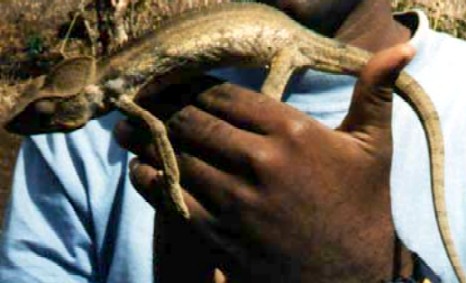
 Family: Chamaeleonidae
Common Name: Madagascar Giant Chameleon
Scientific Name: Furcifer oustaleti
Food: Insects
Distribution: Madagascar
Habitat: Both warm and humid coastal lowlands but seems to prefer drier forests. Most common in disturbed areas, they have also been seen in parks and gardens.
Color Discription: grays and browns. Chameleons from different localities may exhibit variations in the extent of a reddish or greenish tint. Females tend to be slightly more colorful than males.
Physical Discription: Has a high casque which lacks occipital lobes. Horns or other rostral processes are also absent. Gular and dorsal crests are composed of specialized, prominent conical scales. A small abdominal ridge is also present. Body scalation is heterogeneous.
Size: Males reaches a total length of 24" but even larger males have been reported. Females reach half this size.
Temperatures:
Breeding/Reproduction: As many as 61 eggs are laid in a single clutch. In captivity there may be as many as 2 clutches a year although in the wild it is likely that more than one clutch is laid. Sexual maturity is achieved at 6 - 12 months of age.
Cage Setup:
Water: These areas get a great deal of rain during the Malagasy spring and summer but little rain in the fall and winter. The oustaleti are "oblivious to dry atmosphere" and seem to have given many novices the impression that Furcifer oustaleti is a "desert chameleon" with low hydration requirements. But nothing could be further from the truth. Even during the dry season, humidity is high (over 70%) in the coastal lowlands preferred by this species. Consequently, there is extensive daily dewing regardless of season. Like most other chameleons, Furcifer oustaleti should be considered a water-loving species with high hydration requirements.
Special Needs:
Special Note: