
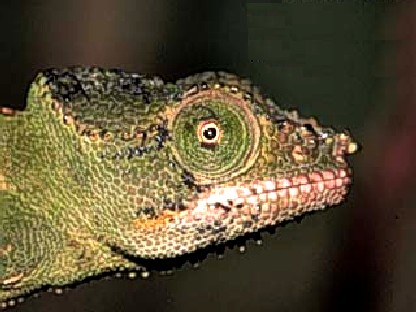
 Family: Chamaeleonidae
Common Name: Comoro Flap-nose Chameleon
Scientific Name: Furcifer cephalolepis
Food: Insects
Distribution: Comoro Islands (Grand Comoro)
Habitat:
Color Discription: light green, with yellow, blue, and brown intermingling, and a light lateral stripe.
Physical Discription: The rostral process projects above the mouth. In some specimens the rostrals may also project slightly anterior to the mouth. Scalation is smooth and homogeneous. The most apparent differences between the sexes are body and rostral size, which are larger in the male. Males also have a prominent hemipenial bulge.
Size: Males may grow to 7" while females are slightly smaller.
Temperatures:
Breeding/Reproduction: Females may lay as many as 3 - 5 clutches per year. Gestation has been reported at 33 - 45 days and egg incubation at 244 - 320 days with incubation temperatures between 78º F - 82º F. However, one observed gestation to be closer to 60 days and incubation range from 255 - 405 days at those same temperatures or somewhat cooler (6 clutches studied). 4 - 9 eggs are laid in a single clutch. Sexual maturity may occur as early as 3 months.
Cage Setup:
Water:
Special Needs:
Special Note: This exquisite little chameleon is locally abundant but restricted to the Grand Comoro Island
(not Mayotte) in the northern part of the Mozambique Channel which separates Mozambique from Madagascar.
This species only entered the U.S.A. legally for the first time in April 2000. They are infested with parasites upon arrival.
One analysis revealed Ancylostoma (hookworms, moderate burden) and Flagellates.
Non-pathogenic organisms and and pseudoparasites included amoebic cysts, pollen granules and possible yeast problems.
High concentrations of actively budding fungal organisms were also apparent.
For all these reasons Furcifer cephalolepis should be kept only by keepers with extensive experience.