
 Family: Chamaeleonidae
Common Name: Angel's Chameleon
Scientific Name: Furcifer angeli
Food: Insects
Distribution: NW Madagascar
Habitat: dry forest
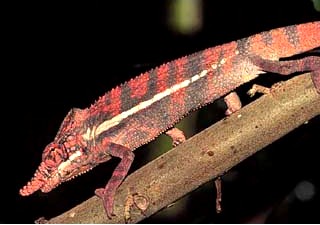
Color Discription: Males are dark to a reddish brown or rich orange-pink (when displaying) with irregular darker brown or black saddle-shaped transverse bands. A very prominent white, longitudinal line at the flanks ends at the insertions of the front legs. The lips (maxillary and mandibular labia) are white. The females are rust brown with head, limbs and tail a paler brown. Markings of darker shades of brown appear on the cheeks, body and tail. Elongated, longitudinal spots of a light brown color form an interrupted line at mid-flanks. Displaying females have numerous neon-purple scales all over the body and cheecks. It is unknown if these neon-purple scales are a sign of gravidity
Physical Discription: Scalation is heterogenous, often with a longitudinal row of enlarged scales at the flanks. Males exhibit a prominent, rigid, boney nasal projection. The nasal projection in females is very small and barely visible. Both sexes possess low casques and gular crests of small, pointed tubercles. Enlarged scales may be present on the cheeks and casque.
Size: Males 12", Females 8". However, because so few specimens are known, it is not unrealistic to suspect that larger specimens may ultimately be found. Thus, it is suggested that a maximum total length of 16" can be found.
Temperatures:
Breeding/Reproduction:
Cage Setup:
Water:
Special Needs:
Special Note: Only a very few specimens of this rare species are known to science.
As far as we know, there are no published records of captive breeding of this species. Probably very few have ever been kept in captivity. They have been banned from export since 1995.
Similar species: Males are very distinct from other Malagasy chameleons.
Females look superficially similar to female Furcifer pardalis but there is confusion in the field because is impossible because the two species nowhere occur sympatrically!.