
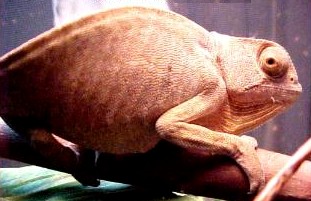
 Family: Chamaeleonidae
Common Name: Senegal Chameleon
Scientific Name: Chamaeleo senegalensis
Food: Insects
Distribution: Tropical West Africa from Senegal to Cameroon: Guinea-Bissau, Guinea, Sierra Leone, Liberia, Ivory Coast, Ghana, Togo, Benin, Nigeria, Mali, Gambia
Habitat: inhabits dry savannahs and gallery forests.
Color Discription: Females are typically a uniform green or brownish green but may exhibit a striking pattern of yellow or orange dots on a black or dark brown background when gravid. Males tend to have more gray and brown, often arranged in 4 roughly triangular blotches, widest toward the dorsum and more pointed toward the ventrum. The interstitial skin of the gular region is often orange.
Physical Discription: Concave casque with a crown-shaped orbital crest. Homogeneous scalation except for small conical scales forming a low dorsal crest. A small gular and ventral crest is composed of white or cream-colored scales. Males exhibit a broader tail base
Size: 12" Males are slightly smaller.
Temperatures:
Breeding/Reproduction: will lay 2 clutches a yr. with up to 70 eggs in a single clutch. Sexual maturity is reached in 5 - 6 months.
Cage Setup:
Water:
Special Needs:
Special Note: Although they are among the most frequently imported and least expensive chameleons, they have been extremely difficult to keep in captivity and captive breeding programs have been very unsuccessful.
A primary reason for these difficulties seems to be the heavy parasite loads typically found in wild caught animals.
A series of fecal checks is, therefore exceedingly important. It is for these reasons that we suggest that these animals are unsuitable for all but the most experienced keepers.