
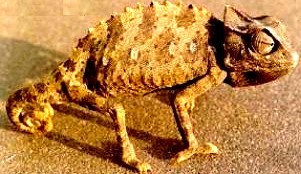
 Family: Chamaeleonidae
Common Name: Namaqua Chameleon
Scientific Name: Chamaeleo namaquensis
Food: Insects and has developed an ability to feed on poisonous scorpions and even small adders.
Distribution: S Angola, Namibia, Republic of South Africa
Habitat: Desert vegetation is rarely more than scattered clumps of low bushes.
Color Discription: gray and bown with 4 - 6 lighter blotches along the flanks and darker triangular patterns below the dorsal crest. The throat make exhibit reddish or yellow striations.
Physical Discription: Stocky chameleon with a relatively large head and shortened tail. Males are slightly smaller than females and may be distinguished by a broader tail base. Ventral and gular crests are absent, as are occipital lobes. The dorsal crest is composed of 12-14 spines, covered with enlarged scales.
Size: 10" - 10.5"
Temperatures/Humidity: Summer temperatures may be as high as 100 º F and drop to 50 º F at night. During the winter temperatures range from the low 70's to below 32º F. This is a habitat of extremes with little rainfall during most of the year although early morning humidity may reach 50%
Breeding/Reproduction: 6 - 22 eggs are laid as often as three times a year in a sandy medium. Incubation is from 3 - 4 months and there are reports of females guarding the laying sites. Sexual maturity occurs as early as 5 - 7 months.
Cage Setup:
Water: Water is primarily from morning dew but also from their prey items and the consumption of plant material. Like many other desert species they are efficient at resorbing water.
Special Needs:
Special Note: They excrete salt from nasal glands.
Another adaptation to their harsh environment is their ability to dig holes in the sand which they utilize for thermoregulation.
They may also use the borrows of other animals for this purpose.
Interspecfic aggression is developed in both males and females. Group housing is not advisable.
Having adapted to a largely terrestrial life style, these are said to be among the fastest runners of all the chameleons.
The tail, is no longer than the body, and has lost at least some of its prehensile ability.