
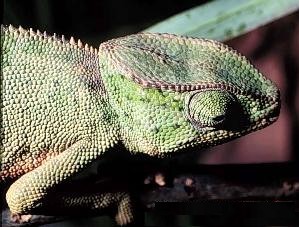
 Family: Chamaeleonidae
Common Name: Graceful Chameleon
Scientific Name: Chamaeleo gracilis
Food: Insects
Distribution: Tropical Africa, e.g. Central African Republic, Ivory Coast, Ethiopia, Democratic Republic of the Congo (Zaire), Gabon, Senegal, Gambia, Sierra Leone, Liberia, Ghana, Nigeria, Cameroon, Tanzania, Kenya, Uganda, Somalia, Ethiopia, Sudan, Gambia
Habitat: dry and humid forests as well as savanna habitats.
Color Discription: a green, yellow and/or light brown. A stripe may appear on the ventral portion of the flanks and extend from the axilla (armpits) to the groin. A series of dark, vertical bands may appear on the body and tail, particularly under conditions of stress. The body may be covered with small dark spots which may be yellow to orange in receptive females. Rays or dark bands extend out from the center of the eye. The interstitial gular skin is orange or red and may be evident during threat or other displays.
Physical Discription: sports a low casque and a head that is flat or even slightly concave. The casque extends past the back of the head by only a few millimeters. The occipital lobes are absent or greatly reduced. Pronounced lateral crests are apparent on the head. Scalation is homogeneous except for the enlarged, conical scales that form a small dorsal crest and slightly more pronounced gular and ventral crests. Males are slightly smaller than females and have a slightly higher casque. Males exhibit a hemipenal bulge (broader tail base) and tarsal spurs.
Size: 12" - 16"
Temperatures:
Breeding/Reproduction: 1 - 2 clutches are laid per yr. with 20 - 40 eggs in a clutch. The young achieve sexual maturity in 4 - 5 months.
Cage Setup:
Water:
Special Needs:
Special Note: They are very abundant, inexpensive and commonly imported chameleons.
They are often bought by inexperienced keepers on impulse.
However, WC (Wild Caught) specimens can carry a heavy parasite loads.
The combination of uninformed keepers, and heavy parasite loads and unable to seek veterinary care until it is to late and the lizard is seriously ill can result in the early deaths of the vast majority of imported animals.
It is for these reasons that it is recommend that only experienced keepers attempt to keep this species.