
 Family: Chamaeleonidae
Common Name: Flap Neck Chameleon
Scientific Name: Chamaeleo dilepis
Food: Insects
Distribution: Congo, Angola, Cameroon, Congo, Equatorial Guinea, Gabon, Kenya, Malawi (Shire Highlands), Namibia, Nigeria, Republic of South Africa, Swaziland, Botswana, Somalia, Tanzania, Uganda, Democratic Republic of the Congo (Zaire; except in the north), Zambia, Burundi, Uganda, E Zaire, Tanzania (Pemba Island), Mozambique, Central African Republic, Ethiopia
Habitat: Typically they inhabit dry forest and savannahs, But with its distribution being in such a large area this means that subpopulations may occupy quite diffrent habitats. For this reason, it can be a real challenge to the herpetoculturist who is trying to keep the flap-necked chameleon in conditions that mimic its home region.
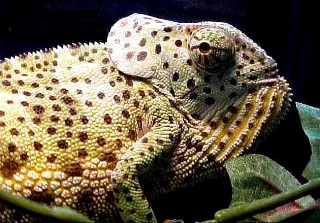
Color Discription: a light green, brown and yellow with a light or dark stripe on the flank extending from the axilla "armpits" to the rear legs. A second, smaller and less pronounced stripe may extend from the head to the shoulder. Many small, spots decorate the body. Normally dark, these spots may take on a bright yellow or orange color when sexually receptive, gravid or excited. Large brown or gray splotches may appear on the body. A series of dark rays on the eye turret emanates outwards from the eye itself.
Physical Discription: In some of subspecies, males lack spurs while in others, spurs are present. The localities of origin for the various subspecies and (where known) the presence or absence of spurs in the males of those subspecies. Males have larger occipital lobes, higher casques, a hemipenal bulge and spurs on the hind legs. There is a flattened head with a low casque. The casque of Chamaeleo dilepis sports a set of large occipital lobes that protrude over the neck thereby giving this animal its common name of "flap-necked chameleon". These flaps can be raised to deter a potential predator or rival. Scalation is largely homogeneous with the exception of conical scales that form low gular, ventral and dorsal crests.
Size: 12" - 15" males being somewhat smaller than females
Temperatures:
Breeding/Reproduction: lays up to 60 eggs in a clutch. Only 1 clutch is typically laid in a year. The young reach sexual maturity in 9 - 12 months
Cage Setup: Lots of Plants to hide in as well as branches to climb on.
Water: Drip System and Misting
Special Needs:
Special Note: Chamaeleo dilepis is one of the most abundant, inexpensive and commonly imported chameleons.
They are often bought by inexperienced keepers on impulse. However, WC (Wild Caught) specimens almost invariably carry heavy parasite loads.
The combination of uninformed keepers, the difficulty of matching a specimen with a particular natal location/habitat, heavy parasite loads and a reticence to seek veterinary care until an animal is seriously ill can result in the early deaths of the vast majority of imported animal.
It is for this reason these reasons that we recommend that only keepers attempt to maintain WC specimens. CB (Captive Breed) specimens seem to be more hardy.