
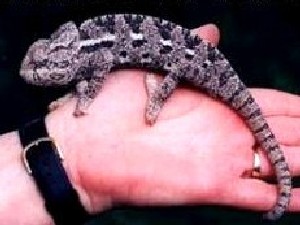
 Family: Chamaeleonidae
Common Name: European (Common) Chameleon
Scientific Name: Chamaeleo chamaeleon
Food: Insects that are dusted with vitamins, minerals, calcium and D3 on a regular schedule. Hatchlings should be fed everyday but adults need only be fed three times a week.
Distribution: S Greece (Aegean Islands, Crete, Chios, Samos), Malta, S Portugal, Sicilia, S Spain, S/E Turkey, Cyprus, N Africa: Morocco, Algeria, Tunisia, Libya, Egypt, Sinai, Israel, Jordan Western Sahara, SW Saudi Arabia, Yemen, Lebanon, Syria, Iraq, Iran
Habitat: Semi desert areas, prairies, eucalyptus forests, oases and often near bodies of water. There is a wide variation in the amount of yearly rainfall, humid rature due to the wide geographic range that they inhabit.
Color Discription: shades of green, gray, yellow, orange and brown. They usually have 2 broken longitudinal white/light stripes along the sides, 1 starting just above the shoulder and 1 starting just below the shoulder. They can have a somewhat complicated pattern at times consisting of a series of v-shapes along the spine interspersed with spots and splotches. Females will show receptive coloration that includes a dotted pattern. All copulation attempts by males are violently rejected when the female shows a black body with yellow spots.
Physical Discription: Large plate-like scales on the face. There is a row of conical scales that form a small crest on the back and a small gular crest. The parietal crest is moderately raised with the highest elevation being towards the back. They have small occipital lobes. There are possible scale organs around the eyes. They have a very slightly higher casque and is slightly slimmer.
Size: 11"
Temperatures/Humidity: 78º F - 88º F. during the daytime with a drop to 68º F at night. They can withstand quite high temperatures (into the 90's F) for short periods of time. Hatchlings should be kept more moderately than adults (high 70's F) since they can over-heat and dehydrate more quickly due to their small body size. They should have a cooling down period at 50º F -59º F for 8 weeks if you want to breed them. The gut must be emptied for at least a week before starting to drop the temperature and water. Humidity is not critical. They seem to be able to withstand both dry and humid conditions well but as with all chameleons,
Breeding/Reproduction: Reaches sexual maturity around 1 year of age. They will lay eggs 45 to 60 days after mating. Mating occurs from mid July - mid September in the northern hemisphere. They usually only 1 clutch per year. The clutch is laid sometime from the end of September to the first of November. Hatching occurs after incubating on moist vermiculite at 72º F - 74º F. for 200 to 290 days. (For instance, in one clutch the first hatched at 253 days and the last at 294. In a second clutch, the first hatched at 260 days and the last at 282 days.) A clutch can consist of 6 - 66 eggs. Hatchlings are 2" - 3" long. Females should be provided with an appropriate place to lay eggs. Always provided a container in their cages to give them a place to start digging and show that they are ready to lay the eggs. The female then can be moved into a larger container where the eggs will be laid. No substrate should be used in the cage as it has been known to cause problems in males when the hemipenes was retracted back into the body, and impaction and infection resulted. Some substrates can contain toxins. Some can be ingested and cause intestinal impaction.
Cage Setup: Branches of a suitable size for them to grip easily should be provided. Plants should be used to provide places to hide. Whether real or artificial the plants should be well washed to remove any residue. If the plant's soil contains vermiculite, remove about an 1" of it and replace with sand or cover the surface of the soil with pebbles that are too big to digest.
Water: proper hydration must be provided in the form of drip system and misting.
Special Needs: Full spectrum lighting, including adequate UVB must be provided. A basking light may be included. They should be housed separately but may be kept in pairs if close and prolonged observation indicates that their interactions are not stressful to one or both.
Special Note: captive hatched seem to be quite tolerant.
However, handling of captive hatched animals still results in hissing and puffing up but rarely biting.
If given the opportunity, they will "run" away. Their reaction to cons.
Due to their ability to live in such a wide range of elevations and environments, these chameleons do not seem to be one of the most difficult to keep in captivity.
However, given a wide amount of information on their captive husbandry they should be kept only by experienced keepers.