
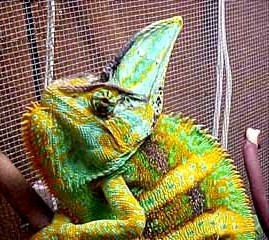
 Family: Chamaeleonidae
Common Name: Veiled Chameleon
Scientific Name: Chamaeleo calyptratus
Food: Veiled chameleons are often voracious feeders and readily accept crickets , meal worms , super meal worms , wax worms, roaches and fruit flies. But unlike most chameleons, veileds will often include vegetation in their diets. Such as blueberries, thin slices of apple or pear, diced zucchini, butternut squash, red pepper, dandelion leaves, collard greens, kale, and other vegetables that are often used to gut load prey items. Do not feed them iceberg lettuce or other nutrient poor items.
Distribution: Yemen, SW Saudi Arabia (up to 2500 m).
Habitat: high, dry plateaus
Color Discription: Colors vary from bands of primarily bright gold, green, and blue mixed with yellow, orange, or black. Females are usually light green with some white or gold body spots.
Physical Discription: Adult males have a higher casque than females and is significantly larger. Some authorities have believe that the casque may serve as a device to aid the collection of water. While others believe that it might serve in heat dissipation. A more recent speculation is that the casque might serve to amplify the low frequency "buzzing" used by veileds to communicate. An easy way to sex this species, is to look for a small "tarsal spur" on the back of the rear "ankle". These are apparent at birth in males and are lacking in females. There are prominent gular, ventral, and dorsal crest made of enlarged, conical scales. The brightly-colored body is flattened from side to side and is leaf shaped. The head has a helmet-like casque, and is almost two inches high. Each eye can swivel 180 degrees and point in two different directions at once. The long tongue shoots out to catch prey. T he skin changes colors to help aid in camouflage. The toes are divided into two opposing groups to hold onto branches. The tail is prehensile
Size: Males may reach a total length of 17" - 24", and the females 10" - 13"
Temperatures/Humidity: The ideal daytime temperature is between 75º F and 85º F. There should be multiple branches throughout the habitat to allow for the regulation of body temperature. Nighttime temperatures should drop down to 65º F - 75º F. They can also be housed outdoors if the nighttime temperature is over 48º F. Temperature fluctuations are absolutely necessary and their environment should never be hot and stuffy. Additionally, a basking area should be created on one end of the enclosure to maintain a local temperature of 95º F - 100º F. This basking area is best achieved with either an incandescent bulb or spotlight basking bulb being placed at one end of the habitat with a "basking-branch" placed underneath. Remember that the basking area does not need to get any hotter than 95º F, so a 75 watt bulb should be the maximum wattage used. The ideal humidity range is 50% or higher. This can be achieved through frequent daily misting.
Breeding/Reproduction: . 30 - 60 eggs are laid per clutch although on a rare occasion over 80 eggs can be laid. Because these larger numbers of eggs are decidedly unnatural and because of the extreme stress that such a clutch puts on females, it is recommended that all females approaching breeding age (6 months) be placed on a restricted feeding schedule. This will reduce the clutch size (whether or or not the females are bred) and dramatically increase the life span of the female. As indicated in the previous sentence, females can lay infertile eggs if not bred, and should, therefore, always have some place within the cage to lay them. A plastic container (without the lid) that is big enough for her to fit into about half full of washed sandbox sand can be placed in her cage. Using a container size gives her a place to start digging but, and wont take up a lot of her cage space. Once she has started to dig, she can be moved to a larger container where she can lay her eggs. A 65 liter Rubbermaid-type storage container with a modified lid works well. (Lid modification = cut a hole in the lid and cover the hole with screen). A whole bag of washed sandbox sand may be placed in the container in a pile at one end and moistened so that it will hold a tunnel (not collapse on her when she is digging). A branch should be placed in the container. Put the female into the container and replace the modified lid. Add a light over the screen part of the lid to provide heat and light for her. She may dig a few test holes first. While she is in the container, the sides of the container should be misted to provide her with water and the sand should be kept moist. Care should be taken not to disturb the female while she is digging or laying. If she is in the container for a few days, she may be fed. No insects should be left in the container or they may nibble on the eggs or the female. Once she turns around to lay her eggs, the light then may be left on until she finishes laying, and burying them. When she has finished burying the eggs, she can be removed from the container and placed back into her cage. Then the eggs can be dug up with a plastic spoon Carefully ... scraping away a layer of sand at a time until the eggs are free from the sand. The eggs should carefully be removed being careful not to turn or rotate the eggs when moving them. The eggs require 6 - 8 months of incubation with temperatures varying from 68º F at night to a day time high of 85º F. Although females are able to breed at about 6 months of age, until they are full grown, they bones are still growing, so it would not in their best interest to put demands on the female for egg production.
Cage Setup: Because of their large size, a screen cage of at least 24" x 24" x 36" is recommended but a 24" x 24" x 48" is much preferable, with plenty of plants as well as branches. Some veileds will all but defoliate cage plants such as pothos while others cannot be coaxed to accept any vegetable matter in their diets. Plus they are primarily tree-dwellers and need lots of climbing surfaces.
Water: Veiled chameleons require misting and a drip systems, as do most other chameleons. The lizards will drink the dew off of leaves and other wet surfaces. Misting the habitat each day will simulate natural rains. You can also set up a drip system on top of the habitat that allows a single drip of water to fall every few seconds.
Special Needs: Fluorescent ultraviolet light should be provided for 12 - 14 hours each day
Special Note: It is generally suggested that beginners purchase a male to avoid potential problems with dystocia (egg-binding) that are often seen in females who have not been given a proper laying site and/or have been overfed.
When the time to mate her comes, the female should be shown to the male by holding her on a stick outside the male's cage so that they can both see each other.
Watch for the following reactions to decide if they are ready to mate.
Sometimes the male will react with aggression at first until he realizes that it is a female...so by keeping the female outside of his cage but in his sight, gives him time to calm down while she is safe.
If she is not receptive she will stair at him and sway back and forth from side to side possibly hissing and lunging at him as well.
Her background coloration will darken. If she is non-receptive, it could cause him to show aggression towards her.
All of these possibilities are good reasons for keeping them separated until you see that she is receptive and that he has calmed down.
If she is unreceptive or he doesn't calm down, the procedure may be repeated in a few days.
If she is receptive, she will remain passive/calm and will likely move slowly away from him waiting for him to follow.
She may "hug" the branch too. If she is receptive, and he is calm then she may be placed into his cage...but continue to watch them to make sure that things are going well.
Sometimes the male will head-butt the female before mounting her.
The female may be left in the cage with the male until she starts to repel/reject him.
Again, they should be checked off and on to make sure that things are still going well.
The female will take on a coloration that will be almost black in the background with bright mustard and torquoise markings indicating that she is gravid by the time of removal.
This dark background coloration doesn't usually remain when she is out of the male's sight but will recur if she sees the male again.