
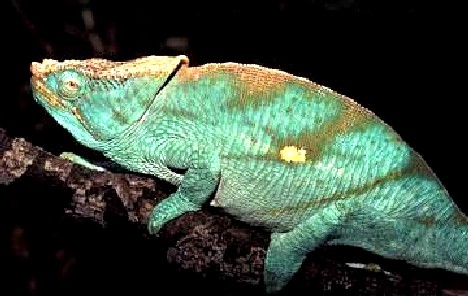
 Family: Chamaeleonidae
Common Name: Parson's Chameleon
Scientific Name: Calumma parsonii
Food: mainly insects of various sizes and at times, small vertebrates. When in captivity, the Parsons Chameleon will usually eat adult crickets or grubs. The main “tool” that the Parsons Chameleon uses to catch its food is the tongue, which extends to 1-1/2 times the length of its body, and is very sticky The feet on the Parsons Chameleon has 4 toes that wrap around the branches and help the animal climb trees.
Distribution: N/E Madagascar
Habitat: Lives mostly in cool, damp conditions and spends its life almost exclusively in trees
Color Discription:
Physical Discription: The Parsons Chameleon is thought to be one the largest of all Chameleon species. The eyes of the Parsons Chameleon bulge from the head of the animal, and are spherical in shape, which allows the creature to see 360 degree around its body. Each eye can move independently of the other. The males have blunt horns on their snouts.
Size: Male reaching around 23.5", and the female will be slightly smaller than the male.
Temperatures:
Breeding/Reproduction: The Parsons Chameleon breeds and has a clutch approximately every 6 - 8 months. The incubation time may vary due to how long the eggs are in diapause (when the eggs have no blood vessels forming) but the average time is from 18 - 26 months. Clutch sizes are variable and one may see as few as 15 - 27. Once the eggs hatch, the babies of the species are completely independent.
Cage Setup:
Water:
Special Needs: It is important that the Parson Chameleon have exposure to UV lights and a drip system in order for the animal to survive in captivity.
Special Note: Parsons Chameleon should be avoided.
It is also important to understand that the Parsons Chameleon is rather delicate and difficult to care for.
Therefore, it is very important that one should have previous experience with reptiles if one is considering keeping the Parsons Chameleon.
In spite of all this, if one has the experience and know-how, the Parsons Chameleon is a fascinating creature, and should not be dismissed as a pet.
It is important to understand that the Parsons Chameleon isn’t very active, and don't move much.