
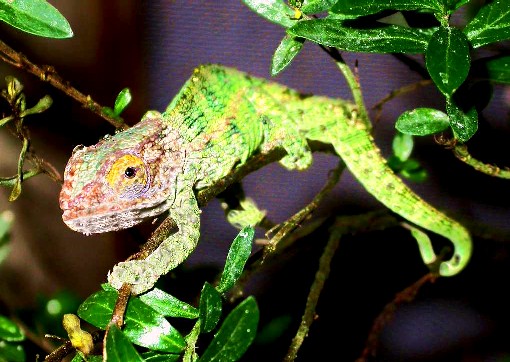
 Family: Chamaeleonidae
Common Name: Hillenius' Short-Nosed Chameleon
Scientific Name: Calumma hilleniusi
Food: flies or waxworms, but if possible it should be provided with netted insects.
Distribution: Madagascar
Habitat: inhabits the scrub and forests, esp. at the forest edges of highland and mountain regions around 1600-2000 meters above sea level.
Color Discription: brownish-gray and mossy green to an off-white and may also include brighter hues of blue, red, and yellow, particularly in displaying males.
Physical Discription: small size, larger, articulated occipital lobes compared to the headsize on the low, flat casque. Possesses a small, reddish rostral process formed by fusing of the large canthi rostralis which is especially obvious the males. A dorsal crest composed of widely spaced, enlarged conical scales extends from the neck to at least half the length of the tail. Gular and ventral crests are present but poorly developed. Scalation is heterogeneous.
Size: 6"
Temperatures/Humidity: 80ºF - 85ºF during the day in the sun and fall to 45ºF - 55ºF or even lower at night. A deep night time temperature drop to about low 60`s ºF is essential. A brumation at low temperatures around 53ºF - 60ºF should be beneficial to the animals esp. if you want to breed them. Frequent mistings are also recommended. But let the cage dry out between the mistings. Overall temps should be around 70ºF - 75ºF with a basking lamp at one place. Relative humidity is typically high, being 50% - 60% during the day and 90% at night. Rainfall typically exceeds 1,000 millimeters/year. There is a pronounced rainy season that peaks in December and January
Breeding/Reproduction: Mating includes exagerrated head bobbing and "glowing" of the red nose of the males. 40 days following copulation, eggs are laid in a moist substrate but details of incubation are largely a matter of conjecture. Experience, combined with the knowledge of other high mountain species like Furcifer campani, which lives in the same regions, but bit higher up on the savannah grassland or the Bradypodion xenorhinum from Uganda mountains induces low incubation temperatures around 64ºF - 69ºF. A diapause of 6 weeks down to 50ºF after the first 2 month of incubation might be of help. The incubation time should be between 9-12 month. The hatching babies are very small and need very small food items in the first weeks.
Cage Setup: this species requires alot space, visual isolation and dense foliage as it is active, skittish around keepers, and highly aggressive toward conspecifics. This is very important for pregnant females. they will become aggressive against males and the same sex. Large screen areas or a full screen caging is recommended.
Water:
Special Needs: Lighting with UV contenting tube lights or halogen lights is highly recommended. Natural sunlight would be best.
Special Note: