
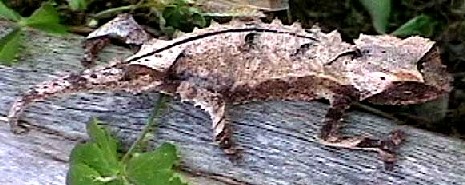
 Family: Chamaeleonidae
Common Name: Spiny Leaf Chameleon
Scientific Name: Brookesia decaryi
Food:
Distribution: Brookesia decaryi has only a small range in Northeast Madagascar, the so-called dry forest of Ankarafantsika.
Habitat: lives in the most humid microhabitat, the floor of the dry-forest
Color Discription: Brown with dispersed black spots.
Physical Discription: possesses a flat casque with thorns at the rear end and a double row of thorny spines along the back. There is a large plate in the pelvic area.
Size: Males reach a total length of 3" and Females reach 3.5"
Temperatures/Humidity: The climate shows significant seasonal changes. The summer is warm and humid, temperatures ranging from 77 - 86ºF during the daytime with a night time drop to 56ºF. Humidity during the day is 50-60%, rising to 90% during the night. The winter is cold and dry with temperatures ranging from the low 40's to mid 50's with only occasional rain.
Breeding/Reproduction: Within the first weeks after hibernation, the male's interest in the female increases. The male circles the females with quick head and body movements, eventually riding on the female's back. Mating takes place on consecutive days. But nothing is known about the Gestation, incubation temperatures, humidity, and length of incubation. Clutch size and age at sexual maturity is also unknown.
Cage Setup: "typical" Brookesia set up: Cage wider than high, small plants (e.g. ferns, ivy, etc.), twigs, and a layer of dead leaves. These are important for hiding during hibernation.
Water:
Special Needs:
Special Note: Fluorescent light tubes are sufficient for the lighting, but a small halogen spot should be installed for basking.
The simulation of change of seasons is essential because it triggers breeding activity but the increase or decrease of temperatures and humidity should take place slowly.
Day temperatures during the summer should be around 78ºF with a significant night drop and intensive misting. During winter, temperatures should be lower than 68ºF to allow the animals to hibernate.
During this time, misting is only necessary twice a week.