
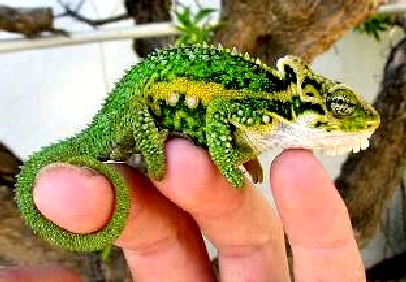
 Family: Chamaeleonidae
Common Name: Natal Dwarf Chameleon
Scientific Name: Bradypodion thamnobates
Food: Insects
Distribution: Republic of South Africa (Natal Midlands from Mooi River to Bulwer and Dargle)
Habitat: preferred habitat is in bushes and scrubs, along roads, fences and gardens. The annual rainfall is less than 1000 mm but no month is without rain. The rainy season is from October to April
Color Discription:
Physical Discription: Both sexes have a relatively high casque without occipital lobes. The gular crest consists of skin flaps (scaly lobes). A dorsal crest of conical scales continues along the back down to the middle of the tail. The body scalation is very heterogeneous with interspersed lenticular scales on the sides. Males have a significant hemipenal bulge. They are docile towards keepers and relatively docile toward conspecifics but males may be significantly aggressive towards each other.
Size: 7.5"
Temperatures: Maximum temperature is around 86º F in January with a night drop to 59º F. In July the maximum temperature is around 68º F with a night drop below the 50's and sometimes below freezing point.
Breeding/Reproduction: The male starts a head bobbing ritual and follows the female. If she is receptive she crawls away slowly and copulation takes place for 15 – 30 minutes. Mating can occur on consecutive days. When the female rejects the male's approaches they should be separated. After a gestation period of 5 - 8 months, 8 - 16 babies and are born in the morning hours. The food is drosophila and pinhead crickets in small groups. They seem to be sensitive to dehydration and should not be housed in all screen cages unless an ultrasonic humidifier is used. At the age of 3 months they should be separated since an early sexual maturity can happen at this time although 6 months is more common. 2 clutches per yr. is possible in captivity.
Cage Setup: screen cages, with lots of plants.
Water:
Special Needs: When kept indoors they need a basking spot (20 W halogen spot), and preferably HQL/HQI lamps of appropriate wattage. The temperatures should be maintained as described above.
Special Note: (from the Greek thamnos meaning "shrub" and "bates" meaning to "crawl or climb over").
They can be housed in pairs. This species seems to be sensitive to upper respiratory infections due to inadequate ventilation.
The lizards will benefit from outdoor housing from spring to fall.
They are heliophilic and like to bask whenever possible.