
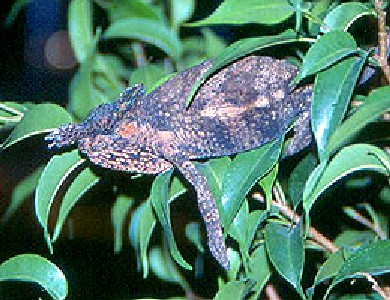
 Family: Chamaeleonidae
Common Name: Dwarf Fischer's Chameleon
Scientific Name: Bradypodion tavetanum
Food: readily accepts most insects of appropriate size such as crickets, flies, small locusts and roaches.
Distribution: East Africa, on the slopes of Mt. Meru and Kilimanjaro (Tanzania) and the Teita Mountains of Kenya
Habitat: found in isolated pockets of forest edges, shrubs and even nature-like gardens.
Color Discription: basic coloration is brown and green. Females sometimes have a red stripe at the back.
Physical Discription: Males have a flat casque, a sharp lateral crest, and sport two horns. Females have only two small rostrals. The males also have a dorsal crest along the first third of their back. This crest is lacking in the females.
Size: Males grow to 8". Females are slightly smaller
Temperatures/Humidity: Day temperatures should be around 77º F, and a night temperatures of 60 - 70º F. the animals require a higher humidity. Misting at least twice day is a necessity.
Breeding/Reproduction: After introducing the female into the male's cage, copulation takes place after a short head bobbing ritual. Approximately 40 days after mating, the female will lay up to 12 eggs. If incubated at room temperature, the babies should hatch after 220 days. If incubated at 73º F during the day and 60º F at night, the hatching will take place after nine months. The babies measure 1" at hatching. The babies will feed on the usual Drosophila and pin-head crickets. It is important to keep the hatchlings at temperatures lower than 77º F. The young reach sexual maturity at 9 - 12 months. 1 - 2 clutches are laid per year.
Cage Setup: Screened cages of 2' x 2' x 3'. A dense foliage is necessary for hiding and also for taking up water droplets. The cage does not have to be entirely screened since the animals require a higher humidity. Misting at least 2 times day is necessary. A dripper may also be installed. This species also benefits from outdoor housing during the warm season.
Water: A water dripper should be installed. they wont drink any other way except off of plants or the side of the glass.
Special Needs:
Special Note: Extremely anti-social and must be kept absolutely solitary. This species will also benefits from outdoor housing during the warm season.
Sometimes shy and nervous towards the keeper, males are quite aggressive amongst themselves. Sometimes the males will stress unreceptive females.