
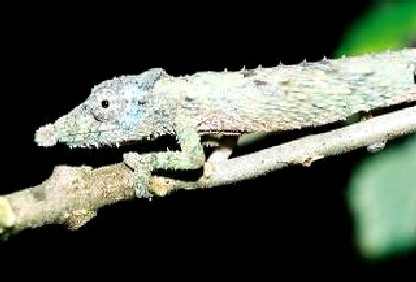
 Family: Chamaeleonidae
Common Name: Rosette-Nosed Chameleon
Scientific Name: Bradypodion spinosum
Food: prefer flies but they will readily take any small insects that is available as they are voracious eaters.
Distribution: Tanzania (Usambara Mts.)
Habitat: They are from virgin forests of the eastern and western Usambara Mountains (elev. approximately 2700' to 4000' — 820 to 1200 meters) of Tanzania where it is threatened by rapid deforestation. They inhabit small trees, brush and vines in high altitude forests where little, if any, direct sunlight penetrates the dense "canopy."
Color Discription: Males is a light gray but may have a green tint on the flanks and the rosette-shaped rostral process. However, the head and body can include pink, yellow, brown, white (lichen-like patches) as well as a bluish tint. Furthermore, males have noticeably larger and more abundant "spines" than females. The stress coloration in males consists of a uniform dark coloration with gray on the back and flanks. The females exhibit brown and black patches and/or bands on the head and body. Females stress coloration is recognized by a tan and/or white body with brown and black bands and/or blotches across the body and over the back.
Physical Discription: The most distinctive characteristic is the laterally compressed, rosette-shaped rostral process, which is soft to the touch and present in both sexes. The low casque lacks occipital lobes. Scalation is heterogeneous and as the name spinosum implies, the body is adorned with patches and rows of enlarged, spinose scales that resemble small spikes. 2 rows of soft spinose scales are apparent on the flanks and additional patches of these scales may be seen on the tail and limbs. Gular and ventral crests are absent but there is a dorsal crest that consists of a small number of soft, spiny scales irregularly spaced along the dorsum and the proximal third of the tail. The tail is approximately the same length, or perhaps a little shorter, as that from the snout to vent itself.
Size: Mature adults will reaching a total length of 3.5"
Temperatures: day time temperatures are mid 70's - low 80's. Nighttime temperatures of low to mid 60's is recommended.
Breeding/Reproduction: It has been reported that in the wild, they usually lay only a single clutch of 2 - 3 eggs a yr. in January. However, it has observed females "double clutching," where a clutch of 2 eggs is typically laid in January and 2 more eggs are laid 1 - 3 months later. Neonates can be raised with the adults for the first few months with no aggression or stress. They may then be separated. Breeding pairs can be maintained together in densely planted enclosure with no aggression or stress.
Cage Setup: a densely planted enclosure. They will usually even sleep close by one another in the same spots every night. They prefer to be kept in a shady area although they will commonly bask in the early morning sun, especially after a cool night.
Water/Humidity: Very need very high humidity.
Special Needs: Densely planted enclosure with high humidity.
Special Note: These forests stay extremely humid despite periods, of up to several months without rain.
However, heavy dew is common and this dew can appear as rain.
The dew collects and falls from foliage high up in the forest, which can form quite large drops and fall for extended periods of time.
It should also be noted that the clouds commonly appear very low as they sweep through the forests, making everything damp and raising the ambient humidity.
They seem to be quite active in the mornings and can usually be seen hunting for food at that time.
Will not adapt well, if at all, if disturbed