
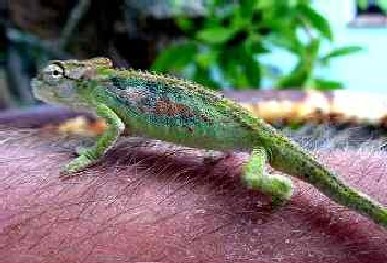
 Family: Chamaeleonidae
Common Name: Setaro's Dwarf Chameleon
Scientific Name: Bradypodion setaroi
Food: Insects
Distribution: Republic of South Africa (From St. Lucia to Lake Sibaya)
Habitat: Found in undergrowth in disturbed dune forest at St Lucia. Also observed in tall tree at Monzi. Found in roadside vegetation adjacent to swamp forest and reed-beds, as well as in a reed-bed at Richards Bay. Found on tall grass stems along a small stream at Arboretum, Richards Bay. They are not found in coastal thicket on the seaward side of the dunes nor were they found on evergreen shrubs.
Color Discription: Light grayish brown with a irregular light orange lateral streak with three darker orange blotches, the surfaces immediately above and below vermiculated with grey-green. There is gray-green barring on the tail and speckling on the head and limbs. Some enlarged scales on lower sides pale orange. Colors are brighter when basking. Interstitial skin of gular region is bluish-white and lateral grooves are blue.
Physical Discription: Snout sharp is the distance from tip to anterior border of the eye. It greater than diameter of the eye. Casque raised and produced posteriorly; median parietal crest straight; temporal crests distinctly developed. Subocular tubercle slightly raised and is not bordering mouth. Color of gular grooves is blue-white. Gular crest lobes have median lobes. Gular lobes are mostly triangular, with denticulate edges. Flanks have blue longitudinal grooves. Posterior dorsolateral scales form a distinct barred pattern. Mid-flank tubercles distinctly enlarged to form a single row. Dorsal crest does not reach tail; tubercles strongly differentiated to form a very distinct pattern. Tail is usually less than head-and-body length in males and females, slender and without a distinct tip region. There are between 13 - 25 gular lobes, and 10 - 20 dorsal crest tubercles.
Size: Largest Male is a little over 5". The largest female is 5"
Temperatures:
Breeding/Reproduction:
Cage Setup:
Water:
Special Needs:
Special Note: This species is not available in the trade but has been successfully kept and bred in semi-natural conditions in South Africa.
It appears to be a delicate species and is unlikely to survive commercial shipping.