
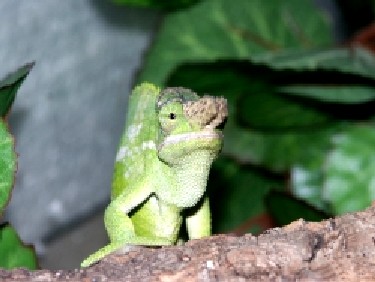
 Family: Chamaeleonidae
Common Name: Fischer's Chameleon
Scientific Name: Bradypodion fischeri
Food: feeds on smaller lizards as well as insects.
Distribution: Eastern Africa (Tanzania, Kenya)
Habitat: Moist, moderate climate montane forests, mainly in bushes and small trees at forest edges at an elevation from 2400 - 5100ft.
Color Discription: White, yellow, lime to olive green, grey, brown and black colouration dominates the males. The females are mainly green with yellow patterns.
Physical Discription: The rostral process is wider at the base than at the tip and bend bend downwards. It is lightly serrated with some pronounced tubercular scales in the first third of the back and the tail base, females lack horns as well as a dorsal crest. The Male's dorso - ventrally flattened rostral process is quite distinctive and can reach a length of 1". A dorsal crest of conical scales reaches the middle of the tail in the males. In the females it ends at the front third of the body.
Size: 15 - 16"
Temperatures: Day temperatures should be around 77º F. And drop at night to 61º F.
Breeding/Reproduction: The Female will start digging a tunnel and deposits her eggs at its end. The soil temperature at the laying site should be around 65º F - 68º F. The clutch size varies between 12 - 20 eggs. During gestation the females should be fed daily with a mineral and vitamin balanced diet to avoid problems in egg-laying. The eggs should be removed from the cage and placed in an Small plastic boxes and filled halfway with substrate (vermiculite:water in a ratio of 1:1). The eggs be buried so that 2/3 of the egg are below the surface and 1/3 of the egg above it. When put into the substrate the eggs must not be turned or twisted. The lid is closed and the box is put into the incubator. It will be between 129 - 150 days before the eggs hatch. Sexual maturity occurs at 9 - 12 months but breeding is best delayed until 14 - 16 months. Maximum lifespan in captivity is approximately 6 - 7 yrs.
Cage Setup: 30" x 60" x 60"
Water/Humidity: Mist the cage two times a day and put some live plants in this will help with humidity.
Special Needs:
Special Note: The forest stay extremely humid despite periods, of up to several months without rain.
However, heavy dew is common and this dew can appear as rain.
The dew collects and falls from foliage high up in the forest, which can form quite large drops and fall for extended periods of time.
It should also be noted that the clouds commonly appear very low as they sweep through the forests, making everything damp and raising the ambient humidity.