
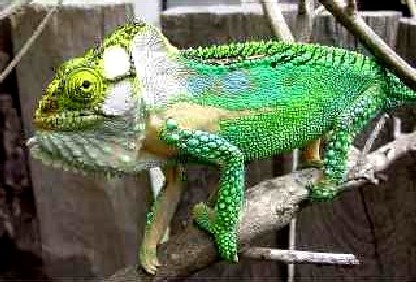
 Family: Chamaeleonidae
Common Name: Bradypodion damaranum
Scientific Name: Knysna Dwarf Chameleon
Food: Feed every 2 - 3 days. Babies and gravid females should be fed more often. All kinds of small food items, including crickets, flies, wax moths and larvae are eagerly accepted.
Distribution: Coastal regions of Western and Eastern Cape Provinces, South Africa
Habitat: inhabits bushes and trees of the Tsitsikamma Forest region on the slopes and foot of the Outeniqua Mountains.
Color Discription: Males display a intensive green to turquoise or blue basic coloration. On the sides there is a long yellow, orange to red or purple spot, mostly limited by a yellow stripe. Females and juveniles are mainly green or yellow-brownish.
Physical Discription: Dorsal crest with enlarged, convex tubercles. Gular crest consists of 8-13 large skin flaps, longer than wide. Abdominal crest of 35-50 intermittent, low tubercles, which increase in size caudally.
Size:
Temperatures/Humidity: day temps: 77-82ºF, at night 60-65ºF; Winter time day temps 70-75ºF, night temps 53-57ºF. The night drop is essential for this lizard. Humidity days: 60-70%, at night 80-100%.
Breeding/Reproduction: For breeding the female is introduced into the male's cage after the winter break. The male approaches the female while performing a head-bobbing routine and displaying intensified coloration. If the female is receptive, and she dont reject the male. If the female isn't receptive, the animals should be separated again. Lack of receptivity is typically indicated by the female gaping at the male and showing stress colors. Copulation will last a few minutes and is performed numerous times during a period of about a week. After that period the female should be separated from the male again. 6 - 14 (maximum of 20) babies are born after a gestation period of 4 - 6 months, usually in the morning hours. The female will attach the babies inside their birth sacs to twigs, leaves, bark or she simply drop them. Healthy babies emerge from the birth sacs within a short time and start to crawl around immediately, feeding will occur within the first few hours. They can be raised in groups in the beginning but then must be separately in suitable cages. First food items for the babies are fruit flies, pin head crickets, spring tails, etc. Sexual maturity will occur at 1 year of age. Life span is 3 - 4 yrs. if maintained under proper conditions.
Cage Setup:
Water: 2 mistings per day but during the dry period only once a day. The use of an extra dripper or individual watering of adult lizards will be helpful. Every other week a multi-vitamin product should be added to the drinking water in an adequate amount.
Special Needs: Semi-screened cages are highly recommended with a minimum space of 20" x 20" x 25". Special fluorescent tubes with UV-light, HQL/HQI-lamps are required for indoor housing in large enclosures. A little spot light for thermoregulation is also necessary. Cages should also contain Small-leaved plants and twigs with dense plantings in one corner of the cage.
Special Note: