PLACES OF INTREST
Little India Arcade
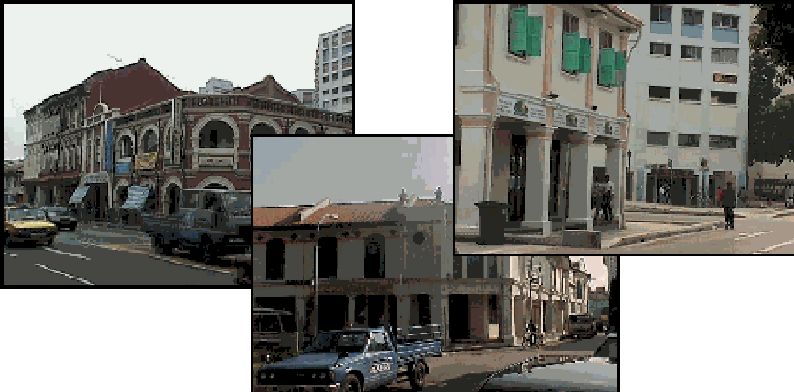
Across the bus-stop you can see Little India Arcade. This row of Shop houses
were conserved in 1982 and later turned into this busy shopping haven. Look
out for flower garlands and sari shops, taking a closer look at the more colorful
fabrics, you will see real gold and silver threads woven into them. You may
even wish to purchase the sari fabric to be tailored into modern dresses. Enter
from the Serangoon Road entrance and you'll see a confectionery selling traditional
Indian sweets and snacks. In the arcade you'll also find medicine shops. very
ancient Indian medicinal practice. You can buy some of these traditional remedies
which are used for different sicknesses Nearby, you can also see the betel nut
seller. Betel nuts are believed to be good for the digestive system and for
dye. Pieces of betel nuts, chopped fine or coarse, are mixed with lime paste
and sometimes other spices. They are then rolled up in a betel leaf are then,
popped into the mouth and chewed. Don't forget to walk into the many Indian
craft shops and booths to discover the exciting mix of carvings, sculptures,
brassware and artefacts. Stop to admire the Hindu images while shopping for
pretty drapes and coverings for your home. At the air-conditioned food court,
look out for a video presentation that gives an interesting view on Indian culture
through the eyes of a prominent Indian Professor
Abdul Gaffoor Mosque
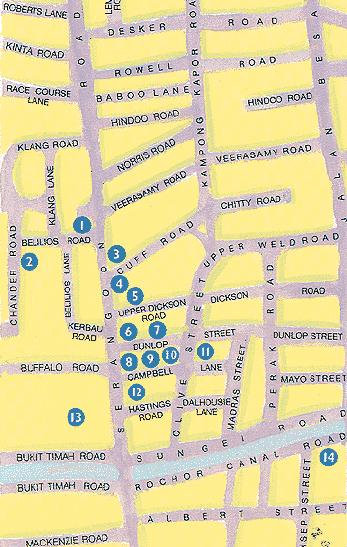
Keep walking down Dunlop Street for another 10 minutes and you'll find on
your right the Abdul Gaffoor Mosque, one of Singapore's 32 national monuments.
Just behind the mosque, you're welcome to join the friendly people at a little
snack shop selling Indian Muslim snacks such as samosas and vadas. Take a short
break and enjoy a cup of iced teh-tarik, "hand-pulled tea"
Spice Grinder 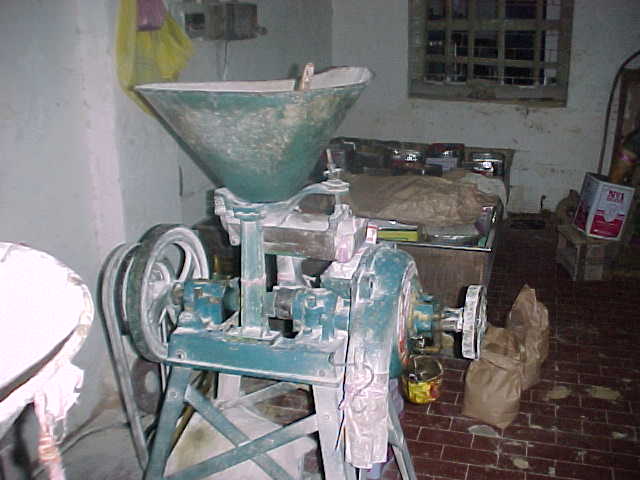
Turn right onto Serangoon Road, walk on and turn right onto Cuff Road, where
you can follow your nose to one of the last spice grinding shops. The betel
nut-chewing spice grinders here will grind spice mixtures or mill flour at your
request Don't miss the music shops here too.
Sri Veeramakaliamman Temple
Walk back onto Serangoon Road and cross the road at the junction of Veerasamy
Road. Built by indentured Bengali labourers in 1881, this temple is dedicated
to the Hindu Goddess Kali, the consort of Shiva. She is known as the Goddess
of Power and the name "Veeramakaliamman" means "Kali the Courageous". On holy
days (Tuesdays and Fridays), the streets are busy with devotees on their way
to pray, worship and make requests to Kali for blessings. This temple is closed
between 12.30 pm and 4 pm everyday. Note that women who are undergoing the monthly
cycle are considered "unclean" and are not allowed to enter temple grounds.
Zhujiao Centre
Carry on down Serangoon Road until you come to your starting point - Zhujiao
Centre. In Mandarin, the name means "the foot of bamboo shoots", reminding us
of the early bamboo growing in abundance by the Rochor River. The original produce
market that once stood across here was called Kandang Kerbau Market or K K Market;
the word "kandang kerbau" means cattle pen in Malay, a reminder of the cattle-rearing
days here. Today Zhujiao Market or K K Market, as it is still affectionately
referred to, bustles with a produce market selling fruit and vegetables as well
as a meat and fish wet market. At one end there's a hawkers' centre offering
typical Singaporean hawker fare. Then climb up the stairs to discover the clothing,
brassware and antique stalls on the next floor. From bedspreads, tailor-made
dresses to quaint knick-knacks, you'll find virtually everything here. Little
India stretches from Rochor Canal to Lavendar Street, centred around Serangoon
Road, embodies the vibrant and colourful culture of the Indian community in
Singapore. While early Indians resided in Chulia Street near Chinatown, most
of them settled to the present Little India beacause of the introduction of
cattle rearing on the fertile land of Rochor River. Immigrants from Madras,
Calcutta and Malaya joined them soon after. Today, Little India is the emotional
and commercial cenre of the local Indian community, including the many foreign
workers from India who gather there every Sunday for familiar taste of home.
The best time to visit Little India is early morning when you can enjoy the
spicy aromas, the colourful traditions, the strains of sitar music and colourful
garlands being made. And not forgetting the numerous eatries, where you can
eat all you want for under S$5. A myriad of exotic scents and sounds welcome
the visitor to the Serangoon Road area, which is the core of the Indian community
in Singapore. Brassware, beautiful textiles and saris, ornate gold jewellery,
temple garlands, incense and spices line the "five foot ways". Smells of spices
and jasmine from the nearby spice traders and garland sellers fill the air as
you walk along the rows of shophouses in the area. Everything from Indian handicrafts,
saris, jewellery and curry powder can be bought anywhere along the street. All
types of Indian foods are available. In some restaurants, curries are served
in the traditional manner on banana leaves. A visit to Little India is not complete
without trying some popular Indian snacks such as dosai (savoury pancakes),
traditional Indian candies and crackers. Women in graceful saris and turbaned
Sikhs go about their daily business in the Zhujiao Centre, where a bewildering
selection of food is on sale. Small shops abound selling bolts of glittering
silks, temple garlands, gold jewellery and spices that are ground in front of
you. Temples and old terraced houses with intricates are intriguing. Hinduism
has a significant influence on the lifestyle in Little India. Sri Veerama Kaliaman
and Sri Srinivasa Perumal Temples are beautiful and well worth visiting. A visit
to Zhujiao Center will provide a look at one of the largest and most vibrant
markets in Singapore. Allowing two hours to browse. THOSAI Thosai is like a
Indian pancake. It can be sweet and also can be savoury. The pancake can be
eaten with some vegetarian curry or with red sugar. We tried it and it was great.
The picture shows a man making thosai on a hotplate.