Clothing
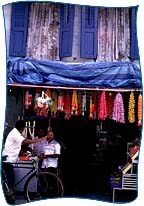
To the foreign
traveler, one of the powerful attractions in India is the colorful and diversified
attire of its people. The silk saris, brightly mirrored cholis, colorful lehangas
and the traditional salwar-kameez have fascinated many a traveler over the centuries.
For a single
length of material, the sari must be the most versatile garment in existence.
It is only one of the many traditional garments worn by women, it has somehow
become the national dress of Indian women. A sari is a rectangular piece of
cloth, which are five to six yards in length. The style, color and texture of
this cloth vary and it might be made from cotton, silk or one of the several
man-made materials. The sari has an ageless charm since it is not cut or tailored
for a particular size. This garment can fit any size and if worn properly can
accentuate or conceal. This attire can also be worn in several ways and its
manner of wearing as well as its color and textures are indicate of the status,
age, occupation, region and religion of a woman. The tightly fitted, short blouse
worn under a sari is a choli. The choli evolved as a form of clothing in 10th
century AD and the first cholis were only front covering; the back was always
bare. Bodices of this type are still common in the state of Rajasthan. Apart
from the choli, women in Rajasthan wear a form of pleated skirt known as the
ghagra or lehanga. This skirt is secured at the waist and leaves the back and
midriff bare. The heads are however covered by a length of fine cotton known
as orhni or dupatta. Another popular attire of women in India is the salwar-kameez.
This dress evolved as a comfortable and respectable garment for women in Kashmir
and Punjab, but is now immensely popular in all regions of India.
Salwars are
pyjama-like trousers drawn tightly in at the waist and the ankles. Over the
salwars, women wear a long and loose tunic known as a kameez. One might occasionally
come across women wearing a churidar instead of a salwar. A churidar is similar
to the salwar but is tighter fitting at the hips, thighs and ankles. Over this,
one might wear a collarless or mandarin-collar tunic called a kurta. Though
the majority of Indian women wear traditional costumes, the men in India can
be found in more conventional western clothing. Men from all regions in India
wear shirts and trousers. However, men in villages are still more comfortable
in traditional attire like kurtas, lungis, dhotis and pyjamas. The traditional
lungi originated in the south and today men and women wear it alike. It is simply
a short length of material worn around the thighs rather like a sarong. A dhoti
is a longer lungi but with an additional length of material pulled up between
the legs. Pyjama-like trousers worn by the villagers are known as the lenga.
Indian dressing styles are marked by many variations, both religious and regional
and one is likely to witness a plethora of colors, textures and styles in garments
worn by the Indians.