 |
 |
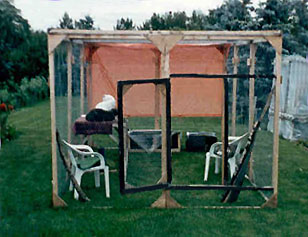
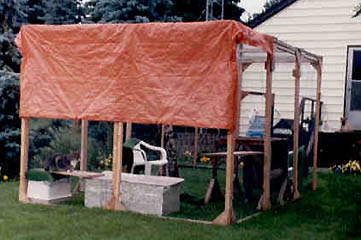
| Cat Runs/Pens If you truly want to keep your cat safe and prolong its life, you will make it an indoor cat. This is an easy feat if you get your cat as a kitten, but an older cat that has been a stray or an outdoor cat can pose a problem. (Murphy needed medication) All of my cats are now indoor-only cats, but that does not mean that they are locked away inside the house with no access to fresh air. A single-cat household can have something as simple as a small caged area that attaches to a window, but when you have a number of cats, something larger is called for. I have seen outdoor pens advertised in magazines that are lovely.....and costly. Don't get me wrong, I would love to have one if I could afford it. I have, however, had 3 different cat-runs over the years and the two that I made myself were large (8'x12') and served quite well. What is more important, neither cost over $250 (Canadian funds). Run #1 The first run I ever made was not my best effort...a carpenter I am not. It was initially detached from the house which meant that I had to carry the cats to the cage and back into the house again. It also did not have a windbreak and I ended up strapping a tarp to one end, BUT it was made out of 4'x8' frames, bolted together with 4" bolts, which meant that most of the panels were interchangeable. Even the roof was made of 4'x8' frames though, being flat it was not suitable for inclement weather. I made 14 frames each of which consisted of 2- 8' long and 2- 3'9" 2x2's and chicken wire with plywood triangles in the corners to give a bit more support to the flimsy frames. However, once bolted to the panels on either side of them it sufficed. I filled the inside with the odd chair, boxes and makeshift shelters. I build a small door in one of the end frames. Only the bolts, the 2x2's, and the wire were new. Everything else was found and made. Discard piles at building sites, and the wood section of your refuse dump are wonderful places to find good lumber. I was unable to attach it directly to an outside wall of the house in which I lived at the time, so I eventually built a small frame and opening in a side panel and ran a 1x8 section of planking insede a wire tunnel from a window to the run. This also meant I had to build a screen and wood frame to block off the upper part of the window. |
 |
 |
 |
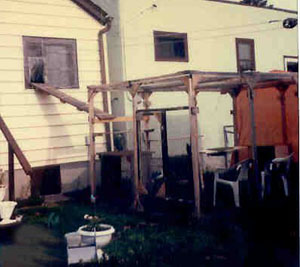 |
| What did I learn from making and maintaining this cat run for the 2 years that it was in use? I am not much good at building things. The run needed better wire...like stucco wire, as chicken wire stretches. The ground should have been leveled. Without a floor, the cats dug in the lawn and used it as a toilet. Without a floor the base of each panel soon rotted. The run needed a windbreak and at least part of the roof should have been solid to afford some shade and protection. 2x4's would have made the frame much more solid, and an extra upright 2x4 in the center of each panel would have been even better. It was, however, a good first effort. |
|
 |
 |
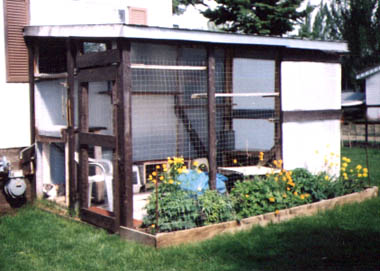 |
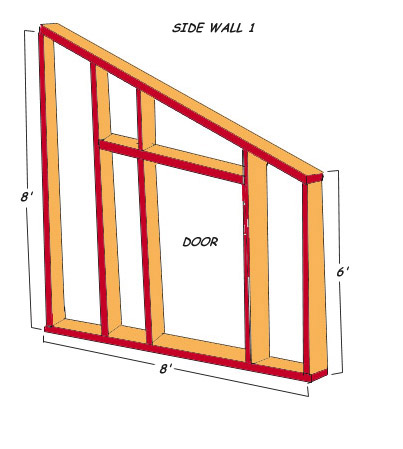
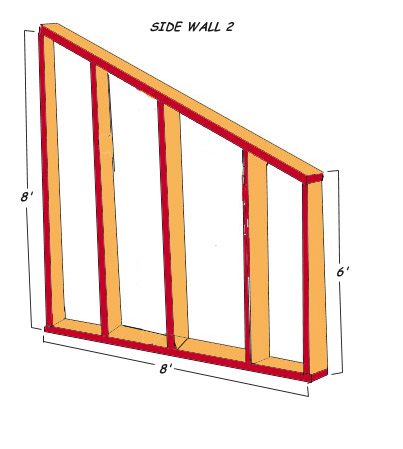
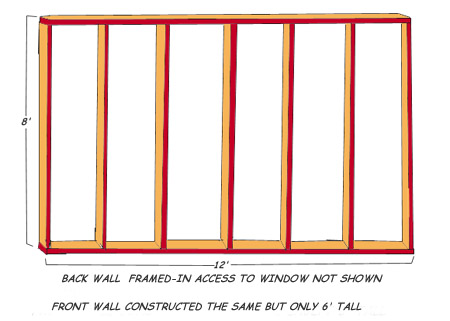
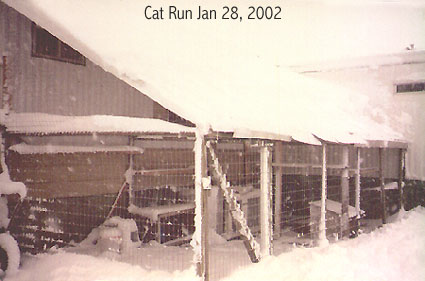
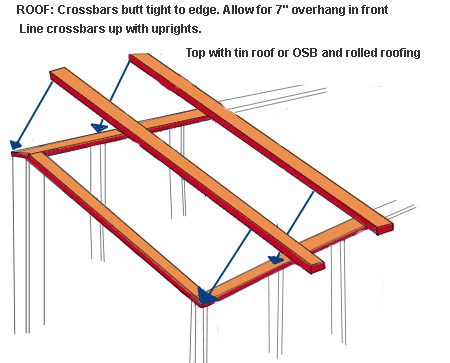
| Run #2 This run was a lot better and was butted directly up to an outside wall. I still had to make a screened frame for the upper part of the window and I put a shelf indoors so the cats could jump to the window level without having to actually jump through the window. There were scrounged 1x8x4' long shelves working their way around the walls in a descending pattern. They were attached to the uprights by common shelf brackets....the L-shaped ones. I used Utility Studs instead of 2x4's. They were a lot cheaper and I didn't mind a few imperfections. Initially the front and back walls and the roof frames were made of studs placed 4' apart but later I got more studs and set them so that on the roof they were 2' apart. I should have made all the walls with uprights set 2' apart which would have made the walls and shelves more secure, but it was actually pretty sturdy as is. With the snowfalls we got in Alberta, the pitch of he roof could have been steeper. The diagrams below reflect this. This run, like the first, was 8'x12'. The photo below was taken when the run was 7 years old and in need of sanding and re-staining. At first I used Corplast panels to block in the far end and one 4' section of front wall. The back wall was sheltered by the house. Then I used Corplast over the entire roof. Eventually it got a lovely tin roof. The roof studs were 10' long cut down to 7' to give a bit of an overhang, and I fed flashing along the edges to deflect the rain. The use of stucco wire was a wonderful idea. The 4' roll was easy to handle and far more secure. I had leveled the ground and made a floor. Being a scrounge, I put down a base of flats that you can find behind many shops or at the refuse dump, and covered it with 1/2"x4'x8' OSB (Oriented Strand Board) which worked out cheaper than plywood. This run was made one wall at a time on my deck during Winter, then I had help with the assembling and with the roof, thanks to kind neighbours who came to my aid. The cats really enjoyed this cage. They would lie on the shelves or chairs or small box-like shelters and watch the birds and neighbours. They could come in and out at will except when extremely cold Winter days froze the window shut. |
 |
 |
 |
|
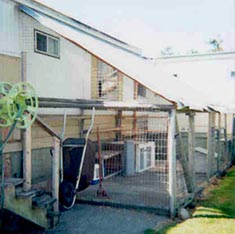
| Run #3 This run is merely a huge roof over an existing old dog run which was made out of very narrow poles. The pole run is not secure and there are no proper 2x4 uprights so shelves were placed awkwardly on poles and a few bits of 2x4, but the run suffices, thanks to a friend of my father's who kindly saw to it that the roof was built and ready for my cats before I arrived from Alberta. The run is 8x16' with a concrete floor over most of the ground and OSB over the rest. The roof is solidly made and covered in corrugated fiberglass, which I don't care for, but here in BC temperatures never get too extreme as to make the fiberglass deteriorate. I used stucco wire to close in the areas between the pole frame and the roof. Also the roof goes up to the roofline of my home, so there is really no need for a window frame. I brought a few of the little shelters with me, so the cats have somewhere to lie and watch the chickens and (unfortunately) feral cats in the yard. Below are some photos. The ugly little strips of flashing are due to the fact that there was no overhang and the roof run-off was pouring onto the already rotted poles and into the run. When I tried to insert the flashing I could not get it around the nails that were connecting the roof to the poles, and was unable to remove the nails, so I had to cut sections and feed the flashing in-between nails. |
 |
 |
 |
|
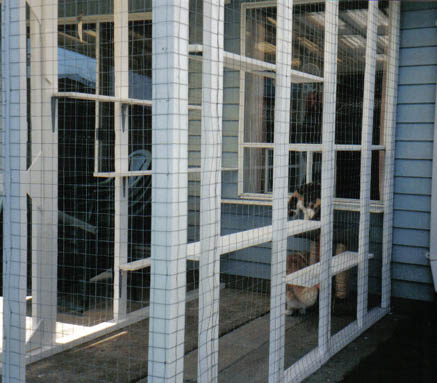
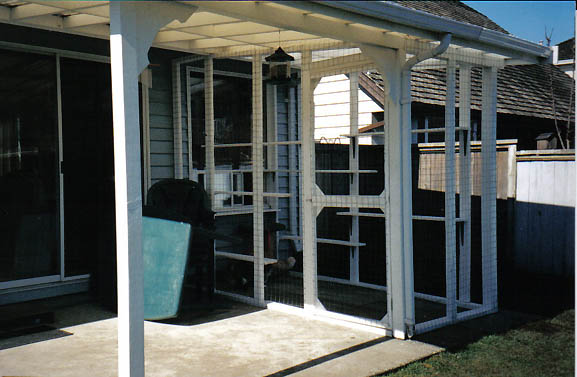
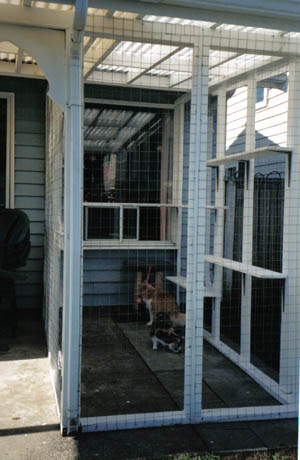
| I have decided that at the next place I move to (probably back to Alberta), I will not need such a large cat run. I have found that not all the cats use it at the same time and as long as there is a few feet of space for each, and interesting view, protection from elements and enough things to climb on and scratch, they will be happy. UPDATE When my father passed I decided for the time being to remain in BC. I moved into Dad's house and as the location I wanted the cat cage to be situated meant that is would incorporate part of the patio and overhang I opted to hire a carpenter. This cage is the smallest I have ever had but the cats are thoroughly enjoying it. Run #4 |
 |
 |
 |
 |
 |
 |