|
As
with so many Lotus models, the design brief for the Elise was to produce a
shape both modern and timeless, and as ever, the principles of form
following function were rigorously applied as the Lotus Design Team crafted
the detail into the final design.
But
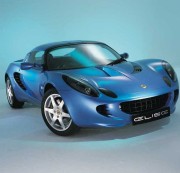
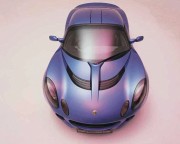
whereas the previous Elise combines subtle curves and rounded shapes, the
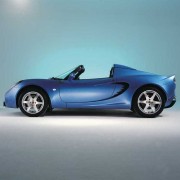
Elise now has sharper, more aggressive edges. It sits closer to the ground
(by 10mm), its wheel and tyres more fully fill the wheel arches and its rear
haunches are more pronounced. Head-on it has a meaner, more menacing look,
and from every angle it portrays speed, motion and energy. As every Lotus
should.
The
Principal Designer in charge of the Elise design, Steve Crijns, explains
some of the changes. "We wanted to create a shape that would reflect an
incredible driving experience. The car has to look a hell of a lot more
exciting than your everyday 2 seater cabrio. But we also wanted to be honest
and not have any features just for stylistic effect. We started the design
by shrink wrapping the bodywork around the mechanical components.
Unnecessary bulk, even if it's for stylistic effect, creates weight, and a
Lotus must be light. Very early in the design phase the full size clay model
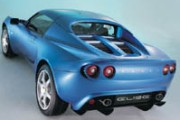
went to the wind tunnel where the rear spoiler and rear diffuser were
created to optimize downforce without causing drag."
As
with everything on a Lotus, the diffuser is not just a cosmetic enhancement,
the Elise aerodynamics were developed to balance downforce over both the
front and rear axles. This aids high-speed stability and has been achieved
without increasing drag in soft or open top configurations. In fact, the
lowered roofline and new hard top actually reduce the drag figures.
Crijns
goes on to add, "We wanted to emphasise that the Elise is rear wheel
drive by increasing the power and volume of the bodywork over the rear
wheels. Lowering the bonnet and reducing the waistline accentuates the width
at the rear. Also, having larger diameter wheels at the rear than those at
the front helps with this effect. In total, the design details of the Elise
pay homage to the very best elements of classic sportscars. Add the design
cues from the motorsport world, such as the fuel filler cap and the bold
treatment of the rear diffuser, and the result speaks for itself."
Recent
Lotus designs have also helped shape the Elise. Its sealed unit headlamp
pack has a strong family link to the exclusive 340R, while the quartet of
multi-function round rear lamps echo those of Project M250.
The
rear tail section of the Elise is slightly longer than that of the previous
car, this increased length and use of the full width of the rear bodywork
creates a much increased luggage space area.
The
revised hood design still flows aft over the rear roll-over bar and onto the
Elise’s tapered rear buttresses. The soft-top has been redesigned to
simplify assembly so it’s much easier to remove and store in the boot. The
new hard-top has a novel design. ‘Gullwing’ roof panels, which can be
easily opened to improve access to the cockpit, and removed, and stored in
the boot, to turn the Elise into a targa-top for those days when the sun
looks friendly but the air temperature isn’t.
Every
body panel on the Elise is new and they are now made using polished high
grade steel tools by French specialist, Sotira. This provides world class
composite panels of a superior quality level over the traditional hand-laid
glassfibre process, it also allows them to be thinner and lighter. This
helps to explain why the Elise, despite its increased length and additional
specifications, weighs in at just 710kg.
Inside
story
Access
to the Elise cockpit has been improved thanks to the re-profiled sill design
adding 40mm to the opening of the door aperture and reducing the width of
the sill, whilst still retaining its impressive chassis stiffness. And as
already outlined, access is even easier with the optional ‘Gullwing’
hard-top in place.
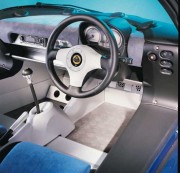
The
exposed aluminium of the Elise’s chassis tub is still one of the dominant
features of the interior, but there’s also a far more integrated and
harmonious design sense to all of the other interior components. Overall,
the effect remains one of thoughtful minimalism, necessity mixed with style.
All
the controls are now of a high quality bespoke design, much of it using
aluminium. The quest for enhanced quality even extends to concealed items,
such as the window lift mechanism inside the doors.
One
of the Elise’s most distinctive features, the Stack electronic
instrumentation, is now updated with new graphics. The race-style dials are
now housed beneath a redesigned binnacle and blue back lighting adds to the
jewel like design detail. Links between the Elise and the track have always
been strong, and the ambience of the facia and trim with the chassis tub
sides provoke a strong sense of being seated in a real sportscar.
Revised
seats head up a list of interior refinements and optional equipment that
also includes a new rear bulkhead trim incorporating improved noise
insulation and twin audio speakers. Additional speakers can be located at
the outer edges of the facia, giving, for the first time in the Elise, the
option of a four-speaker system. Storage space was one of the concerns of
the design team and this has been addressed. An optional full-width curved
shelf runs beneath the facia and features ingenious extruded aluminium
shelf-dividers which can be moved to firmly store objects such as drinks
cans and mobile phones.
In
response to the differing needs of the Elise customer base, the interior
trim and other features will now be offered in two distinct option packages
above the standard car: Sports Touring and Race Tech. Both Sports Touring
and Race Tech options are a set price of £3,195 and £2,995 respectively
over the standard list price.
Race
Tech focuses on functionality and uses racecar materials to create a sporty
interior without compromise. Sports Touring employs Nubuck leather for the
padded seats, door trims and facia as well as carpets to offer a high level
of refinement for long distance journeys.
Achieving
the impossible – an improved chassis
The
Elise, "best handling car" in the business. How do you top it?
Skill, experience, and a lot of dedicated hard work.
Spring
rates have been increased (35Nm-1 on the front springs and 50 Nm-1
at the rear), and thanks to the adoption of Bilstein high pressure monotube
dampers (not to mention hundreds of hours of development driving to
fine-tune the set-up) the handling performance and ride quality are much
improved. Roll rates are slower than before, making the Elise more agile yet
more composed and stable through corners, and less pitch sensitive than
before.
Bridgestone
have jointly developed with Lotus the unique Potenza RE040 tyres (175/55R16
front and 225/45R17 rear) in parallel with the suspension design and tuning
process. The Lotus Ride and Handling team have maximized the ability to hone
the chassis and tyre characteristics to provide an overall increase in
performance.
The
Elise is now equipped with not only more outright grip, greater high speed
stability and better progression at the limit but improved steering feel,
feedback and response. And a wet road grip limit capability that is much
closer to the performance in the dry.
The
result is that overall the Elise feels much quicker, livelier, more
responsive, predictable and even more forgiving, but most importantly more
fun to drive.
Powertrain
– the same, but subtly different
Sitting
snug behind the cockpit is the same 1.8-litre 122PS / 120bhp K series
engine. It’s still the lightest power unit suitable for the application
and it produces capable torque and a more than adequate power output for
such a lightweight car.
However,
there are significant improvements. The engine management system has been
upgraded to pass the latest Euro 3 emissions regulations (which go through
to at least 2004) – this includes fitting Lotus developed on-board engine
diagnostics. Another benefit of fitting the Lotus bespoke engine management
system is that the engine now has been tuned to offer improved throttle
response and drivability, which combined with the close ratio transmission,
now standard fitment, gives the Elise a sense of much increased performance
and a sportier feel.
Because
the Elise runs on larger diameter wheels and tires, 16in at the front, 17in
at the rear, it uses close gearing as standard to enhance overall
acceleration feel and drivability. Top speed is 125mph, and the 0-60mph time
is achieved in 5.7sec.
The
legend grows
The
trouble with icons is that they’re difficult to replace. But not
impossible. The Elise proves that by concentrating on the important issues,
understanding the needs of customers, and through an instinctive
appreciation of the finer points of vehicle dynamics, you can improve, even
on the best.
The
original Elise created a legend; its successor will ensure that the Elise
reputation will continue to grow
|