| |
 |
 |
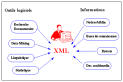
The Extensible Markup Language (XML)
is the universal format for structured documents and data
on the Web |
|
| XML |
|
 |
 |
XSL is a language for expressing style
sheets. An XSL style sheet is, like with CSS, a file that
describes how to display an XML document of a given type.
XSL shares the functionality and is compatible with CSS2
(although it uses a different syntax). |
|
| XSL |
|
|
|
 |
XSLT is designed for use as part of
XSL, which is a stylesheet language for XML. In addition
to XSLT, XSL includes an XML vocabulary for specifying
formatting. XSL specifies the styling of an XML document
by using XSLT to describe how the document is transformed
into another XML document that uses the formatting vocabulary. |
|
| XSLT |
|
|
 |
XPath is a language for addressing parts
of an XML document, designed to be used by both XSLT and
XPointer |
|
| XPath |
|
|
|
 |
This specification defines the XML Linking
Language (XLink), which allows elements to be inserted
into XML documents in order to create and describe links
between resources. It uses XML syntax to create structures
that can describe links similar to the simple unidirectional
hyperlinks of today's HTML, as well as more sophisticated
links. |
|
| XLink |
|
|
 |
The mission of the XML Query working
group is to provide flexible query facilities to extract
data from real and virtual documents on the Web, therefore
finally providing the needed interaction between the web
world and the database world. Ultimately, collections
of XML files will be accessed like databases. |
|
| XML Query |
|
|
|
 |
XML Schemas express shared vocabularies
and allow machines to carry out rules made by people.
They provide a means for defining the structure, content
and semantics of XML documents |
|
| XML Schema |
|
|
 |
XPointer, which is based
on the XML Path Language (XPath), supports addressing
into the internal structures of XML documents. It allows
for traversals of a document tree and choice of its internal
parts based on various properties, such as element types,
attribute values, character content, and relative position. |
|
| XPointer |
| |
| |
| C.Manikandan eMail id: [email protected] |
|
|
|