The JavaTM programming language is robust and versatile, enabling developers to:

Write software on one platform and run it on another.

Create programs to run within a web browser.

Develop server-side applications for online forums, stores, polls, processing HTML forms, and more.

Write applications for cell phones, two-way pagers, and other consumer devices.

 Java
JDBC technology is an API that lets you access virtually any tabular data source from the Java programming language. It provides cross-DBMS connectivity to a wide range of SQL databases, and now, with the new JDBC API, it also provides access to other tabular data sources, such as spreadsheets or flat files.
 Java DataBase Connectivity (JDBC)
Java Servlet technology provides web developers with a simple, consistent mechanism for extending the functionality of a web server and for accessing existing business systems. A servlet can almost be thought of as an applet that runs on the server side -- without a face. Java servlets have made many web applications possible.
 Java Servlets
JavaServer Pages (JSP) technology allows web developers and designers to rapidly develop and easily maintain, information-rich, dynamic web pages that leverage existing business systems. As part of the Java family, JSP technology enables rapid development of web-based applications that are platform independent. JavaServer Pages technology separates the user interface from content generation enabling designers to change the overall page layout without altering the underlying dynamic content.
 Java Server Pages( JSP )
JavaBeans brings component technology to the Java platform. With the JavaBeans API you can create reuseable, platform-independent components. Using JavaBeans-compliant application builder tools, you can combine these components into applets, applications, or composite components. JavaBean components are known as Beans. .
Java Beans
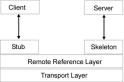
The Java Remote Method Invocation (RMI) system allows an object running in one Java Virtual Machine (VM) to invoke methods on an object running in another Java VM. RMI provides for remote communication between programs written in the Java programming language.
 Remote Method Invocation ( RMI )
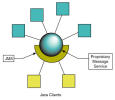
JMS is a strategic technology for J2EE. JMS will work in concert with other technologies to provide reliable, asynchronous communication between components in a distributed computing environment.
Java Message Service ( JMS )
The Java 2 Platform, Enterprise Edition (J2EE) defines the standard for developing multitier enterprise applications. J2EE simplifies enterprise applications by basing them on standardized, modular components, by providing a complete set of services to those components, and by handling many details of application behavior automatically, without complex programming.
 Java 2 Enterprise Edition (J2EE)
The Java Naming and Directory Interface (JNDI) is a standard extension to the Java platform, providing Java technology-enabled applications with a unified interface to multiple naming and directory services in the enterprise. As part of the Java Enterprise API set, JNDI enables seamless connectivity to heterogeneous enterprise naming and directory services. Developers can now build powerful and portable directory-enabled applications using this industry standard.
Java Naming and Directory Interface ( JNDI )
Enterprise JavaBeans is the server-side component architecture for the J2EE platform. EJB enables rapid and simplified development of distributed, transactional, secure and portable Java applications.
 Enterprise JavaBeans( EJB )
Hosted by www.Geocities.ws

1