
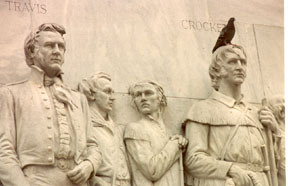
aims a rickety cart forward. Somewhere behind them Santa Anna's men are lurking, and the only escape is across a bridge and into the Alamo compound.
William Barret Travis, natty in a sky-blue suit, and his slave Joe aim their horses toward a doorway where Juan Seguin is loading sacks of corn on a mule-drawn cart.
"Capt. Billy Goat, get your men to the Alamo," Travis says.
"Go to hell," Seguin says. "We're eating corn."
Cut!
A grin crosses the face of "Alamo" director John Lee Hancock. The crew around him erupts into laughter.
"We get a little loopy on Fridays," he says of the joking improvisation from Patrick Wilson (Travis) and Spain's Jordi Molla (Seguin) during the scene rehearsal.
A month to go and all is calm on the set of the biggest budget film production to ever come to Texas--the official number is $90 million--and certainly one that drills to the core of the Lone Star State's mythos. Floating above it all are the ghosts of John Wayne and the seventh-grade Alamo history lesson that every Texas boy and girl has learned for generations.
"I try not to look at the horizon too much for fear of not getting out of bed," says Hancock, a Texas native casually clad in baggy khakis, a t-shirt and sneakers. "Somebody once said, 'How do you eat an elephant?
One bite at a time.' I'm eating it one bite at a time."
Filming began in January 2003, but the project percolated long before, first as an idea by original screenwriter Les Bohem then through re-imaginings by John Sayles, Stephen Gaghan and finally Hancock when he took over directing from Ron Howard (Howard continues as producer through his Imagine Entertainment).
Next the 51-acre set sprouted out of ranch land here. Production designer Michael Corenblith, who grew up in Austin the son of a seventh-grade Texas history teacher, has tacked to his office wall a photo of himself at age 9 crouched in a niche of the Alamo where a statue of St. Dominic once stood (and does again in the film). Nearby is a photo of the set superimposed with a quote from Goethe: "Be bold and powerful forces will come to your aid." It was Corenblith's motto as he conceived of centering filming in one spot.
"My prejudice that the film should be done in Texas was no secret to Imagine or Disney," says Corenblith who presented Disney with photos of four location finalists culled from 80: Montana, Sacramento, Sante Fe
and Dripping Springs--without telling them which was which.
"The choice was unanimous and immediate," says Corenblith, who garnered Oscar nods for his work on "Apollo 13" and "How the Grinch Stole Christmas."
To recreate the town of San Antonio de Bexar and the Alamo compound, Corenblith and his design crew relied heavily on 19th Century paintings such as one by Thomas Allen with chickens frolicking and residents
lunching with a pink church of San Fernando as their backdrop.
"There is no architectural detail, no color that we can't point back to a painting from that period," Corenblith says. "This is not going to look like what people expect of the Alamo."
Still to come are a compound of 17 building that will be San Felipe de Austin and double as Gonzales, plus a Cherokee village set will be at Wimberley's Blue Hole. And Bastrop will serve as San Jacinto for the film's final act with Dennis Quaid portraying Sam Houston. Quaid arrived on the set last week.
San Antonio de Bexar was a half mile from the Alamo in reality, a quarter mile on the set. The orientation of the sun is different to accommodate the cameras. The Alamo chapel is moved up in relation to the long barracks that exist next to it to this day. Otherwise, all is eerily 1836.
Longhorn cattle wait in a raised corral, dead (plastic) rabbits hang from ropes outside a storefront. Everywhere horse droppings litter the ground. A dirt-smudged extra snoozing outside a cantina is a ghost from the past.
Tejanos slurp bowls of beans on the porch of the house where Santa Anna lived while in San Antonio. It is one of a few finished-out buildings used for interior shots.