HYPERBOLIC FUNCTIONS - SINH, COSH AND TANH
click here to enjoy the Hyperbolic Functions word search
The trigonometric ratios of sine, cosine and tangent are generated by the position of points on the unit circle - a circle centered at the origin with a radius of 1
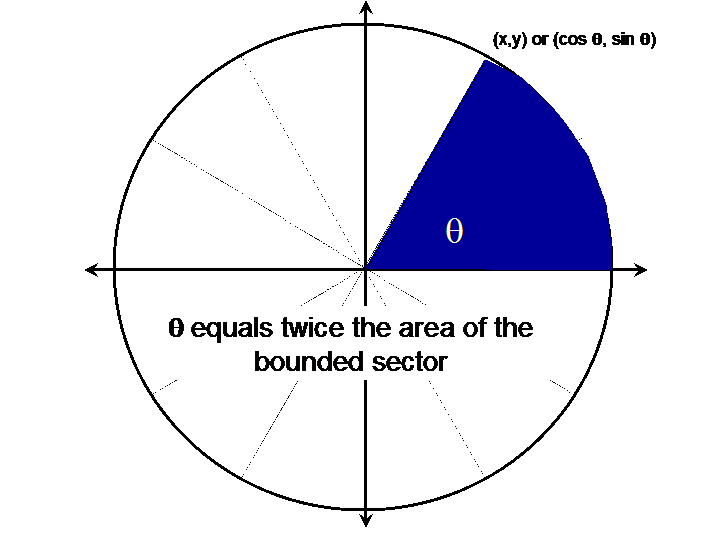

Another way of looking at the unit circle is in terms of AREA. If theta is the included angle, in radians, from the x-axis to the point (cos, sin) then the angle theta equals TWICE the shaded area of the bounded sector.
THE UNIT HYPERBOLA
A hyperbola is a curve generated by the vertical slicing of congruent cones matched by a common vertex.
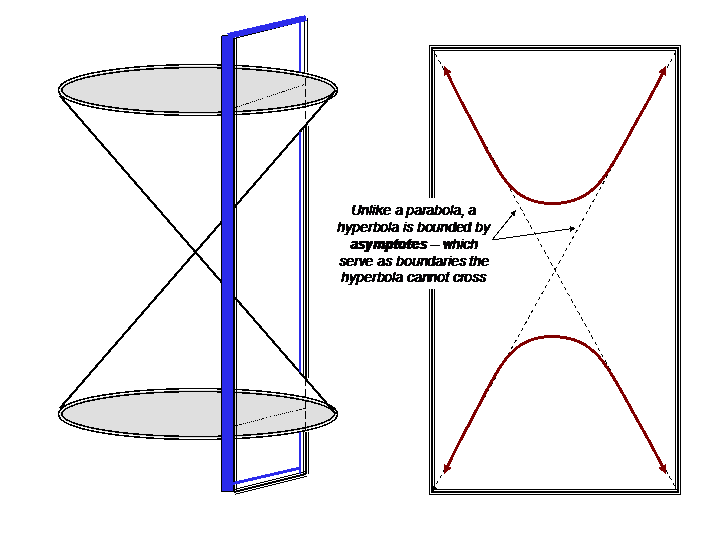
The equation of a unit hyperbola is either x^2 - y^2 = 1 OR y^2 - x^2 = 1
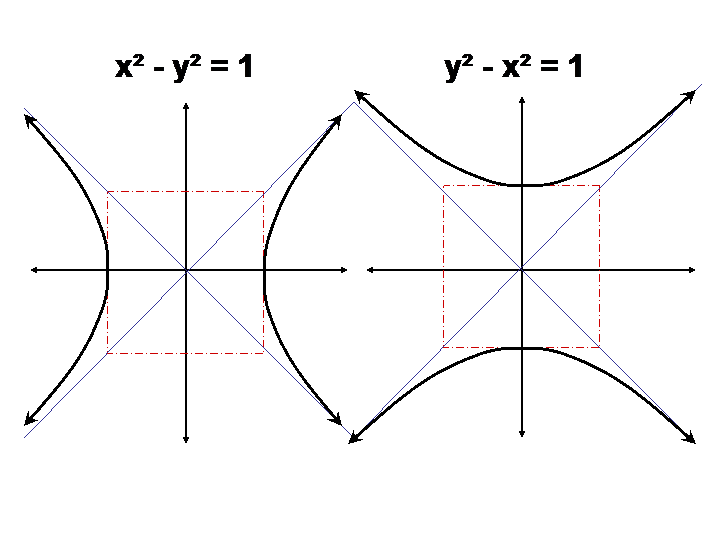
It is these that produce the hyperbolic trigonometric functions of sinh [hyperbolic sine], cosh [hyperbolic cosine] and tanh [hyperbolic tangent].
Sinh rhymes with "pinch"
Cosh rhymes with "gauche"
Tanh rhymes with "ranch"
As (cos x, sin x) represents a point on the unit circle, (cosh x, sinh x) represents a point on the unit hyperbola.
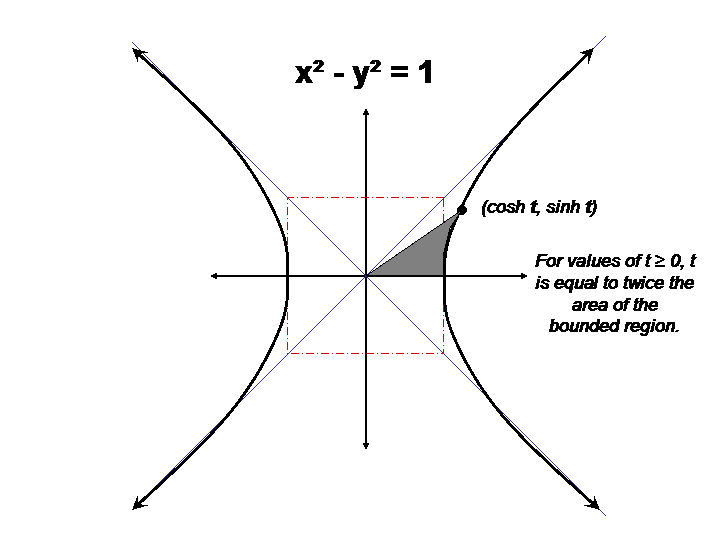
We can also look at the unit hyperbola in terms of AREA. For values of t greater than or equal to 0, t [the angle in radians] is equal to twice the area of the bounded region.
EQUIVALENT EXPRESSIONS OF SINH AND COSH
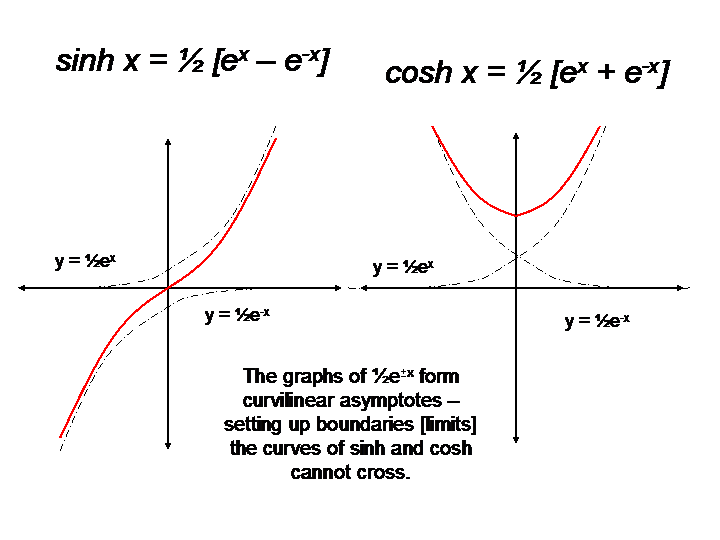
The functions represented by the dotted lines form curvilinear asymptotes. These asymptotes, even though they are curves, form a boundary to which the graphs of sinh and cosh conform. The graphs get closer and closer to these boundaries but will never cross them.
HYPERBOLIC FUNCTIONS IN ARCHITECTURE
The most famous application of hyperbolic functions is the Gateway Arch in St. Louis. The arch is actually an inverted hyperbolic cosine curve.

A cable that hangs from one point to another is called a catenary. Catenaries are used in Physics quite often.

QUESTIONS TO CONSIDER
- If sin x = .8978, what would two possible values be for cos x?
- If x = .75, determine the values for sinh x and cosh x
- Graph the catenary y = 10 cosh [x/10]. Use a trapezoidal approximation to determine the area under the curve from x = -10 to x = 10.
- Use the same graph and right triangles to approximate the length of the curve from x = -10 to x = 10.
go back to the main page