Applications To Physics
click here to enjoy the applications to physics word search
Let's consider the position versus time graph from the previous section:

The values in your table helped you create a velocity versus time graph as below:
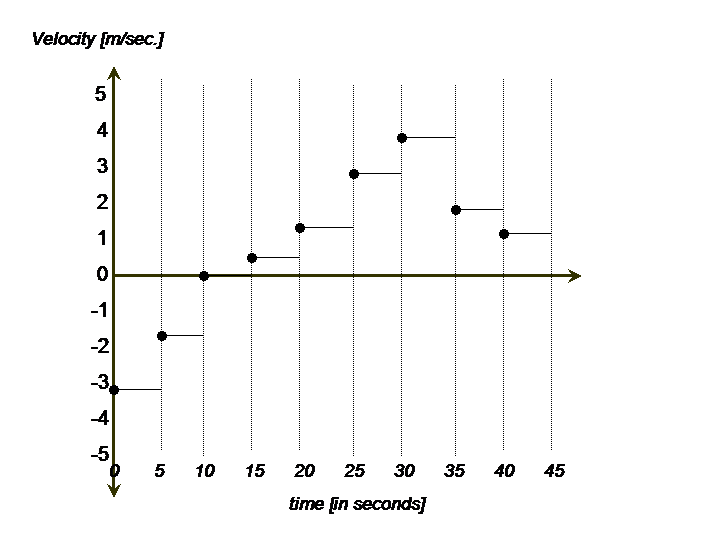
The limitations of a velocity graph such as this become apparent as you picture the actual travel of the object.
**Did the object abruptly and instantaneously change velocity at these 5 second intervals?
**Did the object maintain an absolute constant velocity within each time interval?
The answer to each of these questions is NO, because we plotted the average velocity for each time interval. However, the values in the table and the resulting graph can help us get a clearer understanding of how the velocity changed over its 45 second travel.
SPECIAL NOTE-the position versus time graph does NOT provide us with the initial velocity of the object, only its position. We either need to be given that information or solve for it given some other initial condition.
For our purposes here, we will assume the particle was at rest when t = 0 seconds.
| Time Interval | Initial Velocity | Change In Velocity | Change In Time | Acceleration |
| 0-5 sec. | -3.2 m/sec | -3.2 m/sec | 5 sec. | -.64 m/sec/sec |
| 5-10 sec. | -1.6 m/sec | +1.6 m/sec | 5 sec. | +.32 m/sec/sec |
| 10-15 sec. | -------- | -------- | 5 sec. | -------- |
| 15-20 sec. | -------- | -------- | 5 sec. | -------- |
| 20-25 sec. | -------- | -------- | 5 sec. | -------- |
| 25-30 sec. | -------- | -------- | 5 sec. | -------- |
| 30-35 sec. | -------- | -------- | 5 sec. | -------- |
| 35-40 sec. | -------- | -------- | 5 sec. | -------- |
| 40-45 sec. | -------- | -------- | 5 sec. | -------- |
Acceleration is the rate of change of the velocity. Here, velocity is measured in meters per second. The acceleration is measured in meters per second per second.
**If the acceleration is positive, the object is speeding up
**If the acceleration is zero, the object is maintaining a constant velocity
**If the acceleration is negative, the object is slowing down
Let's go back to the velocity versus time graph and see what connections we can make:
By connecting the midpoints of the segments we can see lines and slopes that are far more useful to us here.
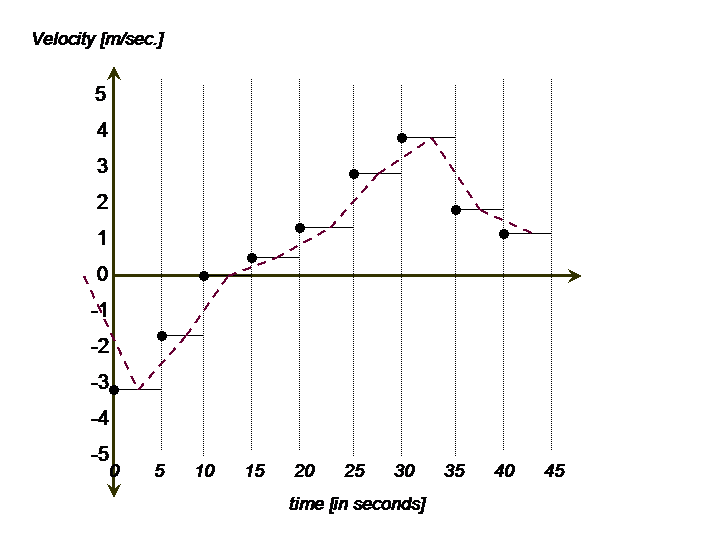
The slope of a graph at any given point is equal to the rate of change at that point.
Looking at the velocity versus time graph we can conclude:
**If the slope is positive, the object is accelerating
**If the slope is zero, the object is moving at a constant speed
**If the slope is negative, the object is decelerating
continue with this section
go back to the main page