|
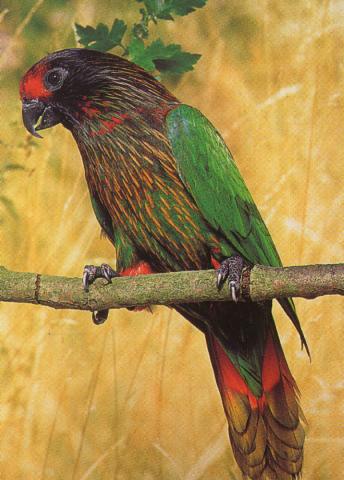
Distribution The Yellow-Streaked lory inhabits southern New Guinea and the Aru Islands. The nominate race is found from Triton Bay and the head of Geelvink Bay, Irian Jaya, east to the lower Fly River, Papua New Guinea. According to Diamond (1972), "chloroptera, originally described from the southeastern coast, may extend in the foothills far west of the easternmost coastal population of C. s. scintillata (originally described from the southwest)." C. s. chloroptera is found between longitudes 146 deg E and 148 deg E, apparently extending westward in the foothills and the upper reaches of the south coast rivers to Soliabeda (upper Purari drainage, longitude 145 deg E), upper Fly River, upper Eilanden River and upper Noord River. Diamond comments that both races show much individual variation (such as the amount of yellow in the primaries of chloroptera, of red in the predominantly green underwing coverts of chloroptera, and of green in the predominantly red underwing coverts of nominate scintillata). He suggested that hybridization of the two subspecies was occurring after a prolonged break in contact at the Fly River. C. s. rubrifrons is found in the Aru Islands, southeastern Moluccas. Milton and Marhadi (1987) observed it on the island of Pulau Warmar.
Plumage
Trade Because this lory comes from the same region (Irian Jaya) as the two preceding species, it too was not exported commercially until the early 1970s. The first time I saw it was at West Berlin Zoo in 1971. Although it is not among the first ten species in terms of abundance, it is fairly common and widely bred, its beautiful coloration ensuring its popularity. However, like other members of the genus, its loud voice deters some aviculturists from including it in their collections. Kyme referred to its voice when describing the behavior of his pair: "the male is more aggressive. When the pair are fed it is the cock who attacks physically although it is both sexes which utter the high pitched, deafeningly loud, mobbing calls. While they shriek they keep the tail flared right out, the wings outstretched and the long, rather narrow, feathers to the head and neck ferociously bristled." Breeding data The clutch size is two. The incubation period is 25 or 26 days. Newly hatched chicks weigh approximately 7-8 g; covered in long, whitish or pale gray down, sparser on head; beak dark brown with white egg tooth, feet pink. Immature birds Age at independence of hand-reared young: Two young only, 40 and 44 days; another, stunted by early parental neglect, 88 days (weighing only 129 g, compared with 168 g and 174 g for the other two at the same age). Status in aviculture Fairly common. Literature
|