 The
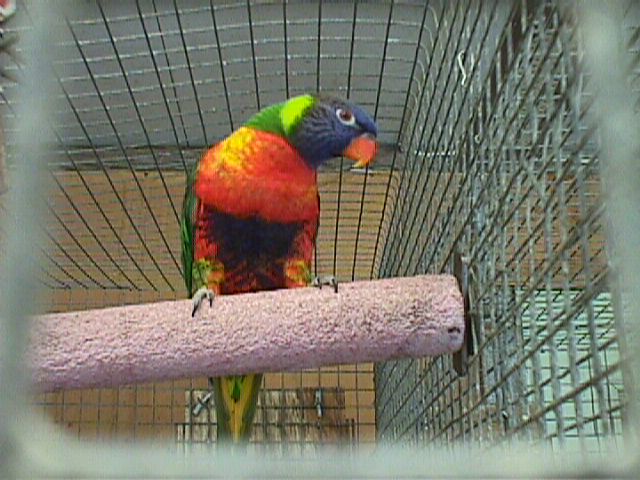
Swainson Blue Mountain Lorikeet, T.h. moluccanus
The
Swainson Blue Mountain Lorikeet, T.h. moluccanus
The
Swainson Blue Mountain Lorikeet, T.h. moluccanus
Distribution
Eastern Australia, from Cape York Peninsula southward along the coast to Eyre Peninsula, South Australia; also Kangaroo Island. It is a rare visitor to Tasmania; there were occasional records from "Tasmanian region" last century. In 1969, a flock of about 16 birds was recorded on King Island where it remained for several months. The population in the region of Perth, Western Australia, originated in the late 1960s from escaped captive birds. Stan Sindel (1987) pointed out how the range of this lorikeet has extended in response to urbanization: "It has been a common resident of the morthern suburbs of Sydney for many years and more recently has extended its range into the southern and south-western suburbs. I often see small flocks in the south-western suburbs where five years ago they were unknown. "By 1995, or before, they were in the very heart of Sydney, for example, at Ashfield, where they visit the balcony of one apartment.
It is found in a multitude of habitats, in fact in any locality where there is sufficient food - in mallee scrub, open eucalyptus forest, rain forest, gardens and parks. It frequents coconut palms on offshore islands along the Queensland coast. Found in mountainous areas in Queensland and northern New South Wales, it is otherwise primarily a lowland species which often moves in large flocks, in search of large trees. Observations of contributors to The Atlas of Australian Birds did not suggest any large scale seasonal movement.
Forshaw (1981) stated: "In the north, there are some birds present in most districts throughout the year, but in the south, they travel more widely in search of blossoms and at times completely vacate a district. Movements are usually erratic though are regular and seasonal in some places."
At Swan Vale, northern New South Wales, they regulary cross the Great Dividing Range. They come from the coast in the east each spring when white box or yellow box trees are in heavy flower. The visiting rainbows used to nest here. They ceased to do so about 1927 when most big gum trees along Swanbrook Creek were finally killed, depriving them of nest sites. John Henry Courtney, John Courtney's father, found the last known rainbow nest in this area in 1927 (Courtney pers. comm. 1995).
Rainbow lorikeets are easily attracted in large numbers to artificial food sites. The most famous of these sites is Currumbin Sanctuary, Palm Beach, Queensland, where twice daily feeding by visitors has been an attraction for many years. They can hold out plates of bread soaked in honey and enjoy (or otherwise!) the sensation of lorikeets perching on their hands and heads in their eagerness to partake. The flocks consists mainly of rainbows with a few scaly-breasts - more of the latter at the morning feed and only about 3 percent at 4:00 pm. Total numbers vary; there were only about 200 on the December day of my visit. Des Spittall, curator for many years, told me that numbers currently fluctuate between about 50 and 1,200, but formerly as many as 1,400 might come. Numbers are influenced by abundance of flowering eucalyptus and the presence of predators; on the day I was there a goshawk was in evidence, thus numbers were lower. The long-term decline in numbers is due to the Gold Coast becoming increasingly developed, and probably also to the fact that more householders put out food to attract lorikeets to their gardens. there were quite a few young ones (some of which had probably only recently left the nest) and I was told that they had bred early that year. Usually young are not seen until January.
Most residents of areas where this species is common take it very much for granted. Yet it must be one of the world's most common birds which is colorful and easily seen; a feeding flock, or one coming in to roost, is a spectacle which would be difficult to surpass. "Rainbow" denotes colorful but the intense hues of this species are not present in a rainbow. My own first view of these lorikeets in the wild, along with musks, took place in an Adelaide park on a fine April day. I was totally spellbound. It amazed me that local people were walking by without giving the feeding birds as much as a glance! I was speaking at a convention being held in the nearby university, and it was with great reluctance that I tore myself away from this wonderful scene! I still find flocks of this subspecies totally mesmerizing from the point of view or color, noise and activity.
The diet of pollen and nectar is varied with seeds, fruits, berries and insects. Forshaw (1981) states that the staple diet is pollen and nectar from the flowers of Eucalyptus, Angophora, Melaleuca, Banksia and other native and introduced trees and shrubs. They also feed on fruits of Ficus, mangoes which have been broken open by fruit bats, Casuarina flower heads, beetles and small grubs. Orchard fruits such as apples and pears are eatenk, causing some damage. Maize and sorghum crops may also be attacked before they are ripe, as lorikeets like to feed on the milky grains.
Nesting usually occurs from August to January, also at other times in the north of the range. The most favored nest sites are hollow limbs in Eucalyptus or Melaleuca, generally at the height of about 16 m (50 ft); nests as low as 3 m (10 ft) have been recorded.
According to Courtney, the nest entrance can be a symmetrical round hole in teh side of the trunk of a living river red gum tree (into which they can barely squeeze), or it can be a short dead spout leading into a living limb or trunk. Both types or nest entrance have been observed by John courtney at Bonshaw, west of the Great Dividing Range, on the NSW/Queensland border. A clutch of three eggs from Grafton, New south Wales, averaged 27.6 x 23.0 mm (Forshaw 1981).
Plumage
The head is
rich blue,
almost
violet,
shaft-streaked
with lighter
blue;
abdomen is
deep
purple-blue.
Nuchal
collar is
yellowish
green.
the breast
is orange,
usually
without any
barring but
marked with
yellow at
the sides to
a varying
degree;
underwing
coverts are
orange,
tinged with
yellow.
The key
identification
features are
the blue
head, almost
unbarred
orange
breast and
yellow-green
collar.
More
mutations
have
appeared in
this
subspecies
than in any
other
lorikeet.
A
photograph
of a pied
appeared in
the Magazine
of the
Parrot
Society
for April,
1984.
The
normally
green areas
were
replaced by
vivid
yellow
except on
the thighs
and some of
the wing
coverts.
There was a
brief
comment by
Dr. A. J.
Wright that
this
mutation
had
appeared in
collections
in South
Africa
during the
precious 10
years.
He stated
it was
recessive,
delicate
and
infertile!
Not
surprisingly,
the
mutation
was not
established.
Sindel
(1987) was
informed
that a cinnamon
mutation
had been
developed
in South
Africa.
There are
now a few
in
Australia.
The green
areas are
replaced by
greenish
yellow; the
head is
lilac and
whitish
lilac with
some orange
streaks.
The
underparts
are
entirely
red.
In
Australia
there is
another
form which
has been
called the Dutch
cinnamon;
all its
colors
(including
those of
the soft
parts) are
paler.
Stan Sindel
developed
an olive
mutation in
the rainbow
lorikeet by
hybridizing
it with an
olive
scaly-breast.
Two
interesting
mutations
in
Australia
are the blue-breasted,
which lacks
red and
yellow in
the
plumage,
and the blue,
which is
various
shades of
blue with
white
breast and
white
nuchal
collar.
General
Due mainly
to its
wonderful
plumage,
this has
always been
a very
popular
lorikeet
with
aviculturists.
Outside
Australia,
demand
probably
exceeds
supply and
females
have become
harder to
find.
(Buyers
should note
that in the
U.K. birds
of the
nominate
race are
often
advertised
as
"rainbow
lorikeets."
This may
happen
quite
innocently
when
reference
has been
made to Parrots
of the
World,
where the
name green-naped
lorikeet is
not
used.)
Up until
1961, when
Australia
ceased to
export her
fauna, this
was one of
the few
lorikeets
which was
freely
available
in Europe.
In Australian aviaries it breeds throughout the year. Peter Philp, a speaker at the Fifth National Avicultural Convention in Adelaide in 1989, stated that his pair had fledged young in every month except May and September. They had reared 33 young in ten years. Australian breeder Barbara O'Brien, who kept every species of Australian lorikeet, commented that her rainbows were the only ones which would eat seed and "only when the have chicks and then only hulled oats." These were limited to a handful daily.
In Lories and Lorikeets I recorded several instances of aviary birds burrowing into the ground in order to nest.
Hutchins
and Lovell
(1985) give
a
description
of the
display:
"The
courtship
dance of
the male
rainbow
lorikeet is
rather
acrobatic;
he resorts
to dancing
up and
down, then
hanging
upside down
from the
perch or
hopping
along the
perch
sideways
and
twisting
from side
to
side.
Often this
is done in
silence byt
at other
times loud
screeches
are uttered
and added
to these
antics a
fair amount
of bobbing
and bowing
is
done.
During this
display the
male's eyes
dilate,
this is
very
pronounced
and very
striking to
the
observer."
It should
be noted
that both
sexes blaze
the eyes,
arch the
neck, hiss
and bob in
typical Trichoglossus
manner.
Literature
