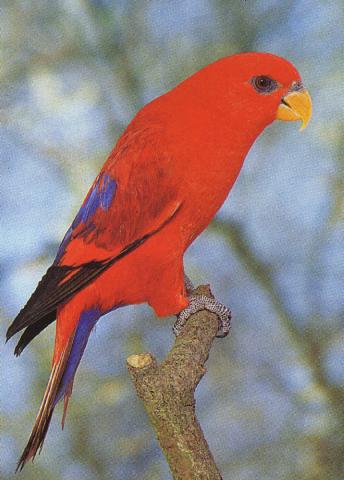
 The Moluccan
Red Lori, Eos bornea
The Moluccan
Red Lori, Eos bornea(click on the pic for a larger view)
The Moluccan
Red Lori, Eos bornea
(click
on the pic for a larger view)
Distribution
The Ambon (Amboina) and Saparua, islands of the Moluccas (Maluku), Indonesia. (Saparua is one of the small Lease Islands to the east of Ambon.) The birds from Seram are considered to belong to the subspecies rothchildi and apparently differ only in their smaller size. Those from the Kai Islands are said to be slightly larger than the nominate race and have been assigned to the subspecies bernsteini and rothschildi. The only subspecies recognizable outside its natural habitat is cyanonothus, from Buru.
Plumage
Predominantly
red with
small areas
of black and
blue on the
wings.
The
primaries
are black
with the
speculum
red;
secondaries
are red,
broadly
tipped with
black.
The greater
wing coverts
are blue,
also
scapulars in
some
specimens.
The area
surrounding
the vent and
the
undertail
coverts are
cobalt
blue.
The upper
side of the
tail is
darker than
the body
plumage; the
under side
is brownish
red.
The beak is
orange; the
cere, the
skin
surrounding
the eye, and
the feet are
gray.
The iris is
orange-red.
Note that
the shade of
red of the
subspecies cyanonothus
is darker
than that of
other red
lories.
Trade
For many
years this
was the only
member of
the genus
available in
captivity;
even in the
mid-1980s
when other Eos
were
exported, bornea
quotas were
the
highest.
PHPA
government
statistics
detail
minimum
numbers of
parrots
exported
from the
Moluccas for
the
international
market.
In 1981, the
total was
18,829 of
which 2,735
were Eos
bornea;
1982 total
was 25, 358
including
4,853 red
lories; 1983
total,
41,673
including
4,968 red
lories; 1984
total,
44,056
including
10,022 red
lories
(Milton and
Marhadi
1987).
By 1984,
excessive
numbers of
red lories
were being
exported and
populations
must have
been
declining.
However, no
studies of
abundance
were made
during that
period.
It is little
wonder that
this species
was one of
the cheapest
lories
available.
General
Information
Red lories were regularly imported until the 1990s. Up to this time the price had been low (as low as $45 in the US). In Australia and New Zealand, where importation of birds was forbidden for over 30 years until (in Australia) 1992, the price is very high. In 1989, a New Zealand aviculturist told me they cost $10,000 per pair there! At the time they cost about L80 each in the UK. This is the best known member of the genus and was the only one readily available in aviculture for many years.
Reds make wonderful aviary birds. They are hardy and often free-breeding. Collins and Sefton noted their birds seemed to prefer cool weather. "They have very thick down feathers, similar to those of waterfowl. They play outside in weather as cold as the low 30s and 20s... Our lories' highest egg production occurs in the coldest weather, typically during the months of February and March... We have also noticed that northern lory breeders with cooler climates are significantly more successful than (southern) breeders." They also noted deaths occurred during unusually hot weather with high humidity.
A common problem with this species is feather-plucking; they may pluck themselves or their young. Collins and Sefton state: "We have always been able to cure this problem by switching them over to our diet. We believe that feather picking in red lories can be an indicator that their protein is too low." An interesting suggestion which might be tested by someone with two pairs of reds which pluck. One pair should be offered a diet with an increased protein level and the others should act as control birds with unchanged protein levels.
The diet of the pair at Palmitos Park consists of nectar made from Milupa baby cereal, Nekton-Lori and honey, fresh fruit (apple, pear, banana, other fruits in season) once or twice daily, a small amount of sunflower seed and, when available, pollen-laden blossoms, and small branches of Casuarina equisetifolia bearing small cones. They eagerly consume the sunflower and would undoubtedly take much more. The female is slightly plucked on the breast. The male can be very aggressive when breeding and I hesitate to increase the protein level of the diet. The chick in the weight table was from this pair. I had weighed the chick daily without encountering any problems until the chick was 11 days old. When I opened the nestbox, the male suddenly flew in and bit my finger. The following day he attacked the female. she had to be removed for a few days to recover from a leg injury which he had inflicted. I then removed the chick to hand-rear and discovered it had been bitten on the back, presumably by the male. The injuries were not serious but indicated possible mutilation and resulting death, if the chick had been left in the nest. I was told a young one bred from this pair previously was so aggressive that it had killed another young lory when it was only about four months old. The one I reared had a Stella's lorikeet of the same age as a companion. When the red was only 11 weeks old I separated them. They had previously spent hours playing together, but I feared for the Stella's when I saw the red's behavior becoming slightly aggressive. In my experience with many parrot species, aggression is inherited.
Red lories are colorful and entertaining with an often flamboyant display, which precedes copulation. It has been described by Gerischer (1991) as follows: "The male circled around the hen with outspread wings, constantly jerking his head up and down. After a while the female began the same play and soon they were chasing each other and 'embracing,' uttering hissing and cheeping cries. Both puffed out the body feathers and the pupils of their eyes narrowed and widened, showing the iris quite clearly."
Breeding data
The clutch size is two. The incubation period is 24 to 25 days. Collins and Sefton have recorded periods up to 29 days and state that "the eggs take a day or two longer in cold weather."
Immature birds
Their plumage is variable; in some birds the red feathers of the underparts are margined with blue and the ear coverts are blue. The beak and the iris are brown. The beak gradually becomes paler at the tip and the brown coloration is lost, replaced by dull yellow-orange. Gerischer (1991) described the plumage of the young of his pair as having "red and blue markings on the back stronger than in the parents. Chest and belly were red crossed by wavy black lines. The blue patches behind the ears disappeared in time."
Specialist breeders of red lories described their young as follows: "The juveniles have far more black and less blue on their wings than adults, and the black is irregular... After each molt, the blue wing band becomes more pronounced: There is less black, and they lose the blue ear patches. The blue wing bands reach their maximum blue coloration after 5 years. some begin to develop orange irises at about a year. Some begin to develop orange irises at about a year, although we have noticed adults that never develop the orange iris ring" (Collins and Sefton 1994).
At nine weeks old, one youngster hand-reared by the author did not duffer substantially from its parents. The underparts were pure red but there were only one or two blue feathers on the thighs; a mere tinge of blue could be seen on the ear coverts. The primaries were tinged with gold on the outer edge. The iris was dull brown and the beak was yellow-orange, except for brown tips to both mandibles.
Status in aviculture
Still common in most areas but it has declined due to overtrapping. If the Indonesian export ban which became law in March, 1995, is implemented, some recovery might occur.
Literature
