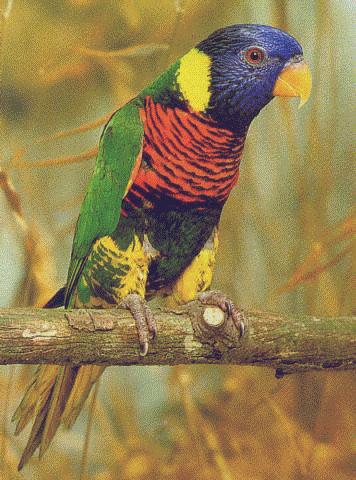
The Green-naped Lorikeet, Trichoglossus haematodus
(click on the pic for a larger view)

Plumage

The forehead and forecrown are blue, also lores and chin; the throat is blackish blue; the area between the crown and nape is purplish brown, the feathers are shaft-streaked with dull green.  The nuchal collar is greenish yellow, with a spot or two of red in most birds.  The breast is red, each feather strongly margined with blue, and the red of the breast spills down under the wings.  Abdomen is margined with dark green; inner part of the thighs are mostly yellow.  Underwing coverts are orange-red with a broad yellow band across the underside of the flight feathers.  Upper parts, including upper side of the tail, are green, bases of the feathers of the mantle are red.  Underside of the tail is dull olive yellow and yellow.  The bill is orange-red, the feet are gray and the iris is red.

Range

The nominate race occurs in western New Guinea and Irian Jaya in the north (Humboldt Bay), and east to the upper Fly River (Black River) in the south; Indonesian islands of Buru, Ambon, Seram (see Gazetteer for all three), Ceramlaut, and the Goram, Watubela and Western Papauan Islands, and islands in Geelvink Bay.  (Its reported occurrence in the Kai (Kei) Islands is based on two specimens mentioned by E. Hartert in 1901.  As the collector's specimens normally gave a definite locality but these were labeled only "Key Islands," Cain (1955) doubts that they originated from there.  He states: "The known range of haematodus comes very close to the Kei Islands but cannot be stated definitely to include them.")

Subspecies are numerous, more so than in any other parrot species; each is covered separately.  The ranges of the various subspecies are listed below, alphabetically by locality.  However, some of the subspecies are so difficult to distinguish that there is not necessarily general agreement on their exact ranges.  

Status/Conservation

Still common, but declining in parts of its range due to trapping and increasing deforestation.  There are no conservation measures at present-but I believe that trapping should cease; it is not necessary to export this common and easily bred species.  (This occurs only to provide some small income to local people, as happens in so many tropical countries worldwide).

General

The green-naped has been one of the best known and most readily available of lorikeets in aviculture since lory breeding occurred on a regular basis, from the 1960s.  Because it has always been common and inexpensive, the assumption has been that breeding accounts will be of little interest, thus the amount of information published on this species is scant.  In addition, many keepers found it difficult to identify the sub-species, which again deterred them from writing about their birds.  In numerous instances, even in zoos, pairs consisted of two different subspecies of Trichoglossus haematodus.

This is undoubtedly one of the easiest lories to breed.  One generally finds that parrot species which, in the wild, are common and widespread, often occurring in large flocks, breed readily in confinement.  They are successful species, without specialized requirements, and very adaptable.  Not only do green-naped lorikeets breed readily, but they are prolific, laying and/or rearing clutch after clutch.  However, they should be deterred from this by removing the nestbox for, say, three months of the year.  This could result in the female laying eggs from the perch, and frustration at the lack of a nestbox.  In this case the new-laid eggs should be substituted with infertile ones from other birds, kept for the purpose.  If the egg size is not identical, the female is unlikely to object.

**Subspecies of Trichoglossus haematodus
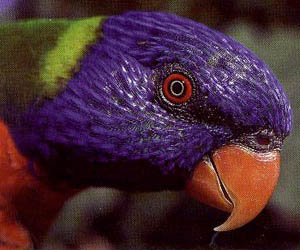


There are 22 subspecies, although some of these are doubtfully distinct.  The nominate subspecies, T. h. haematodus, has already been described.  In order to assist the reader in referring to them, the remaining subspecies are described below in alphabetical order as follows: aberrans (see flavicans); berauensis; brooki; caeruleiceps; capistratus; deplanchii; djampeanus; flavicans; flavotectus; forsteni; fortis; intermedius; massena; micropteryx; mitchellii; moluccanus; nesophilus; nigrogularis; rosenbergii; rubritorquis; septentrionalis; stresemanni.

***NB:  Immature plumage is not described for individual subspecies.  In each instance, it resembles the adult's except it is slightly dull and less glossy.  Shaft-streaking on the head is inconspicuous until after first molt.  The beak is dark brown, becoming orange by about four months; the iris is grayish at first, and almost as bright as an adult's around five months of age. 

Literature

  • Low, R (1998): Hancock House Encyclopedia of the Lories. (242-245) Hancock House Publishers Ltd.


BACK


Hosted by www.Geocities.ws

1