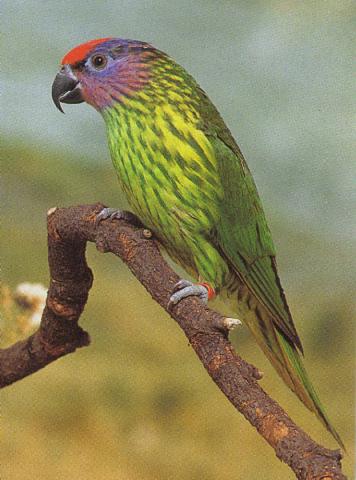
 The Goldie's
Lorikeet, Trichoglossus goldiei
The Goldie's
Lorikeet, Trichoglossus goldiei(click on the pic for a larger view)
The Goldie's
Lorikeet, Trichoglossus goldiei
(click
on the pic for a larger view)
Taxonomy:
At the time of writing, it is not clear in which genus Goldie's lorikeet should be placed. Salvadori (1891) favored Glossopsitta and Peters (1937) placed it in Psitteuteles. In appearance it seems to me to have some similarity to Oreopsittacus, in head coloration and bill color and in general shape. Joshua (1993) states that recent studies of chromosomes have shown that "it has differences to the species within Trichoglossus." Its behavior is also different from members of that genus. Here it is retained in Trichoglossus because as yet there is not sufficient evidence to place it elsewhere.
Plumage
This is a
distinctive
species,
with its
scarlet
crown and
forehead
and
vertically
streaked
underparts.
The area
bordering
the crown
and the
eyes is
mauve and
the cheeks
and facial
area are
pink, with
the dark
green
streaks of
the
underparts
extending
upward to
the lower
part of the
cheeks.
The entire
underparts
are
streaked
(more
broadly on
the sides),
also the
nape and
the
undertail
coverts.
Upper parts
are dark
green.
The beak is
black and
the iris is
dark brown.
In immatures, the plumage is duller and streaking less pronounced throughout. Newly fledged young are dull plum-colored indistinctly streaked with black on the crown and cheeks and usually slightly brighter red on the forehead. the hindcrown may be green or dull purple. There may be a small area of blue below the eye. Forshaw (1989) states that the crown is green, variably marked with red-but "variably marked with red" suggests an immature bird molting into adult plumage. The cere and the skin surrounding the eye are whitish. Kapac (1985) states: "Goldie's are easier to sex upon just weaning when the male shows more color on the head."
Head and bill are usually slightly larger in the male. Some breeders believe that the mauve on the head is more pronounced in the male. Bosch (1993) states that the "adult male is heavier in build and has more red on the top of the head." Joshua (1993) noted that "the margin of purple head coloration is also often straight in males, while in females the line behind the eye has the green body color cutting into the purple in a V shape. This however is not an absolute measure." The larger head and beak of the male and the slimmer, more feminine appearance of the female are perhaps the best indications of sex where several birds are available for comparison.
Status/Conservation
The least
common of
the
midmontane
lories,
according
to
Diamond.
The general
opinion is
that it is
generally
scarce and
only
locally
common.
Because it
is nomadic
and/or
migratory
it is
difficult
to study
and
therefore
there is
absolutely
no
indication
of its true
abundance.
Lambert,
Wirth et
al.
(undated),
who tried
to estimate
the
population
of all
parrot
species,
suggested a
total
population
of more
than
100,000 for
Goldie's.
To even try
to make an
estimate
seems
unrealistic.
As a
midmontane
species its
habitat may
be more
secure than
lories from
lower
altitudes.
Its skins
are not in
demand by
native
peoples for
decoration,
thus no
threats to
its
existence
are known.
General
Perhaps no
other
lorikeet
achieved
such rapid
popularity
as the
Goldie's.
Its good
qualities
were soon
apparent:
it is
quiet,
nonaggressive
and
free-breeding.
First
exported to
Europe on a
commercial
basis in
1977, by
the
mid-19802
it was
firmly
established
in
aviculture.
The first
consignment
to reach
the U.K.
was
imported by
Mrs. S.
Belford.
I can still
recall
seeing the
30 birds,
all
together in
a single
cage (by no
means
large).
But they
thrived;
not one was
lost.
I bought
seven, for
I was
enchanted
by my first
sight of
this
species.
I soon
discovered
that they
lacked the
playful and
boisterous
ways of Trichoglossus
species.
Often they
creep about
in a
cautious
manner,
with the
head held
low, almost
horizontal
to the
body.
Literature
