The Chattering Lori
Lorius garrulus and its subspecies
by Jos Hubers, The NetherlandsCopyright � 1999 Lori Journaal Internationaal
The Chattering Lory
Lorius garrulus
Photo � Cyril Laubscher
The Chattering Lory is probably the most popular type of Lori. In spite of the positive breeding results, the demand remains greater than the supply. This is not for nothing, because it is a very beautifully coloured, powerfully built bird.
Just as we read in the article (LJI #4, 1995) about the Black-capped Lory, Lorius Lori, it also counts for the Chattering Lory that in the past as well as in the present there is a lot of cross breeding. In this article, the emphasis is on the difference in subspecies.
Description
The differences in the subspecies are mostly in the amount of yellow on the mantle. The description is based totally on museum specimens.
Species Latin Name Length Distribution Description Chattering Lori Lorius garrulus garrulus 30 to 31 cm Halmahera Amount of yellow varies from a diameter of about 2 cm to absolutely none. Yellow-
backed LoriLorius garrulus flavopalliatus 28 to 31 cm Batjan and Obi The diameter of the yellow spot is minimum 3.5 cm. Once in a while, one sees birds with dark red feathers around the yellow mantle up to the green of the wings. A bird in my collection has some red through the yellow mantle, so it looks as if the bird has an orange mantle. Morotai Lori Lorius garrulus morotianus about 30 cm Morotai The diameter of the yellow mantle varies from about 2 cm to 3.5 cm. Once in a while it is sparsely flecked with greenish feathers. According to Forshaw (1989) the wings should be darker green in comparison with the other subspecies. The museum specimen did not verify this. As we have seen from the above, there could be overlapping between the different subspecies. The garrulus with the most yellow cannot be differentiated from the morotianus with the least amount of yellow. The same goes for the flavopalliatus. One cannot tell the birds with the least amount of yellow from the morotianus with the most yellow. There are rumours sometimes that only two types exist, i.e. only the garrulus and the flavopalliatus. That this holds no water is proven by the museum specimen. On Morotai, we find no birds with a lot of yellow or no yellow at all. The problem is that the Morotai Lori cannot be distinguished from a cross between the Chattering Lori and the Yellow-backed Lori.
Discussion
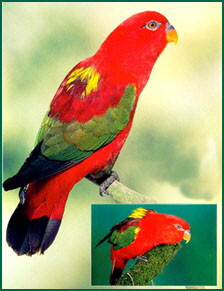
Morotai Lori (top)
Lorius garrulus morotianus
Yellow-backed Lori (inset)
Lorius garrulus flavopalliatus
Note: the yellow feathers on the back can be raised independently
photos � Cyril Laubscher
A number of years ago a group of Obi Lories, Eos squamata obiensis and Yellow-backed Lories were imported into the United Kingdom. What several breeders noticed was the appearance of the Yellow-backs. These birds were noticeably smaller than the Yellow-backs that people were used to. Trevor Buckell (England) went searching in the Museum of Natural History in Tring. He looked at the Yellow-backs and saw that birds which had been gathered on the island of Obi were noticeably smaller than those from Batjan.
I myself have studied the skins and can confirm this. In the future, the skins (including wing and tail feathers) will need to be measured. During my visit in 1995 to the Museum of Natural History in New York I paid extra attention to this and there, as well, the birds from Obi were smaller than those of Batjan. It would be good if the experts (ornithologists) could study these skins intensively and conclusions could be drawn. In England they are labelled as Obi Yellow-backed Lories. This name is used quite frequently and the birds are therefore bred as a separate subspecies. The positive aspect is that, if it is a separate subspecies, there is a hardy population present.
Advice
As is obvious from the description, it is difficult to differentiate the morotai subspecies from cross bred subspecies types. However, I would like to try to give some guidelines. As much as possible, try to breed identically marked birds to each other. Under no circumstances breed birds with little or no yellow to birds with a medium to large amount of yellow. When one has real Yellow-backs, try to keep those together and pair subsequent small birds with small birds. As you have read, this counts especially in England. Use the correct names when buying or trading, i.e. don't use "Chattering Lori" for all of this type, but use only for the specific type. Better yet is to use the Latin name, especially when dealing internationally.
This naming brings me to the German for the garrulus. From the German this translates to Yellow-backed Lori; for the flavopalliatus Bright Yellow-backed Lori is used. Yellow-backed Lori as type form (Chattering Lori) is confusing because a number of birds have no yellow on their backs at all. When buying birds from Germany, be absolutely certain of this difference.
As we can see from the above, the difference in types is not as complicated as with the Black-cap Lori. With this last one, we are dealing with more types and also with the adolescence colouring which is often different from the parents. This last point does not count for Lorius garrulus.
As numbers in the wild have gone down in the post few years, as was noted in recent studies, it is now high time that we breed as many birds as possible that are as pure as possible.
Literature
- Forshaw, JM & Cooper, WT (1989): Parrots of the World. Melbourne.