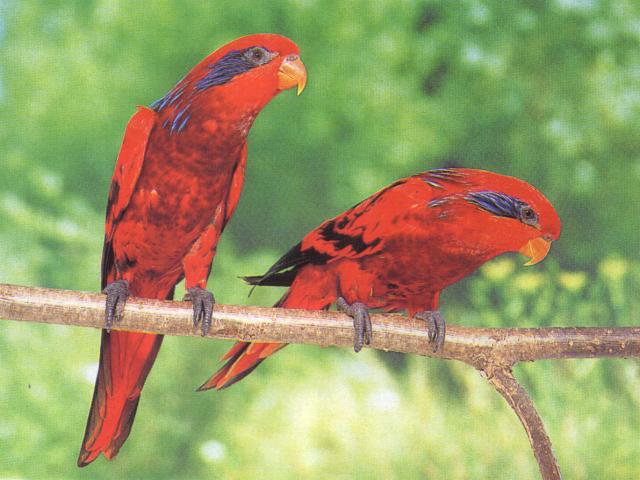
|
Distribution Tanimbar (Tenimber) Islands, Indonesia, of which Yamdena is the principal island and is said to account for 55 percent of the range of this species. It was introduced to the Kai Islands to the north of Tanimbar, where it probably no longer occurs, and to the island of Damar in the Southwest Islands. Finsch (1900) recorded it from the island of Babar in the same group. This is the most southerly representative of the genus.
Plumage
Trade As long ago as 1822, Lord Stanley (afterward Earl of Derby) had a live specimen in his collection in England. But it was another 150 years before this species was exported on a commercial and regular basis. Since the mid-1970s it has been bred regularly in Europe and in the USA. In California, Jay Kapac has been breeding this species for nearly 20 years. All his lory chicks have been incubator hatches and hand-reared from the egg since 1976. In the U.K., the first-recorded success was achieved in 1972, by R. Phipps. The pair had been imported the previous year by Jim Hayward-who observed, to his surprise, that they were mating a few hours after he collected them from Heathrow Airport. They had just been imported from Singapore! With Mr. Phipps they reared a single chick on a diet which included maggot pupae, corn on the cob and nectar with wholemeal breadcrumbs. This pair was then sent to a breeder in South Africa, and thence to Rhodesia where they continued to breed for Mr. D. Edwards, in 1973. these much traveled birds then went back to South Africa. Breeding data The clutch size is two. The incubation period is 25 to 27 days. Gibson (1984) kept records of three clutches; the eggs hatched after 28 days except the second egg in the first clutch which hatched after 27 days. A newly laid egg placed in an incubator hatched after 25 days. Immature birds Age at independence of hand-reared young: 56 days for one hand-reared by the author. Chick growth shows the weight of one chick hand-reared from the age of eight days by the author in 1986. Rearing food consisted of Milupa baby cereal, wheatgerm cereal and tinned Heintz Fruit Dessert baby food. Status in aviculture After the 1993 survey on Yamdena it was described as a "common forest bird"; previously it was described as vulnerable/endangered by Lambert, Wirth et al. (undated) after heavy trapping for export during the 1970s and 1980s. In 1992, they suggested that the population was in the region of 10,000 to 50,000 birds. However, after the 1993 survey, its population on Yamdena was estimated at 220,000 birds, plus or minus 52,000. In 1982, a comprehensive system of protected areas was proposed for Maluku Province, of which the Tanimbar and Kai islands are a part. However, up until 1992 nothing had been done. One proposed reserve on Yamdena would protect a large part of the island and would be of great importance for the endemic avifauna. The single reserve proposed for the Kai Islands comprises about 37,000 hectares of forested hills in the north of Kai Besar. Literature
|