|
The Black Lori,
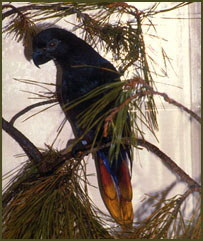
Chalcopsitta atra atra The Black Lori, Chalcopsitta atra, is the least colourful member of an otherwise very colourful genus. It is, in aviculture, therefore the least popular. This is regrettable for it is equally as interesting as the other members of the genus. It is certainly one of my favourites ones. I acquired my first atra in 1971 and, since then, there has been a period of only six years when this species has not been in my care. Today, I keep the subspecies C. amsignis, the care of which is identical in every respect. (The only difference, in my experience, is that the nominate race can be sexed fairly readily by the larger head of the male whereas, in C. aminsignis, head size and shape is not indicative of gender.) The Black Lori measures 31 cm and weighs about 250g. Males of the nominate race are the heaviest. Distribution
The nominate race occurs in the westernmost part of Irian Jaya (the Indonesian part of New Guinea), in the western Vogelkop, also on the islands of Misool, Batanta and Salawati, off the coast. Handbook of the Birds of the World, volume 4, gives this information under the heading of Habitat for Chalcopsitta atra: "Open habitats including coastal plantations, grassy
Plumage
Trade
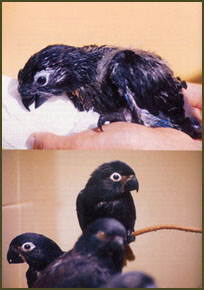
My first three birds were all females, although I could not be sure of this. I remember making a journey of several hours to acquire a male, only to reject the bird at a glance because it had a severe candida infection. This was common in newly imported birds and became serious if left untreated. Finally, in 1975 I obtained from a friend a bird whose mate had died. I knew at once (before the days of surgical sexing) that I at last had a male. Its larger size and more massive head made both my birds look very feminine. The newcomer was housed with one of my birds and the first breeding occurred in 1977. This was the first time the species had been bred in England since EJ Brook was successful in 1909. The first clutch was laid during the second week in May, but did not hatch. The first egg of the second clutch was probably laid on July 9. On August 5 I heard a chick which could have hatched one or two days previously. On the following day work commenced on rebuilding the adjoining block of aviaries. A screen was erected so that the Black Lories could not see what was going on � but there was much disturbance which often brought the female out of the nest. However, she always returned in a matter of minutes. Two chicks could be heard in the nest. Both fledged but, sadly, one died soon after. Diet They were reared on the usual nectar mixture which consisted of glucose, malt extract, condensed milk and Farex baby cereal (later replaced by Milupa). Some wheat germ cereal was added during the nearing period. Occasionally ripe pear was taken; fresh corn on the cob was refused. In those days, of course, there were no commercial diets for aries. On this homemade nectar mixture they thrived. I have to say this is more than can be said for some commercial Lori mixtures. In my experience, one well-known product does not suit Chalcopsitta species. I ceased to use it after I lost two adult C. adnsignis and, at about three weeks old, a parent-reared C. scmntmllata chick. It is interesting that the Yellowstreaks have reared a chick in the two successive years on a diet of Nekton Lori, or Nekton and my own mixture, both being given each day during the second year. My own mixture now consists of malt extract and honey, with smaller amounts of C�D� Lori food and Complan. The Complan cannot be fed during warm weather unless the food is changed after about four hours, as the skim milk content turns the nectar sour. I do not recommend the C�d� as 100% of the nectar offered, as it is too thick. (It might be reformulated soon.) Here I would like to point out that on my nectar mixture of the 1970s the first pair of Duyvenbode�s Lories, C. duivenbodei, which neared young in the UK (in 1983, and still with Bob Gnantham) are still rearing young. They have been on this food for at least 22 years. Whereas some Lori species, and this includes Stella�s, Charmosyna papou goliathina, and Greennaped Lonikeets, Trichoglossus h. haematodus and Dusky Lanes, Pseudeos fuscata, seem to thrive on various kinds of nectar, I do not believe that this is true of the Chalcop�sitta species. This is, in part, because the latter take a larger proportion of their diet as nectar so if the nectar is not correct, they will not thrive. Black Lories take, in addition, fruit such as pear (not too hand or too soft), apple, and sweet oranges (preferably soft Satsumas) but grapes and pomegranates are the preferred fruits. Soaked raisins and sultanas are also relished. They are seldom interested in green foods or vegetables other than raw carrot. Breeding data The clutch size is two -- invariably, in my experience. The incubation period is 24 days, although the first egg usually hatches after 25 days. Only the female incubates but most males spend long periods in the nest with the female. Newly hatched chicks weigh about 6g. They have whitish or pale grey down, dark brown beak and dank feet. Chicks are ringed at about 17 days with 7.5mm rings. From about this age the nest litter will need to be changed at least a couple of times a week, depending on whether there are one or two chicks. Nest inspection should take place fr�om a service passage and not by entering the aviary. Males can be loud and aggressive when there are young in the nest and entering the aviary will result in unnecessary confrontation. Also at this time, the wisdom of the use of notary feeders will be realised! Young spend ten or 11 weeks in the nest. Although there have been reports of aviary-bred birds breeding at the age of two years, it is more realistic not to expect eggs from a female until it is four years old. Immature birds On fledging the eyes are dank grey and the area of bane skin surrounding the eye is white (dark grey in adults). There are usually a few scattered red feathers on ear coverts and body. In birds kept outdoors, the peniorbital skin starts to turn grey (in patches) about four months after they leave the nest. In birds kept without exposure to sunlight, it might stay white. Status in aviculture Never numerous, my suspicion is that the Black Lori is in the process of disappearing from aviculture. It exists in small numbers in the USA, South Africa and in Europe. There are few sources by which to judge numbers reared. In the UK the Breeding Register produced spasmodically by the Parrot Society is the only source. Of course, not all breeders belong to the Parrot Society and not all PS members submit their results. Nevertheless, it provides an indication. Numbers reported bred are as follows:
The Black Lori has one major fault: its voice is loud and unpleasant. Otherwise, it is a delightful aviary bind, becoming very friendly. It is inquisitive, playful and intelligent. Hand-reared young are among the most affectionate and appealing parrots I have ever encountered. Breeding is not difficult if the birds are fed correctly. Literature
|