Green Shaman
Team Overgrow
  

Registered: Sep 2001
Posts: 10233
Overgrow Site Mod
 |
 |
|
GreenHeart,
Yes I believe the seed type is the
most relevant "trait" to tell a
"Sativa" from an "Indica", and as
far as I can tell, this never
changes in a seed line unless you
cross a "Sativa" with an "Indica"
(the offspring can then produce
"Sativa"-type seeds, or
"Indica"-type seeds, or something
in-between -- the latter being very
common). In a seedline that is also
an IBL, and either pure "Sativa" or
pure "Indica", the colour of all the
seeds from all the female plants of
a batch will be pretty much the same
(same kind of stripes too, if any).
The size of seeds may (will) vary,
but that's usually the only
difference.
Now, with S/I hybrids, especially
F1s, the type of seeds as well as
the phenotypes aren't relevant.
Because a hybrid could be Sativa
dominant from a genetical point of
view, and show mostly "Indica"
traits, including the type of seeds.
In such a cross the "Indica" would
be dominant as far as phenotypes are
concerned. This could just be due to
the fact that one of the selected
parents for a F1 seedline happened
to be "Indica" dominant, or breeds
true for these traits, while there
could have been many other, more
"Sativa" looking plants of the same
strain, same generation, but these
were not used in the end. A
commercial F1 hybrid is only, after
all, the offspring of one selected
male and one selected female, each
parent being only one phenotype (or
rather, phenotypic group) among
several.
Strawdog,
Granted, the genes, or alleles,
aren't changed by environmental
conditions. The drift toward
different phenotypes could, in
theory, be reversed (it should work
both ways). However, I believe that
lost phenos are... lost.
I mean, oriental short, bushy hash
plants grown for generations in NW
Europe will tend to get taller, less
bushy, and less resinous. In this
different environment (Europe), the
plants will produce more fibers and
less resin after a few generations.
I am not sure, however, that if you
bring this acclimatized type "back"
in its original country, it will
reverse fully to its former state.
Obviously, I have never reintroduced
in the wild seedlines I've grown for
generations. Observations on the
field make me think it doesn't work
the other way round, though. Like,
the escaped plants in North Africa
never reverted to a real "resinous
Indica" type, even after a hundred
years, despite favorable
conditions...
Greenz,
There won't be a genetical change. I
never said there would be. There
will be a difference in phenotypes,
and that's all we can see (nobody's
working on Cannabis DNA mapping
here, I guess?). BUT that's also all
we can use to differenciate
"Sativas" from "Indicas" since there
IS NO proven genetical difference,
at least nothing sufficient to
permit a split between two
distinctive species of Cannabis or
more.
And again, this "Sativa" vs "Indica"
phenotypes talk is futile, since the
traits commonly mentioned to
differenciate one type from the
other aren't very relevant since
some of them can't be used for some
geographical types.
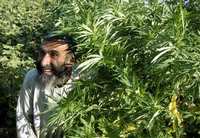
PIC:I believe I MUST post a
pic that will illustrate my point of
view better. So here's an original
pure Indica, an Afghan cultivar in
Mazar-e-Sharif. Supposedly a pure
Indica hash plant, then. I'll let
you check the type of leaf,
internodal distance, and floral
cluster type (from what you can
guess on that pic). |
Last edited by Green Shaman on November
9th, 2004 at 01:05 PM |
 November 9th, 2004
01:03 PM
November 9th, 2004
01:03 PM |
|
|
|
Greenz
Trichome Toker

Registered: Nov 2001
Posts: 975
 |
Originally
posted by Greenz
However, I think (and possibly
c-ray was implying) that cannabis
may be able to evolve in a matter of
a few hundred years.
|
Green Shaman's reply:
"A few hundred years? A couple generations,
you mean."
But then after he said:
"There won't be a genetical change. I never
said there would be. There will be a
difference in phenotypes, and that's all we
can see (nobody's working on Cannabis DNA
mapping here, I guess?). BUT that's also all
we can use to differenciate "Sativas" from
"Indicas" since there IS NO proven genetical
difference"
Alright,
Of course, by evolve, I meant an ACTUAL
genetic change. I mean, I'm pretty sure
everyone already knows that environment can
affect the resulting phenotypes that are
expressed. That's a given. My point is that
if you took seeds of indica origin, then
bred them only for a couple generations in
an equatorial region, the resulting seeds
would not have changed that quickly to a
sativa variety. It's as simple as that. They
might appear more sativa, but that's only
the environments effect on morphology. What
C-ray and I were talking about was an real
genetic change from indica to sativa after
MANY generations of being bred in an
equatorial environment.
Consider this scenerio (expanded version of
my old scenerio):
You've got some "indica" seeds. You live for
200 years. LOL. When you are young, you
decide you want to breed these seeds outside
near the equator. First, however, you grow a
batch of these seeds inside and take note on
the physical structure of the plants
(pictures) and also the flowering time,
potency etc... They appear to be the
"typical indica".Then you start breeding
them outside. You do this for 150 years.
However, after 3 generations you notice that
during these years, the plants outside don't
look exactly the same as the ones you grew
inside three years before. So, you take a
batch of seeds from that years crop and grow
them inside to compare to the batch you grew
the first year. However, the resulting
plants still appear quite similar to the
"indica" plants that you grew three years
earlier inside. You realize it was mostly
just the environment affecting morphology of
your plants outside. You continue breeding
them outdoors. After 150 years, you notice
that your outdoor crop really looks very
different then it did when you first started
breeding them. They are taller, lankier, and
take longer to finish, and have a more
pychoactive high. So, you take some seeds
from the last years crop and decide to grow
them inside again. You grow them inside and
take pictures and take note of the flowering
time etc... This time you notice a big
difference when you compare the pictures to
the plants from 150 years ago. You grew them
exactly the same indoors as you did 150
years ago, but the plants look very
different. Now, they are taller, lankier,
and take much longer on 12/12 to finish.
Here, there has been an ACTUAL genetic
change.
Make sense?

Also,
There obviously is a genetic difference
between indicas and sativas, otherwise there
morphology would be the same if they were
grown in the exact same environment (which
we know from indoor growing). When grown
indoors, varieties of sativa origin appear
sativa, and ones of indica origin appear
indica.
Alright Later guys,
Greenz

|
|
November 9th, 2004
11:47 PM |
|
|
|
Green Shaman
Team Overgrow
Registered: Sep 2001
Posts: 10233
Overgrow Site Mod
|
Okay, here we go again (I think I begin to
like this thread too
).
Strawdog,
Thanks, I know there are alpine varieties as
well as "lowland" varieties in Afghanistan.
You're wrong there, though, as regards the
non-interbreeding of both types. You will
find broad-leave plants only in gardens
where selective pressure is applied, or
where there is no slim-leaved plants growing
wild nearby. The slim-leaved plants are
pulled, is all. "Afghani" refers to so many
types of plants, really...
And the Himalayan Sativas (wild or
cultivated) aren't so different from some
"lowland" types. Check the famous Nepali
Sativa, that is used as a hash plant. Except
the long internodes and meagre yield, it
looks very "Indica", don't you think? It
produces less resin, and the hash is less
"oily", more "dry". But it has the typical
taste and smell of all the hash produced in
the region. There are also lots of
slim-leaved plants in high valleys between
India and Pakistan. These are very resinous
and are used to produce hash as well, so
they're considered "Indica". But
technically, they're very different from the
plants on the other side of the mountains,
like the Citral valley, for instance.
Greenz,
Once again, my point here is that refering
to "Sativa" plants vs "Indica" plants is
futile and definitively artificial.
| My point is
that if you took seeds of indica
origin, then bred them only for a
couple generations in an equatorial
region, the resulting seeds would
not have changed that quickly to a
sativa variety. It's as simple as
that. They might appear more sativa,
but that's only the environments
effect on morphology. What C-ray and
I were talking about was an real
genetic change from indica to sativa
after MANY generations of being bred
in an equatorial environment. |
What you mean here is that the drift of an
oriental lowland, broad-leaved, short
stature type toward a taller, intermediate
or slim-leaved type would take time.
Correct, but don't call such a strain just
"Indica" (as a matter of fact, a good number
of lowland, broad-leaved "Sativas" could
qualify for these "Indica" traits as well).
Because there are LOTS of "Indica" types
that are already quite "Sativa"-like, as
regards leaf, internodes, critical
photoperiod, and possibly other phenotypes.
And such plants grown under tropical
conditions side by side with local
"Sativas", provided the critical photoperiod
isn't too different, would certainly look
very "local" after a few generations only.
You see, it's all about what we call
"Sativa" and what we call "Indica", and each
"type" refers in fact to a quite wide range
of (geographical and human-induced)
variation.
Going from "Indica" to "Sativa":
- On one extreme we have the lowland,
broad-leaved, incredibly resinous hash
plants. The "typical Indicas".
- Then come "intermediate Indicas",
the taller, more lanky or still bushy,
intermediate-leaved hash plants. I would
personally add the North India, North
Africa and Middle-East types in this
category.
- The come the "intermediate Sativas",
somewhat short, bushy and
intermediate-leaved marijuana plants
(South Asia, lowland and "jungle"
types).
- Far on the other "end" of the
spectrum, we have the slim-leaved,
lanky, equatorial and tropical marijuana
plants, the "typical Sativas".
It's all very subjective, in fact, and
telling an "intermediate Indica" from an
"intermediate Sativa" would be impossible in
some cases. If the geographical origin is
unknown, and if you can't see the seeds or
smoke the buds, you can't tell.
Do the test: post pics of phenotypically
intermediate landrace cultivars, IBLs, and
ask everybody what type they are. It's
useless.
Sooo, if I'm not happy with the definitions
of "Indicas" and "Sativas" (Ruderalis would
be a problem, that's why I haven't mentioned
that third type yet), what would be better
descriptions?
Well, in my opinion, we should mention a
marijuana or hash "drug" Cannabis plant, and
its geographical origin. And nothing else.
|
|
November 10th, 2004
12:00 PM |
|
|
|
Green Shaman
Team Overgrow
Registered: Sep 2001
Posts: 10233
Overgrow Site Mod
|
Several types of cultigens, you mean.
Cultivars are just cultivated plants. They
can have a lot in common with wild plants or
be very different. They can be stable,
true-breeding or not.
There's been a lot of work and interest
about Afghan Cannabis and Hashish. Come on,
what you mention here has happened naturally
and artificially simultaneously or not in
lots of different places, not just
Afghanistan. If two distinct populations
that are also two very different types
aren't in contact with each other, as is the
case with many valley plants and their
alpine neighboors, each type preserves its
"typical" traits. But it takes nothing more
than a gust of wind to change that, unless
one type can really not live and prosper in
the other environment. Like, the alpine type
can grow in valleys but the lowland type
will die up in the mountains.
Also, what do you call a "wild" type, and
how do you tell a "wild" indigenous plant
from a feral population that escaped from
cultivated fields, even if it happened long
ago? About when do you consider a population
"wild" and not "escaped" anymore?
It is also funny that the work you mention
does not refer to "wild Sativa". Does this
mean the alpine "Sativas" that grow
naturally in lots of places in the Himalayan
where no man has cultivated them before, and
where cultivated types can't survive, aren't
wild plants?
The truth is, there's a lot of BS in all
this. I have no personal opinion on Mr
Vavilov's work. I also know that there is a
"Russian" "school" of scientists, all
pleading in favor of a split between at
least two distinct subspecies of Cannabis,
vs "the rest of the world" scientists, who
don't agree. Shall we exchange links
regarding Mr Vavilov's studies and how they
are questioned, to say the least, by other
prominent botanists?
I don't want to sound rude, but Vavilov's
work mentions just what I've posted here
too. Let me quote him (I hope he won't mind,
now): "series of races of the typical wild
and typical cultivated forms of hemp show
many overlapping characters", and also that
all transitional forms from wild hemp to
cultivated hemp can be found, and that for
many forms "the morphological limits between
weed hemp and true wild hemp are difficult
to draw, and in regard to the characters of
the fruits, the flowers and the leaves, they
are indistinguishable from each other".
On the other hand, in a brief treatment
dealing with material collected in
Afghanistan, Vavilov and Buchinich (1929)
recognized C. indica as distinct from C.
sativa by small leaves, small fruit, and low
growth. And that's all. Interesting, we know
more today.
I won't cite the complete thing here, but
back in 1926 what Vavilov described met,
let's say, considerable disagreement.
Besides, there have been lots of more recent
studies that show that there can be more
internal variation (chemical constitution)
between plants of a same Cannabis "race" or
"subspecies" (as described by authors like
Vavilov or Schultes) than between plants of
different geographical "races".
You should really abandon these concepts of
"Sativa" and "Indica", and Vavilov was
certainly not the best reference to mention
here. Now a debate between Shultes' work and
was someone like E. Small had to say about
it in 1975 would certainly be more
interesting...
OK, time for my medecine.

|
|
November 10th, 2004
01:28 PM |
|
|
|
strawdog
Cannabis K-9

Registered: Aug 2000
Posts: 3557
|
Originally
posted by Green Shaman
Come on, what you mention here
has happened naturally and
artificially simultaneously or not
in lots of different places, not
just Afghanistan. |
The reason why I am saying this is because
you said...
"I believe I MUST post a pic that will
illustrate my point of view better. So
here's an original pure Indica, an Afghan
cultivar in Mazar-e-Sharif. Supposedly a
pure Indica hash plant, then. I'll let you
check the type of leaf, internodal distance,
and floral cluster type (from what you can
guess on that pic)."
A supposedly pure Indica Hash plant which
obviously has some Sativa influence. I am
just pointing out that it looks like a
recent Indica/Sativa hybrid, no a pure
indica plant.
If two distinct populations that are
also two very different types aren't
in contact with each other, as is
the case with many valley plants and
their alpine neighboors, each type
preserves its "typical" traits. But
it takes nothing more than a gust of
wind to change that, unless one type
can really not live and prosper in
the other environment. Like, the
alpine type can grow in valleys but
the lowland type will die up in the
mountains. |
What you must remember is that something
like a gust of wind should have happened
long ago, thus the contact would have taken
place a long time ago. If the contact takes
place in the now then it is a first or if
they had made contact in the past then
evolutionary development should be evident
somewhere or the offspring may have been
purged, or some of the offspring purged etc.
Anyway the point to make here what happens
in the now is more than likely a man made
influence rather than nature.
| Also, what do
you call a "wild" type, and how do
you tell a "wild" indigenous plant
from a feral population that escaped
from cultivated fields, even if it
happened long ago? About when do you
consider a population "wild" and not
"escaped" anymore? |
It you look at Vavilov's work he explains
how this is done. In fact bonanists do it
all the time by comparing the 'new'
species/strain with what is already out
there - simple as that. If it ain't out
there then it is new. Vavilov found that
with his wild Indica. Landrace strains show
domesticated traits that are not apparent in
their wild counterparts. It is done by
comparison.
| It is also
funny that the work you mention does
not refer to "wild Sativa". Does
this mean the alpine "Sativas" that
grow naturally in lots of places in
the Himalayan where no man has
cultivated them before, and where
cultivated types can't survive,
aren't wild plants? |
Wild plants have no obvious man-made
influences.
Landrace is wild, but has been influenced by
man and is then left to selective breeding
pressures in the wild.
Landrace or Wild when influenced by man,
remaining under man's influence, is
domesticated.
| The truth is,
there's a lot of BS in all this. I
have no personal opinion on Mr
Vavilov's work. I also know that
there is a "Russian" "school" of
scientists, all pleading in favor of
a split between at least two
distinct subspecies of Cannabis, vs
"the rest of the world" scientists,
who don't agree. Shall we exchange
links regarding Mr Vavilov's studies
and how they are questioned, to say
the least, by other prominent
botanists? |
Vavilov is a legend in the world of cannabis
botany. He is the one that actually went out
to make observations of the cannabis plant
in both dometicated and natural habitats. He
followed up on the discoveries of others
which where nothing more than mere samples
to sent to various botany students. Vavilov
studied all the various types of cannabis in
Afghanistan and his own country. R. Clarke
has a couple of hundred pages on the web
devoted to the man.
| don't want to
sound rude, but Vavilov's work
mentions just what I've posted here
too. Let me quote him (I hope he
won't mind, now): "series of races
of the typical wild and typical
cultivated forms of hemp show many
overlapping characters", and also
that all transitional forms from
wild hemp to cultivated hemp can be
found, and that for many forms "the
morphological limits between weed
hemp and true wild hemp are
difficult to draw, and in regard to
the characters of the fruits, the
flowers and the leaves, they are
indistinguishable from each other". |
Okay I see where you are coming from now.
Mr. Small's little 1975 paper on why
cannabis should be treated as one species
"American law and the species problem in
Cannabis: Science and semantics" was a
propaganda tool devised to prevent Americans
from growing Indica who where contesting
that it was not cannabis sativa. To be
honest Mr. Small's paper lacks foundation
because he defines 'species' and we know
that 'species' actually has no defintion.
|
|
November 10th, 2004
02:12 PM |
|
|
|
Unregistered
Guest
Registered: Not Yet
Posts: N/A |
The problem is Taxonomy.
Humans seem to want to lable everything.
Sometimes life is not black and white.
So, we get arguments over what constitutes a
"species."
Wanna get a real mindfuck on the subject...
pick up Darwins "Origins of Species." I got
free beans for anyone who actually reads it
AND comprehends it. LOL.
I'm not sure Darwin even thought species was
a cut and dried issue.
|
|
November 10th, 2004
08:25 PM |
|
|
|
Green Shaman
Team Overgrow
Registered: Sep 2001
Posts: 10233
Overgrow Site Mod
|
Not propaganda, Strawdog, just common sense;
don't let the legal context make you miss
the important conclusion, that is also
accepted by contradictors:
It is fairly easy to point out differences
between a few selected geographical types of
cannabis, or between plants cultivated for
fibers and plants cultivated for drug (in
some cases...), but it's impossible to study
the entire spectrum of variation of this
species and define only two or three
"subspecies". Again, because many characters
overlap bewteen different types, you can't
find reliable ID criteria. And even if you
managed to create a collection of absolutely
all the cultigens you could find, you
couldn't separate them in only two or three
main groups.
Taxonomy isn't carved into stone. New
techniques appear that make scientists
reconsider what seemed granted.
However, the current possibilities of
science do not permit a split between
several species of Cannabis, and because of
the high variability of populations, it is
not even possible to separate the types in
only a couple of "subspecies". All you can
do, at best, is trace back the history and
genetic lineage of a population. This will
show you how it is different from another
population, but that's all. You won't find
enough things in common between several
populations to separate them from others at
the level of a species or even a "race".
Because you won't be able to point out what
defines that "race", really.
This is a fact, you can't ignore it. All the
field work, that is very valuable, that took
place only makes this problem more evident:
too much diversity.
|
|
November 11th, 2004
02:18 PM |
|
|
|
Uncle Bug
Junior Member


Registered: Sep 2004
Posts: 92
|
A recent genetic study by Hillig shows that
there are two major gene pools of Cannabis
with different geographic ranges. The indica
gene pool includes both narrow leaflet
"sativa" and wide leaflet "indica" drug
strains. It also includes eastern Asian hemp
(fiber/seed) landraces and wild or feral
Himalayan populations. The sativa gene pool
includes hemp landraces from Europe and
central Asia, and feral European
populations. It might also include
"ruderalis" populations from central Asia.
Both gene pools appear to have accumulated
mutations over a long period of time.
Last edited by Uncle Bug on March 31st,
2005 at 03:38 PM |
|
November 12th, 2004
01:04 AM |
|
|
|
|
All times are GMT. The time now is 02:50
PM. |
  |
|
|
Provided & Serviced by
Heaven's
Stairway
|

 Magazine



 Sponsors
 Bongs
Bongs.gif)



 except the wild/landrace side of things.


