Chimera
Cannabis Researcher
  

Registered: Jan 2001
Posts: 1315
Overgrow Moderator
 |
 Hi Beast
You've just discovered the biggest myth
(IMNSHO) of marijuana breeding- it is a
mistake that almost EVERYONE
makes (including many of the most respected
breeders!).

Backcrossing will not stabilize a strain at
all- it is a technique that SHOULD be used
to reinforce or stabilize a particular
trait, but not all of them.
For eg- G13 is a clone, which I would bet my
life on is not truebreeding for every, or
even most traits- this means that it is
heterozygous for these traits- it has two
alleles (different versions of a gene). No
matter how many times you backcross to it,
it will always donate either of the two
alleles to the offspring. This problem can
be compounded by the fact that the original
male used in the cross (in this case
hashplant) may have donated a third allele
to the pool- kinda makes things even more
difficult!
So what does backcrossing do?
It creates a population that have a great
deal of the same genes as the mother clone.
From this population, if enough plants are
grown, individuals can be chosen that have
all the same traits as the mother, for use
in creating offspring that are similar (the
same maybe) as the original clone.
Another problem that can arise is this-
there are three possiblities for the
expression of a monogenic (controlled by one
gene pair) trait.
We have dominant, recessive, and co-dominant
conditions.
In the dominant condition, genotypically AA
or Aa, the plants of these genotypes will
look the same (will have the same phenotype,
for that trait).
Recessive- aa will have a phenotype
Co-dominant- Aa- these plants will look
different from the AA and the aa.
A perfect example of this is the AB blood
types in humans:
Type A blood is either AA or AO
Tybe B blood is either BB or BO
Type AB blood is ONLY AB
Type O blood is OO.
In this case there are three alleles
(notated A, B, and O respectively).
If the clone has a trait controlled by a
co-dominat relationship- ie the clone is Aa
(AB in the blood example) we will never have
ALL plants showing the trait- here is
why:
Suppose the clone mother is Aa- the simplest
possibility is that the dad used contributes
one of his alleles,
let us say A. That mean the boy being use
for the first backcross is either AA or Aa.
We therefore have two possibilties:
1) If he is AA- we have AA X Aa- 50% of the
offspring are AA, 50% are Aa. (you can do
the punnett square to prove this to
yourself).
In this case only 50% of the offspring show
the desired phenotype (Aa genotype)!
2) If the boy being used is Aa- we have Aa X
Aa (again do the punnett square) this gives
a typical F2 type segregation- 25% AA, 50%
Aa, and 25% aa.
This shows that a co-dominant trait can ONLY
have 50% of the offspring showing the
desired trait (Aa genotype) in a backcross.
If the phenotype is controlled by a dominant
condition- see example #1- all 100% show the
desired phenotype, but only 50% will
breed true for it.
If the phenotype is controlled by a
recessive condition- see example #2- only
25% will show the desired phenotype, however
if used for breeding these will all breed
true if mated to another aa individual.
Now- if the original dad (hashplant) donates
an 'a' allele, we only have the
possibilities that the offspring, from which
the backcross boy will be chosen, will be
either Aa or aa.
For the Aa boy, see #2.
For the aa boy (an example of a test cross,
aa X Aa) we will have:
50% aa offspring (desired phenotype), and
50% Aa offspring.
Do you see what is happening here? Using
this method of crossing to an Aa clone
mother, we can NEVER have ALL
the offspring showing the desired phenotype!
Never! Never ever ever!
 Never!! LOL

The ONLY WAY to have all the offspring show
a Aa phenotype is to cross an AA individual
with an aa individual- all of the offsrping
from this union will be the desired
phenotype, with an Aa genotype.
Now, all of that was for a Aa genotype for
the desired phenotype. It isn't this
complicated if the trait is AA or aa. I hope
this causes every one to re-evaluate the
importance of multiple backcrosses- it just
doesn't work to stabilize the trait!
Also- that was all for a monogenic trait!
What if the trait is controlled by a
plygenic interaction or an epistatic
interaction- it gets EVEN MORE
complicated. AARRGH!!!!
Really, there is no need to do more than 1
backcross. From this one single backcross,
as long as we know what we are doing, and
grow out enough plants to find the right
geneotypes, we can succeed at the goal of
eventually stabilizing most, if not all of
the desired traits.
The confusion arises because we don't think
about the underlying biological causes of
these situations- to really understand this,
we all need to understand meiosis.
We think of math-eg 50% G13, 50% hashplant
Next genertion 50% G13 x 50% g13hp or (25%
G13, 25%HP)
We interpret this as an additive property:
50% G13 + 25% G13 +25% HP = 75% G13 and 25%
hashplant
This is unfortuneately completely false- the
same theory will apply for the so called
87.%% G13 12.5% HP next generation, and the
following 93.25% G13, 6.25% HP generation;
we'd like it to be true as it would make
stabilizing traits fairly simple, but it
JUST DOESN'T work that way. The above is
based on a mathematical model, which
seems to make sense- but it doesn't- we
ignore the biological foundation that is
really at play.
I hope this was clear, I know it can get
confusing, and I may not have explained it
well enough- sorry if that is the case, I'll
try to clear up any questions or mistakes I
may have made.
Have fun everyone while making your
truebreeding varieties, but just remember
that cubing (successive backcrosses) is not
the way to do it!
-Chimera
[Edited by Chimera on 07-18-2001 at 10:00
AM]
|
April is the cruelest month,
breeding |
|
 July 18th, 2001 05:40
PM
July 18th, 2001 05:40
PM |
|
|
|
Guest
Registered: Not Yet
Posts: N/A |
Very nice Chimera
Would you explain further please?
"The above is based on a mathematical model,
which seems to make sense- but it doesn't-
we ignore the biological foundation that is
really at play."
Please elaborate, and thanks for all the
knowledge on breeding you provide here. I
hope they realise what and how much you are
doing.
Peace and good buds
Greenhands
|
|
July 18th, 2001 07:05
PM |
|
|
|
Guest
Registered: Not Yet
Posts: N/A |
 complex lol
that was a good way too show how all this
happens but that was to detailed,you could
have explained it alot easier,that was alot
of concentraiting,lets keep it simple eh??
|
|
July 18th, 2001 07:21
PM |
|
|
|
Chimera
Cannabis Researcher
Registered: Jan 2001
Posts: 1315
Overgrow Moderator
|
Too Complex? ouch!
I tried to keep it simple lol. I'll plead
bubblehash.

Unfortuneately aussidoc, it is a complex
issue and I know of no way more simple to
explain it. Maybe this will help:
Greenhands- I enjoy it- and I must admit
that this issue is one of my pet peeves, so
I don't mind trying to clear it up!
Let us consider a hypothetical situation
where cannabis has two chromosome pairs (in
reality there are 10 pairs), but for
simplicity we'll consider only two.
Each parent contributes a single copy of
each of the two chromosomes to the
offspring's initial cell. Everytime the
cells are about to divide, each of the
chromosomes duplicates itself (this process
is known as mitosis- please search this on
the net to fully understand the process- It
will surely be there, and the pics will
help). The chromosomes line up along the
metaphase plate (mid-cell), and then 1 of
each of the duplicated copies goes to
opposite ends of the cell. We now have 2
exact copies of the 2 sets of chromosomes (2
pairs), but they are at opposite ends of the
cell. The cell then splits down the middle,
form two cells, which are identical in all
respects (for our purposes anyhow).
Cells grow and divide, grow and divide, etc.
untill a mature plant has formed and is
ready to reproduce. When the reproductive
structures have formed on both sexes, some
cells will perform the initial steps of
mitosis, but there is a slightly different
process which occurs. This is known as
meiosis.
Here's a pic...
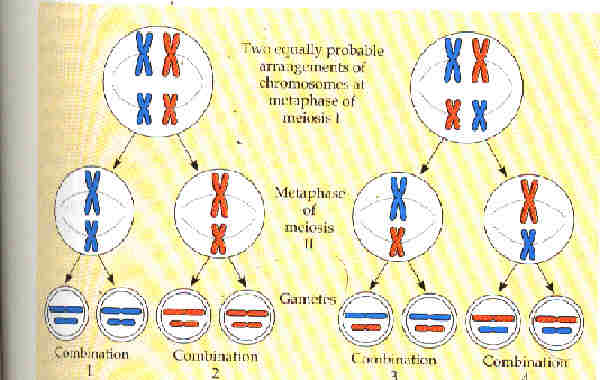
[Edited by Chimera on 07-18-2001 at 12:33
PM]
|
April is the cruelest month,
breeding |
|
|
July 18th, 2001 08:31
PM |
|
|
|
Chimera
Cannabis Researcher
Registered: Jan 2001
Posts: 1315
Overgrow Moderator
|
Now we're cooking!
Alright.
Now, as you can see from the picture, our
cell has a red set (let's say initially from
mom) and a blue set (initiall contributed
from dad). The picture really isn't perfect,
because it has only 1 set of each- at this
stage it should have two, but we'll pretend,
OK?
Let's assume that there is a picture before
the one above, where our cell has two sets
of two- it then divided along the vertical
axis to give the top portion of the above
pic- let's say the original chromosomes are
on the left, and the copies are on the right
of the diagram.
This is where meiosis is different from
mitosis- Instead of copying the chromosomes
again, they just split and have only 1 copy
of each chromosome, instead of two. The
result is depicted on the bottom portion of
the picture.
Why?
Because these cells will become gametes-
pollen or ovules (akin to sperm of eggs)-
they only need 1/2 of the regular amount of
DNA, because when the pollen from one plant
fertilizes the ovule from another, they will
come together to make a full set!
These 1/2 sets of DNA are packaged into
seperate cells, which become either pollen
(male sex cells) or ovules (female sex
cells).
So the gametes are represented by the bottom
portion of the pic.
Now- back to backcrossing!
OK, now imagine the F1 boy- being used as
our backcross male individual- has one set
from the mom (red), one set from the dad
(blue). When he makes his gametes (sex
cells) as pollen, he can either package the
red set (mom), or the blue set(dad) into the
pollen- he actually makes both, in equal
proportions.
For simplicity we'll say the the mom's
chromosome pairs are identical- she is
completely homozygous. In her sex cells
there are only sets of red chromosomes,
which are also packaged as a 1/2 set in each
ovule.
When fertilization occurs, the male donor
(F1 boy) can donate the red set, in which
case the new zygote (the new cell that is a
result of this union- this is the new
offspring) that forms will be the same as
the mom
OR
he donates the blue set, in which case the
offspring will be the SAME AS THE F1
individual.
How is this possible? According to the math
model, the offspring should all be 75% mom,
25% dad, right? WRONG!
The mathematical model implies that the
chromosomes are NOT discrete units, which
they are. It implies that they mix like you
are mixing 1/2 of a glass of juice and 1/2
of a glass of water in a new glass to get
1/2juice, 1/2 water, and then mixing 1/2 of
the juice/water mixture with 1/2 a glass of
juice to get 3/4 juice, 1/4 water. This
isn't what is happening- they chromosomes
don't mix, they remain seperate discrete
units.
Our biological model shows that the BX1
(Backcross 1) offspring are either like the
F1, or like the mom, or anywhere in between.
If they are like the F1 generation, this
same this will happen again when they
themselves go to reproduce!
This point shows why it is of utmost
importance to CHOOSE the proper individual
when selecting a backcross parent, otherwise
we might not get the chromosomes we want.
Our goal is to remove the male's
contribution, and select only for the
chromosomes (and thus genes) from the mom.
Improper selection fails to remove the
influence of the male (blue chromosomes).
Now- that model has two sets of chromosomes
there are actually 10 pairs- there is a
50/50 chance, for each chromosome, that we
will get the contribution from the dad, and
not the mom.
So you see, it is possible that the Bx1 and
Bx2 offspring can still have 1/2 of their
chromosomes (DNA, genes) from the dad, or
they can have 100% of their chromosomes from
the mom, or they can have any percentage in
between.
For this reason, the 75% mom, 25% dad
assumption is NOT ALWAYS true - it CAN
be (rarely), but not always, or even often.
And even when it is true, it doesn't mean
that 75% of the plants will look exactly
like mom, and 25% will look exactly like
dad. It doesn't even mean that plants will
have 75% of the traits of mom and 25% traits
of dad- we then have to take dominance,
recessive and co-dominace into account like
in the first post! Again, AAARGH!
Phew, this breeding stuff is a lot of work
eh?
To do it properly, you don't just pick any
male and backcross! You have to test each
male, by crossing it and growing the
offspring- the only way (other than using
molecular techniques) to see if it is the
right male is to cross it and grow out the
kids, and then infer from the offspring if
the male was good. If not, grow out the
cross of another male, and another, and
another untill you get it right.
What is the probability that the male will
donate all of the chromosomes of the mom?
There is a 50/50 chance for each chromosome.
So for the first chromosome the probability
is 1/2.
Same for the second cromosome- peobability
of mom's chromosome is 1/2.
The probability of both of these events
occuring together, is 1/2 X 1/2= 1/4
What if we include #3? =1/2 x 1/2 x 1/2= 1/8
#4? = 1/2 x 1/2 x 1/2 x 1/2=1/16
All 10 from mom? Which is the point right?-
no contribution from dad!
=1/2 x 1/2 x 1/2 x 1/2 x 1/2 x 1/2 x 1/2 x
1/2 x 1/2 x 1/2 =
1/1024 chance!!!
That means only 1 out of every 1024 plants
we grow out from the bx1 generation will
have ALL the genes from the mom! That SUCKS!
And that is only a statistical number- we
made need to grow out and test more, or
less, depending on chance.
The 1024 number is if we want all traits
from the dad in ONE generation, so by
spreading out fixing the traits over
multiple generations, we can grow out less
plants and select less traits at once.
Oh yes, I forgot! (you'all love this I'm
sure hehe)
That 1024 number? That was our male- since
we are now filial breeding, we also need a
female that has the same genetic
condition/makeup for thise traits- SO DOUBLE
IT!!!
That's right double it hahahahahahah! 2048
plants, to find a female and a male that
suits our needs.
We can also try to only fix some traits at a
time- maybe all the traits we are looking
for are on 3,4, or 6 chromosomes- That will
bring the probabilities down significantly.
So Beast- how do we do it properly?
We choose the plants from that bx1
generation, and start to filial breed- we
cross two and get our F2 generation, and
from these we choose our F3 generation and
so on untill the line has been stabilized
for all traits.
A hell of a lot of work I'd say!
I'm sure this is even confusing - heck I'm
confused right now! LOL
There may be acouple of flaws in there - I'm
tired right now (and high on bubble
hash- I'll get you yet bubble man! lol), but
I'll look at it again in a bit to make sure
it makes sens. I hope it puts into
perspective just why cubing or successive
backcrosses won't necessarily mean a
truebreeding strain will result.
Take it easy everybody!
-Chimera
[Edited by Chimera on 07-18-2001 at 01:53
PM]
|
April is the cruelest month,
breeding |
|
|
July 18th, 2001 09:41
PM |
|
|
|
Guest
Registered: Not Yet
Posts: N/A |
GREAT THREAD GUYS!!!!
as degreed person, i must say that there
have been a number of the 'OG vets' who have
really supplied some great info the last
couple of weeks particularly. wonderful use
of a thread. one problem though, reading
this thread killed my buzz. think i'll try
some hindu kush.
|
|
July 18th, 2001 11:49
PM |
|
|
|
Guest
Registered: Not Yet
Posts: N/A |
 enthalpy, entropy, chaos, and IBL's
anybody.
enthalpy, entropy, chaos, and IBL's
anybody.
trying to create order from randomness are
we. for awhile, you may, but momma nat will
win. i've always found i've enjoyed the
pursuit best. just trying to egg you guys on
a little more. all in the pursuit of
information and experience, john.
|
|
July 19th, 2001 11:27
AM |
|
|
|
|
All times are GMT. The time now is 03:53
PM. |
  |
|
|
 
|
Pages
(3): [1]
2
3
» |
Provided & Serviced by
Heaven's
Stairway
|

 Magazine



 Sponsors
 Bongs
Bongs.gif)