Sylvie
 |
 |
 |
 |
 |

|
|
Sylvie |
| |||||||||
|
|
| ||||||||
|
| ||||||||||
Satin. Feathers. Fur. Lace. No matter what storms may brew, what heatwaves rage, twice a year those haute couture creations are strutted out by an army of highly-paid Glamazons.
But if the inner circle of haute couture has always floated in its own orbit, more or less oblivious to the outside world, this Autumn-Winter 95-96 season a little glimmer of modern reality has seeped into the sanctum sanctorum. The naming of British bad boy, John Galliano, as the replacement for the retiring Hubert Givenchy set the tone for a general reappraisal of fashion's finest art. Givenchy, now 68, set up his influential couture House in 1952. Since 1988, it has belonged to luxury goods group Louis Vuitton Moët Hennessy, whose president Bernard Arnault had signed Monsieur de Givenchy to a seven-year contract. The appointment of Galliano who, since moving to Paris in 1993, has consistently hit fashion headlines with his bias-cut dresses and inspired tailoring, may mark a major change in haute couture's direction. Dressed in silky pyjama pants, a piratical vest and hair flung back in dramatic dreadlocks, 35 year old Galliano explains, "I intend to inject a lot of myself into the House, but with the utmost respect for Monsieur de Givenchy and all he's done."
 The aging of couture's elite clientele - there are estimated to be only 2000
left in the world, compared to 20,000 in 1943 - and the (mis)conception that
haute couture is all about what Galliano skeptically calls 'heavy, constipated,
beaded numeros', is of concern to most of the leading Houses. Across the board,
from Saint Laurent to Chanel, via Laroche, Givenchy and Lacroix, this season saw
an easing up of ornamentation, and a return to the couture basics of adroit
cutting, luxury of fabrics and emphasis on the female form. Still far from
austere, the most skillful among them managed to flaunt an evident opulence
while steering clear of ostentation.
The aging of couture's elite clientele - there are estimated to be only 2000
left in the world, compared to 20,000 in 1943 - and the (mis)conception that
haute couture is all about what Galliano skeptically calls 'heavy, constipated,
beaded numeros', is of concern to most of the leading Houses. Across the board,
from Saint Laurent to Chanel, via Laroche, Givenchy and Lacroix, this season saw
an easing up of ornamentation, and a return to the couture basics of adroit
cutting, luxury of fabrics and emphasis on the female form. Still far from
austere, the most skillful among them managed to flaunt an evident opulence
while steering clear of ostentation.
Full proof that (relatively) less can mean spectacularly more came from Christian Lacroix. Another of Arnault's protegés, since his house was formed in 1987, Lacroix has become known for his gaudy clashing colours and textures as much as the admirable confidence of his cut. But this season he put aside his fetish colours and patterns in favour of a controlled collection of even-paced elegance, opting for myriad blacks, combined in different shades, fabrics and textures. While hips and busts thrust out from bondage-esque bustiers, and a spectacular Infanta silhouette received rapturous applause, it was a couple of understated floor-length sheaths, sensually flowing around ecstatic models, that best represented Lacroix's new-look.
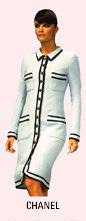
 At Versace and Chanel, as well, things looked a little more decontracté.
Versace left the rock n' roll rebel look behind him, going instead for an almost
all-white collection of glittery full-zippered robes. At Chanel, Karl Lagerfeld
seemed to be reapproaching the basics of Coco's couture legacy. His media-savvy
tactics - the bouclé hotpant suits, the vinyl knee-boots and the rhinestone
bikinis - all seemed things of the past as endless variations on the wool suit
shimmied by. In pale pastel blues, pink and greys, jackets stretched to
mid-thigh while skirts and dresses continued sensibly to the knee.
At Versace and Chanel, as well, things looked a little more decontracté.
Versace left the rock n' roll rebel look behind him, going instead for an almost
all-white collection of glittery full-zippered robes. At Chanel, Karl Lagerfeld
seemed to be reapproaching the basics of Coco's couture legacy. His media-savvy
tactics - the bouclé hotpant suits, the vinyl knee-boots and the rhinestone
bikinis - all seemed things of the past as endless variations on the wool suit
shimmied by. In pale pastel blues, pink and greys, jackets stretched to
mid-thigh while skirts and dresses continued sensibly to the knee.
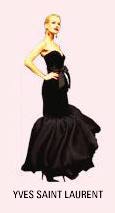
In the same way, Yves Saint Laurent emphasized impeccably clean-lined tailoring and simple draped-on-the-body effects. Detailing was kept to a bare minimum. But Yves himself appeared dazed and confused as he took his obligatory bow before being led backstage by a herd of sympathetic supermodels. A sure sign that haute couture is in need of new blood.

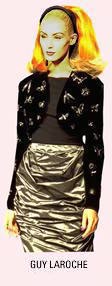
Enter Michel Klein, stage left. For two years now, Klein has been working on the flagging fortunes of Guy Laroche, and this season sent out his most refreshing collection yet. Engaging a dialogue with couture history, but remaining thoroughly modern, Klein presented garments of unparalleled youthfulness, humour and simple joie de vivre. But while Klein has in the past been accused of ignoring haute couture's 'need' for opulent excess, this collection was not without its flourishes of flamboyance. A simple velvet sheath dress, once the model turns, is backed by a trailing taffeta skirt. A sumptuous flamingo pink trench coat, when opened, sets the retinas spinning with a lining of orange marabou feathers. The skill is in Klein's ability to make such potentially garish garments appear like something a real woman might wear. And it's precisely this modern audacity, built upon a firm base of couture skill, that now sets Guy Laroche apart.
This is also the aim of Bernard Arnault in appointing John Galliano couturier, and giving him total creative control, at Givenchy. Hubert de Givenchy's final haute couture collection was witnessed by an impressive gathering of his colleagues - including Saint Laurent, Lacroix, Paco Rabanne, Oscar de la Renta and Valentino - and was a graceful finale to 43 years of creativity. Some of the trademark looks were there - the lush velvet little black dresses, swathes of stiff taffeta and improbable bustles of silk - but it was the overall feeling of sublimely confident cutting, of attention to detail and understated elegance that really marked the passing of a master. But in true testimony to the attention-span of fashion's aficionados, no sooner had the lab-coated Givenchy turned his back and walked off with his army of similarly-clad assistants, than talk quickly turned to his successor.
Valentino says Galliano doesn't "technically know
everything about how to make a dress". Versace reckons John's 'a genius',
but has doubts about his self-control. Others are already speculating that
Arnault has just picked him up to thrust the venerable house into the media
spotlight, enabling LVMH to take on Arnault's Goliath - Karl Lagerfeld.
 If spotlight's all
they're after, they've got that already. Galliano's hard clubbing habits and
young rebel status are well established in fashion circles, and the ostensible
cause of several past business failures. But the last two years have seen the
once unreliable small prêt-à-porter house climb to unbelievable heights,
receiving unprecedented popular cognoscenti and, most importantly, client
accolades. Each new collection is strutted out by a barrage of supermodels who
donate their time for the pleasure of working with the boy wonder. Fashion
Editors scramble for scarce places at his shows, and resort to tears if they
can't get in. This is the boy Bernard Arnault wants. He is also the boy haute
couture needs, to, as Galliano puts it, "kick it into the 21st century!"
If spotlight's all
they're after, they've got that already. Galliano's hard clubbing habits and
young rebel status are well established in fashion circles, and the ostensible
cause of several past business failures. But the last two years have seen the
once unreliable small prêt-à-porter house climb to unbelievable heights,
receiving unprecedented popular cognoscenti and, most importantly, client
accolades. Each new collection is strutted out by a barrage of supermodels who
donate their time for the pleasure of working with the boy wonder. Fashion
Editors scramble for scarce places at his shows, and resort to tears if they
can't get in. This is the boy Bernard Arnault wants. He is also the boy haute
couture needs, to, as Galliano puts it, "kick it into the 21st century!"
Edward Fox. All Photos: Tony Amos