Sylvie
 |
 |
 |
 |
 |

|

|
Sylvie |
| |||||||||
|
|
| ||||||||
|
| ||||||||||
 Cardin, Pierre (1922-), French
couturier and master merchandiser who realized that fashion authority and
designer identity could be translated to a wide realm of products. Cardin was
born in San Biagio di Callatla, north o f Venice, on July 2, 1922. He was raised
in St-Étienne, France, and studied architecture in Paris, later switching to
fashion design. He was employed by a Vichy tailor during the German occupation
and in 1944 moved to Paris. After working for the couture houses of Paquin,
Schiaparelli, and Dior (he also designed the costumes for Jean Cocteau's 1946
film, La Belle et la bête, or Beauty and the Beast), Cardin established his own
couture business in 1950. He opened Eve, a boutique for women, in 1954 (followed
by an Adam boutique for men in 1957), and he launched ready-to-wear clothing
collections in 1959, the first time a top-ranked couturier had ever done so. In
his 1950s designs, geometry predominated, in the guise of, among other things,
boxy jackets that comprised barrel and bubble shapes in rough, heavy fabric. In
the 1960s Cardin was enamored with the space age and thrilled by its
implications for clothing technology. A fashion visionary, he was interested as
well in the possibilities of unisex or similar clothing for men and women (including
helmets and goggles), in the radical simplification of clothing via the
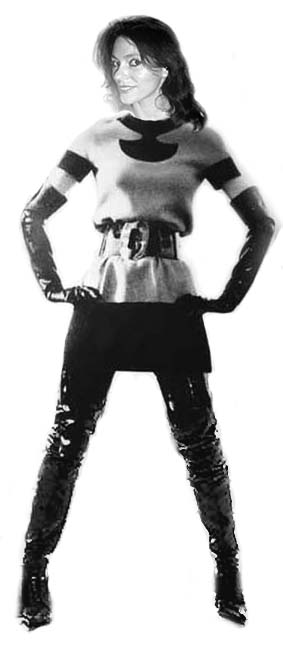
elimination of adornment, and in body exposure, sometimes through vinyl inserts
and apertures in clothing, frequently in clinging bodysuits, short skirts, and
tunics. His 1960s style was largely astronaut-futurist, in keeping with the
era's scientific advances, its space exploration, and its love of science
fiction. In the middle of the decade Cardin equally embraced contemporary art,
taking his inspiration from both pop art and op art. His fundamental conception,
however, always came from tailoring: it was his sensibility for the clean cut of
clothing that allowed him to experiment with clothing as cones, cylinders, and
other geometric forms, or as flat fields that invited the influence of
contemporary painting, and with the invention of futuristic shaping around the
body. Avoiding ornamentation, Cardin used bright color in conjunction with
assertive design to create virtual semaphores in his distinctive clothing.
Cardin was better known for his commercial acumen than for his clothing
creations. Through the 1960s and 1970s (and, to a lesser extent, into the 1980s
and 1990s), the Cardin name proliferated on ventures and licensed products as
diverse as menswear, home furnishings, fragrance and toiletries, restaurants,
entertainment, and luggage, with more than 500 licensees expanding the Cardin
reputation and style. Cardin's interests in the arts encompassed other
disciplines besides fashion: in 1970 he bought Les Ambassadeurs, a 1930s Paris
boîte, and transformed it into the Espace Pierre Cardin Théâtre, a multimedia
complex including a cinema, concert hall, art gallery, and experimental theaters.
He also wrote a book on the French painter Fernand Léger in 1971 and was a
UNESCO ambassador in 1991. Cardin was the first designer to realize fully the
possibility of franchising fashion to become a comprehensive lifestyle. If
Cardin's clothing was a radical reconsideration of apparel, his view of the
world and his influencewhich by the 1990s was truly international, with
businesses on every continentwere no less radical: he captured a modern
imagination for the best in unadorned, visible structural simplicity, taking the
principles of modern design to a universal audience with colossal success. At
once, Cardin was an accomplished couturier, a global businessman, and a dreamer.
Cardin, Pierre (1922-), French
couturier and master merchandiser who realized that fashion authority and
designer identity could be translated to a wide realm of products. Cardin was
born in San Biagio di Callatla, north o f Venice, on July 2, 1922. He was raised
in St-Étienne, France, and studied architecture in Paris, later switching to
fashion design. He was employed by a Vichy tailor during the German occupation
and in 1944 moved to Paris. After working for the couture houses of Paquin,
Schiaparelli, and Dior (he also designed the costumes for Jean Cocteau's 1946
film, La Belle et la bête, or Beauty and the Beast), Cardin established his own
couture business in 1950. He opened Eve, a boutique for women, in 1954 (followed
by an Adam boutique for men in 1957), and he launched ready-to-wear clothing
collections in 1959, the first time a top-ranked couturier had ever done so. In
his 1950s designs, geometry predominated, in the guise of, among other things,
boxy jackets that comprised barrel and bubble shapes in rough, heavy fabric. In
the 1960s Cardin was enamored with the space age and thrilled by its
implications for clothing technology. A fashion visionary, he was interested as
well in the possibilities of unisex or similar clothing for men and women (including
helmets and goggles), in the radical simplification of clothing via the
elimination of adornment, and in body exposure, sometimes through vinyl inserts
and apertures in clothing, frequently in clinging bodysuits, short skirts, and
tunics. His 1960s style was largely astronaut-futurist, in keeping with the
era's scientific advances, its space exploration, and its love of science
fiction. In the middle of the decade Cardin equally embraced contemporary art,
taking his inspiration from both pop art and op art. His fundamental conception,
however, always came from tailoring: it was his sensibility for the clean cut of
clothing that allowed him to experiment with clothing as cones, cylinders, and
other geometric forms, or as flat fields that invited the influence of
contemporary painting, and with the invention of futuristic shaping around the
body. Avoiding ornamentation, Cardin used bright color in conjunction with
assertive design to create virtual semaphores in his distinctive clothing.
Cardin was better known for his commercial acumen than for his clothing
creations. Through the 1960s and 1970s (and, to a lesser extent, into the 1980s
and 1990s), the Cardin name proliferated on ventures and licensed products as
diverse as menswear, home furnishings, fragrance and toiletries, restaurants,
entertainment, and luggage, with more than 500 licensees expanding the Cardin
reputation and style. Cardin's interests in the arts encompassed other
disciplines besides fashion: in 1970 he bought Les Ambassadeurs, a 1930s Paris
boîte, and transformed it into the Espace Pierre Cardin Théâtre, a multimedia
complex including a cinema, concert hall, art gallery, and experimental theaters.
He also wrote a book on the French painter Fernand Léger in 1971 and was a
UNESCO ambassador in 1991. Cardin was the first designer to realize fully the
possibility of franchising fashion to become a comprehensive lifestyle. If
Cardin's clothing was a radical reconsideration of apparel, his view of the
world and his influencewhich by the 1990s was truly international, with
businesses on every continentwere no less radical: he captured a modern
imagination for the best in unadorned, visible structural simplicity, taking the
principles of modern design to a universal audience with colossal success. At
once, Cardin was an accomplished couturier, a global businessman, and a dreamer.
Les artistes et les grands
couturiers indépendants qui créent les collections uniques et des
avant-gardes. Elles abordent les sujets tabous et elles sont inspirées de l'art
de différents cultures et subcultures.
"LES TENDANCES VERS LA CONSCIENCE DIFFÉRENTE"
Quant, Mary (1934-), English
fashion, textile, and cosmetic designer who was instrumental in popularizing the
"mod" style of "swinging London" in the 1960s. Quant was born in Blackheath,
London, on Feb. 11, 1934, the daughter of Welsh-born teachers. From 1950 to 1953
she attended Goldsmiths' College of Art in London, where she met Alexander
Plunket Greene, whom she married in 1957. In 1955 Quant, Greene, and
photographer Archie McNair opened a boutique called Bazaar on the King's Road in
Chelsea, London's art district.
Dissatisfied with the clothes she could buy for herself or her boutique, Quant
began making young, colorful clothes for herself and Bazaar. In the late 1950s
her bright, cheeky sportswear typified the mod (an abbreviation of "modern") or
"Chelsea" look. Britain's leadership in the 1960s "youth revolution" of rock
music and stylespearheaded by the Beatles and the Rolling Stoneswas affirmed by
young British fashions, especially Quant's dazzling color blocks, spare
silhouettes, bright tights, skinny-rib sweaters, vinyl boots, low-slung belts,
and short skirts (by 1966, the miniskirt). Even her idea of a lively,
small-scale boutique (in opposition to department stores and big specialty
stores) addressing the tastes of a young audience became an global phenomenon in
the 1960s and 1970s, as Bazaar expanded and was widely imitated. In 1966 she
also started a line of cosmetics aimed at the youth market.
Quant audaciously stated that "Good taste is death, vulgarity is life," so denying staid fashion and advocating the young, disestablishment, swinging London philosophy. Although most identified with the 1960s, Quant continued to design knitwear, underwear, hosiery, and many other fashion items and accessories for decades afterward. Her books include the autobiography Quant by Quant (1966), Color by Quant (1984), and Ultimate Makeup and Beauty (1996).
Les artistes et les grands
couturiers indépendants qui créent les collections uniques et des avant-gardes.
Elles abordent les sujets tabous et elles sont inspirées de l'art de différents
cultures et subcultures.
"LES TENDANCES VERS LA CONSCIENCE DIFFÉRENTE"


