A Journey to Peru
Part 1
Foreword
I cannot simply tell you that I went to Peru, throw twenty
pictures here and leave...
So I decided to try and describe this journey, recall the feelings and the memories. I
tried to say something about the photos you will find here, about the ones that didn't
make it into this page and about those that were not taken at all.
If you are interested, or just curious, enough to read the whole story, I hope I did
manage to communicate these feelings and memories: I would be delighted to know that we
shared a similar experience, that you felt prompted to visit these places, or simply that
you like the pictures.
if nothing of this happens, then well... thanks for coming anyway -and for not telling
anyone how bad this page is...
I had dreamed of visiting the Andes for a long time.
Peru is certainly a place worth more than a visit, for its history, for the vastness of
the highlands and the beauty of the mountains, for its traditions, for the musica
folklorica (although not everyone likes it) not to mention, above everything else,
Machu Picchu. I was actually attracted by all of this.
Of course, as soon as I boarded the plane, full of enthusiasm and
anticipation, I met with a lot of people who almost routinely travel to the most exotic
places, whose passport -their second or third booklet obviously- is full of stamps and
visas. They didn't seem to be too thrilled, and looked upon my excitement with fatherly
condescension.
I hope I will someday be able to talk about hundreds of travels,
like these lucky souls do. This was my first real journey, and I consider it as a major
achievement: I had to wait for a lot of time and to break up with my girlfriend -among
other things- before I could make it. It was June 2001.
Peru is a large country
And I did not visit all of its corners; still, it was a very
intense tour. If you are willing to forgive me a little guidebook-style paragraph, I will
quickly describe it.
It started from Lima, where I arrived on a flight from Europe
through the United States.
Incidentally, I discovered on that occasion that Delta will always show you the same
movies on the same leg -so if you have seen Miss Congeniality between Atlanta and
Lima, you are going to see it again on the way back. I quite like the movie, but I think I
have seen it at least seven times -and always on an airplane...
From Lima I followed the coast southwards to Paracas and Nazca. At
Caman� I turned inland towards Arequipa, whence I went to visit the marvelous Ca�on del
Colca.
I then continued south-east to Puno and the lake Titicaca, and finally to Bolivia. La Paz
was the turning point of the voyage: from there I went north again to Tiawanaku, Cuzco,
Machu Picchu.
The travel ended with the Fiesta del Sol in Cuzco, about three weeks after arriving in
Peru; when the fiesta finished, I slowly returned to Lima to take my flight back home -and
my last dose of Miss Congeniality.
Lima
Lima is a large, chaotic city. It almost feels like one of
"our" cities, even though one can perceive something different -an experienced
traveler would say it is a "typical south-american city", whatever that means.
I remember the excitement of the landing. It was the feeling of
starting an adventure, the promise and the expectation; it was also my fear of flying,
most of all of the landing phase.
As an aerospace engineer, I should probably feel ashamed of this, but everyone has his own
little weakness, I am afraid.
I only spent a few days in Lima, but I still managed to visit its
museums, see the Plaza de Armas, walk along the streets and markets.
I even became addicted to Inca Cola, and went so far as to bring two bottles of this
unlikely yellow beverage back with me; the larger one is two liters and a quarter (which
must mean half a gallon to make any sense), and it was a bit embarrassing to explain what
it was to the Italian customs officers.
I loved the liveliness of this city and its frightening traffic
jams, but I found the climate a bit depressing.
The garua, the mist that wraps the city for about three quarters of the year,
gives everything a gloomy appearance. Streets and buildings are always wet from this
combination of mist and smog; pavements are often slippery (as I had a chance to test on
myself, ahem), and the grayish sky is not really inviting one to take pictures.
I do have one, actually: it was taken in Plaza de Armas, and it would show you both the
architecture and the garua. But I don't like it very much, and space on Yahoo is
limited, so...
After a few days, I found myself longing for the Cordillera. I
wanted to see the mountains: it was a good feeling when I finally started moving along the
Carretera Panamericana.
The Coast
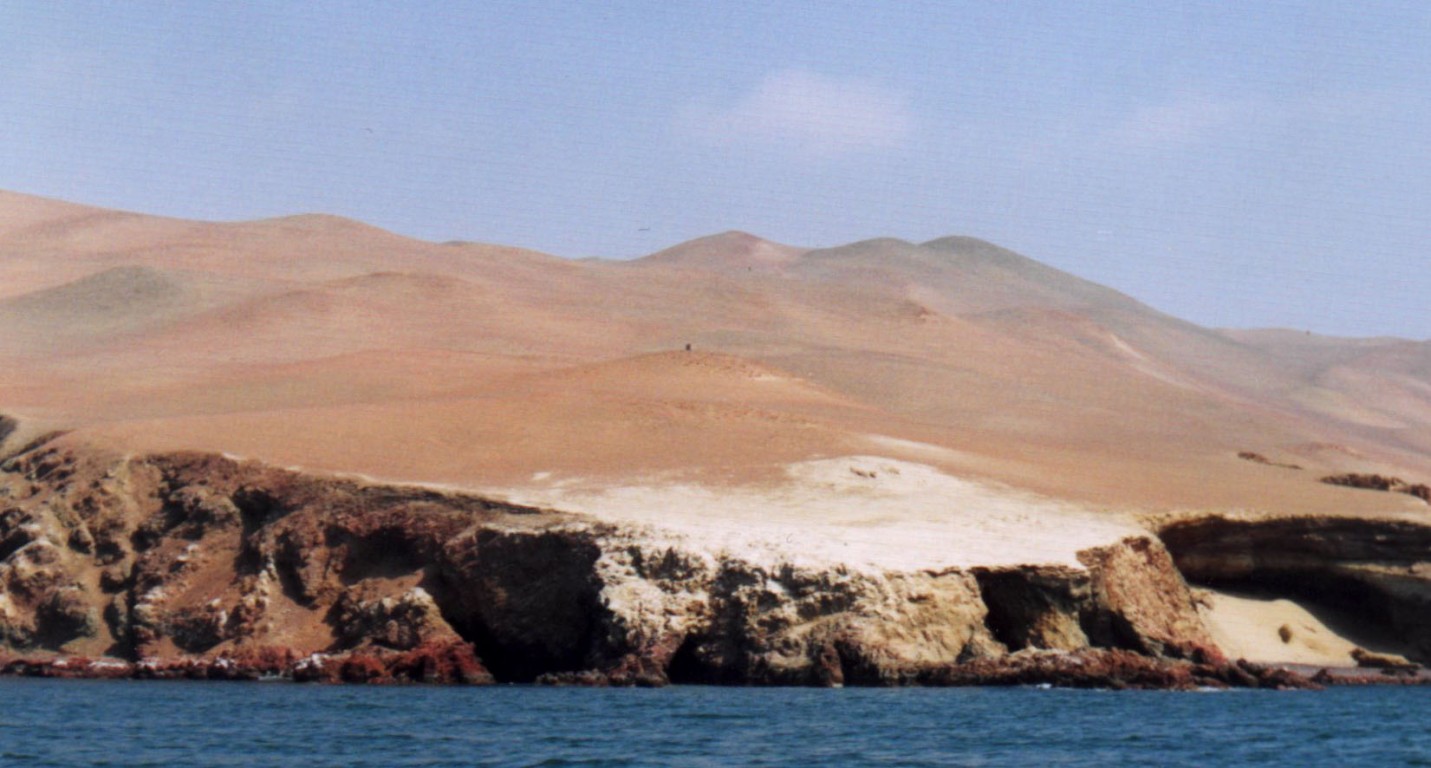
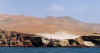
I realize only now that this is the first desert I
ever crossed in my life. Of course I had read that a long stretch of the Peruvian
coastline is actually a desert, but it is so different when you actually see it -and it
lies right on the sea!
The next thing one realizes is that this desert was not really that desert. |
|
|
The desert coastline at
Paracas |
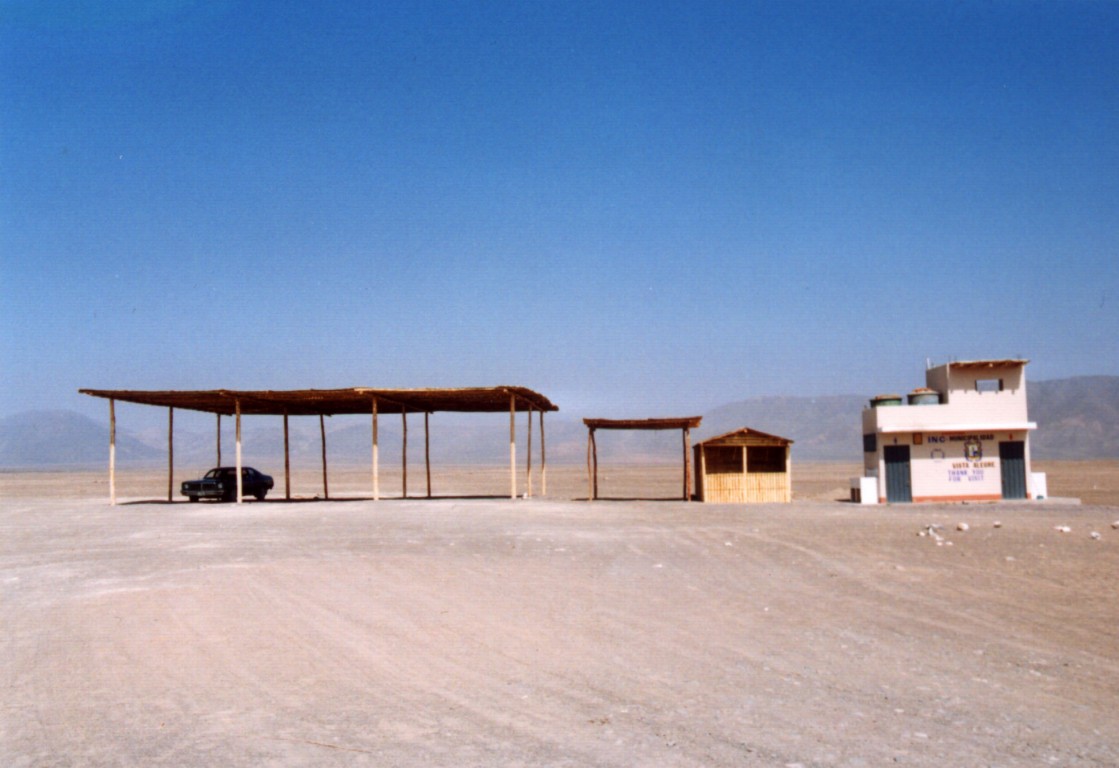
| People had lived there, at least some time ago, and
the extreme aridity preserved even their garments for hundreds of years: you can visit
some of their tombs near Chauchilla. And even if you are not a tomb lover, the place is by
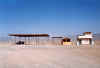
itself worth a visit. The photo shows the "parking lot" at the entrance - there
is absolutely nothing else around... |
|
|
The museum of Chauchilla |
The guide will tell you that the region is full of tombs, most of
which were looted by huaqueros who sell all the treasures to (typically western)
private collectors. Incidentally, Italy used to have the same problem.
They will also explain you the history of the people that lived in the area long ago; I
haven't heard two guides tell me the same story throughout this journey -and none of them
ever said anything that was even close to what I had read on the books, but this was part
of the fun.
Studying the history of Andean peoples is actually as intriguing
as it is difficult. They didn't use an alphabet: written reports or annals simply do not
exist until the arrival of the Spaniards. After that, what documents we have are rather
biased by some strong religious and political opinions.
Anyway, I am not an expert in Peruvian history nor have I got any chance to become one. I
did some reading on the subject before leaving, and it gave me all the information that I
can probably handle on the subject.
If you are interested, my favourite reference is a book written by Nigel Davies and edited
by Penguin; I do not think it is the most comprehensive nor the most updated on the
subject, but I liked it a lot (and no, Penguin don't even know that this web-page exists,
so this is not a paid advertisement).
Nazca
If you were starting to wonder whether I visited Nazca or not,
well -yes, I did. I obviously took a flight to see the famous lines from above, and I
survived it.
There are so many pictures and images of the Nazca
lines that mine are not worth appearing on the web.
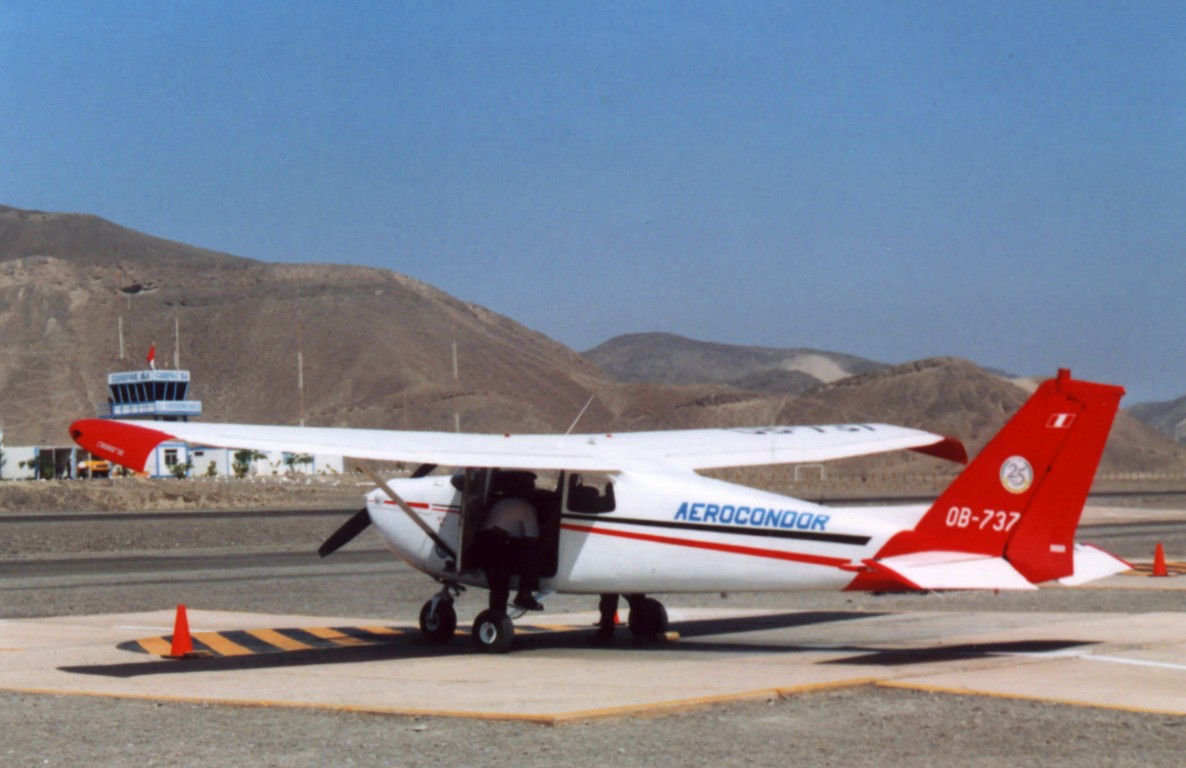
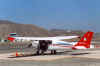
But I want you to give a look at this aircraft, if you ever go there and decide that you
absolutely must see the lines yourself. |
|
|
Aerocondor |
Did I mention that flying scares me? And I was talking about big,
reliable civil jet airplanes. I had never, ever dreamed of boarding a small single-engine
Cessna. I actually did not want to do that, but I could not escape it.
I will not bother you will all that crossed my mind during those
minutes; I remember sitting in the front seat, hearing the pilot as he named all the
shapes in the desert and made all sorts of acrobatics to let us see them better.
I was more than satisfied with the first couple of images, but he mercilessly showed us all
of them; I think that I only felt worse than that on the dentist's chair of tortures...
I also remember the distinct suspect that he switched off the engine right before the
landing. He cannot have done it, I know (you do not remove your only chance of
climbing up again should anything go wrong with the landing)... But right then, my heart
stopped beating as the aircraft bounced on the ground to a complete stop.
To be honest, nothing horrible happened: the pilot clearly knew
his job and the plane seemed to be well looked after. And the lines are really worth the
price.
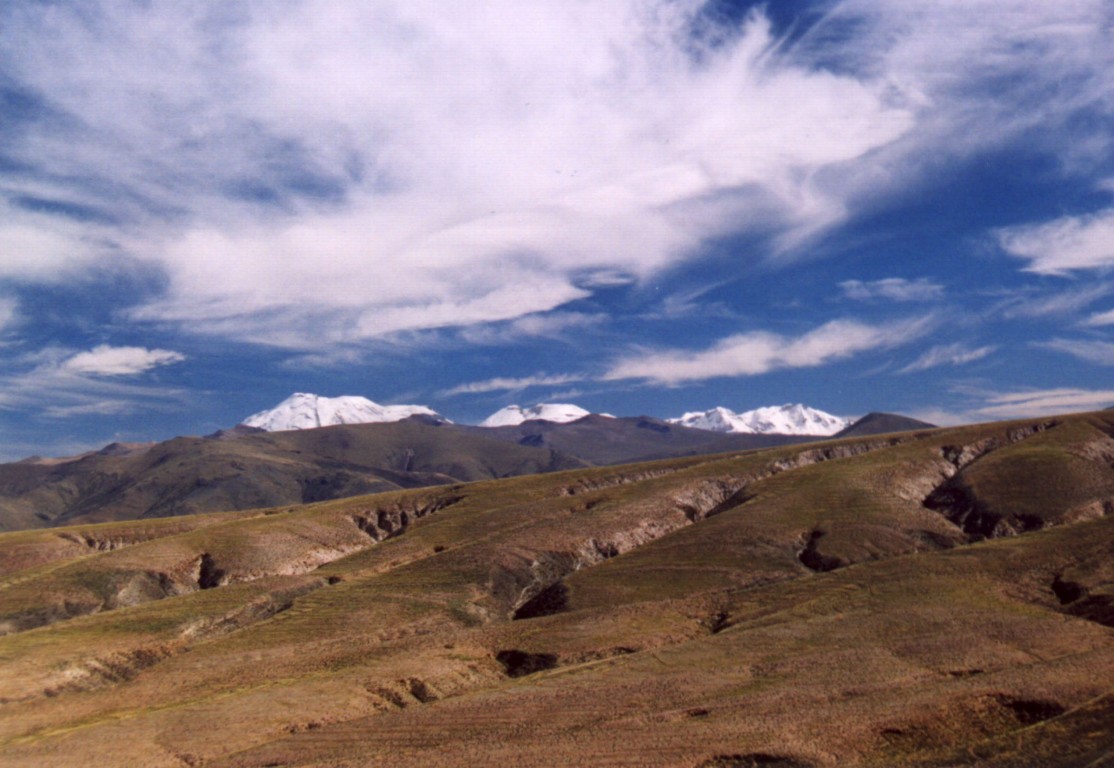
From Nazca I went south to Caman�. I woke up early
in the morning and started to follow the long road to Arequipa.
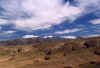
For the first time, I saw the Andes. |
|
|
Los Andes |
| Page maintained by Lorenzo Serafini |
Last update: 31/03/2004 |