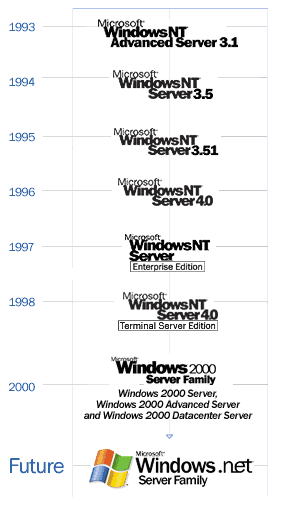
Windows Desktop Operating Systems
Many longtime PC users trace Windows to the 1990 release of
Windows 3.0, the first widely popular version of Windows and the
first version of Windows many PC users ever tried. But Microsoft
actually released the first version of Windows six years earlier, in
1985. To understand the roots of today's Windows operating systems,
we must journey back nearly 20 years.
|
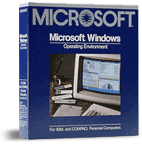
| The
Windows 1.0 product box showed the new tiled windows and
graphical user interface in the operating system |
1985: Windows 1.0
The first version of Windows was a milestone product because it
allowed PC users to switch from the MS-DOS® method of typing
commands at the C prompt (C:\) to using a mouse to point and click
their way through functions, such as starting applications, in the
operating system.
Windows 1.0 also allowed users to switch between several
programs—without requiring them to quit and restart individual
applications. The product included a set of desktop applications,
including the MS-DOS file management program, a calendar, card file,
notepad, calculator, clock, and telecommunications programs, which
helped users manage day-to-day activities.
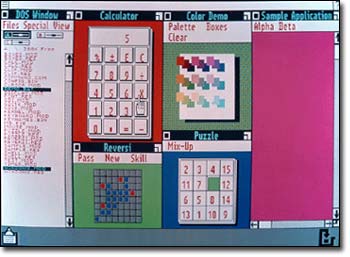 |
| Even before the Windows 1.0
graphical user interface, there was this pre-Windows 1.0
Interface Manager |
With the second version of Windows, Microsoft took advantage of
the improved processing speed of the Intel 286 processor, expanded
memory, and inter-application communication capabilities using
Dynamic Data Exchange (DDE). Windows 2.0 featured support for the
VGA graphics standard, and also allowed users to overlap windows,
control screen layout, and use keyboard combinations to move rapidly
through Windows operations.
Many developers started writing their first Window-based
applications for Windows 2.x. Following the release of
Windows 2.0 was Windows/386 2.03, which took advantage of the
protected mode and extended memory capabilities of the Intel 386
processor.
Subsequent Windows releases continued to improve the speed,
reliability, and usability of the PC, and improved the interface
design and capabilities.
1990: Windows 3.0
Microsoft's first mainstream computing platform offered 32-bit
performance, advanced graphics, and full support of the more
powerful Intel 386 processor. A new wave of 386 PCs helped drive the
popularity of Windows 3.0, which offered a wide range of new
features and capabilities, including:
- Program Manager, File Manager, and Print Manager
- A completely rewritten application development environment
with modular virtual device drivers (VxDs), native support for
applications running in extended memory, and fully pre-emptive
MS-DOS multitasking
- An improved set of Windows icons
The popularity of Windows 3.0 blossomed with the release of a
completely new Windows software development kit (SDK), which helped
software developers focus more on writing applications and less on
writing device drivers. Widespread acceptance among third-party
hardware and software developers helped fuel the success of Windows
3.0.
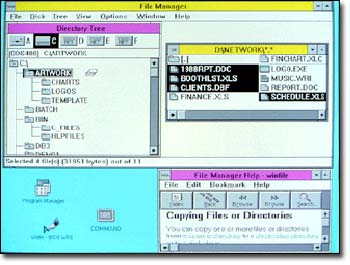 |
| Windows 3.0 featured a new File
Manager |
1993: Windows for Workgroups 3.11
A superset of Windows 3.1, Windows for Workgroups 3.11 added
peer-to-peer workgroup and domain networking support. For the first
time, Windows PCs were natively network-aware and became an integral
part of the emerging client/server computing evolution.
Windows for Workgroups was used in local area networks (LANs) and
on stand-alone PCs and laptop computers. It added features of
special interest to corporate users, such as centralized
configuration and security, significantly improved support for
Novell NetWare networks, and remote access service (RAS). Windows
for Workgroups also offered the performance benefits of Microsoft's
new 32-bit file system.
1993: Windows NT 3.1
The release to manufacturing of Microsoft Windows NT® on July 27,
1993, marked an important milestone for Microsoft. It completed a
project Microsoft began in the late 1980s to build an advanced new
operating system from scratch. "Windows NT represents nothing less
than a fundamental change in the way that companies can address
their business computing requirements," Microsoft Chairman Bill
Gates said at its release.
Windows NT was the first Windows operating system to combine
support for high-end client/server business applications with the
industry's leading personal productivity applications. The operating
system broke new ground in security, operating system power,
performance, desktop scalability, and reliability with a range of
key new features. These included a pre-emptive multitasking
scheduler for Windows-based applications, integrated networking,
domain server security, OS/2 and POSIX subsystems, support for
multiple processor architectures, and the NTFS file system.
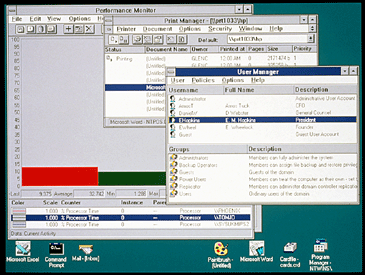 |
| Windows NT 3.1 contained
overlapping windows and other features similar to Windows 3.1 |
The new operating system began with version 3.1 in order to
maintain consistency with Windows 3.1, which at the time was a
well-established operating system for both home and business users.
Windows NT was geared toward business users and was initially
available in both a desktop (workstation) version and a server
version called Windows NT Advanced Server. The desktop version was
well received by developers because of its security, stability, and
rich Microsoft Win32® application programming interface (API)—a
combination that made it easier to support powerful programs.
Windows NT was a strategic platform that could integrate
client/server applications with existing Windows-based desktop
applications, or function as a technical workstation to run high-end
engineering or scientific applications.
1993: Windows NT Workstation 3.5
Windows NT Workstation 3.5 supported the OpenGL graphics
standard, which helped power high-end applications for software
development, engineering, financial analysis, scientific, and
business-critical tasks.
The Windows NT Workstation 3.5 release provided the highest
degree of protection yet for critical business applications and
data. The product also offered 32-bit performance improvements,
better application support, including support for NetWare file and
print servers, and improved productivity features, such as the
capability to give files 255-character names.
1995: Windows 95
Windows 95 was the successor to Microsoft's three existing
general-purpose desktop operating systems—Windows 3.1, Windows for
Workgroups, and MS-DOS. Windows 95 included an integrated 32-bit
TCP/IP stack for built-in Internet support, dial-up networking, and
new Plug and Play capabilities that made it easy for users to
install hardware and software.
The 32-bit operating system also offered enhanced multimedia
capabilities, more powerful features for mobile computing, and
integrated networking. In order to keep memory requirements to a
minimum, it did not include support for such features as
system-level security or Unicode, which came later.
1996: Windows NT Workstation 4.0
This upgrade to Microsoft's business desktop operating system
brought increased ease of use and simplified management, higher
network throughput, and a complete set of tools for developing and
managing intranets.
Windows NT Workstation 4.0 included the popular Windows 95 user
interface and improved networking support, providing secure, easy
access to the Internet and corporate intranets.
In October 1998, Microsoft announced that Windows NT would no
longer carry the initials "NT," and that the next major version of
the operating system would be called Windows 2000.
1998: Windows 98
Windows 98 was the upgrade to Windows 95. Described as an
operating system that "Works Better, Plays Better," Windows 98 was
the first version of Windows designed specifically for consumers.
Windows 98 enabled users to find PC- or Internet-based
information easily, it opened and closed applications more quickly,
and it included support for reading DVD discs and connecting to
universal serial bus (USB) devices.
1999: Windows 98 Second Edition
Microsoft Windows 98 SE, as it was often abbreviated, was an
incremental update to Windows 98. It offered consumers a variety of
new and enhanced hardware compatibility and Internet-related
features.
Windows 98 SE delivered an improved online experience with
Internet Explorer 5 browser software and Microsoft Windows
NetMeeting® version 3.0 conferencing software. It also included
Microsoft DirectX® API 6.1, which delivered a variety of Windows
multimedia improvements, and offered home networking capabilities
through Internet connection sharing (ICS). Windows 98 SE was also
Microsoft's first consumer operating system capable of using device
drivers that also worked with the Windows NT business operating
system.
2000: Windows Millennium Edition (Windows Me)
Windows Me offered consumers numerous music, video, and home
networking enhancements and reliability improvements.
System Restore let users roll back their PC software
configuration to a date or time before a problem occurred. Windows
Movie Maker provided users with the tools to digitally edit, save,
and share home videos. Microsoft Windows Media™ Player 7
technologies allowed users to easily find, organize, and play
digital media.
Windows Me was the last Microsoft operating system to be based on
the Windows 95 kernel. Microsoft announced that all future operating
system products would be based on the Windows NT and Windows 2000
kernel.
2000: Windows 2000 Professional
 Windows
2000 Professional was the upgrade to Windows NT Workstation 4.0, but
it was more than just that. Windows 2000 Professional was designed
to replace Windows 95, Windows 98, and Windows NT Workstation 4.0 on
all business desktops and laptops. Built on top of the proven
Windows NT Workstation 4.0 code base, Windows 2000 added major
improvements in reliability, ease of use, Internet compatibility,
and support for mobile computing. Windows
2000 Professional was the upgrade to Windows NT Workstation 4.0, but
it was more than just that. Windows 2000 Professional was designed
to replace Windows 95, Windows 98, and Windows NT Workstation 4.0 on
all business desktops and laptops. Built on top of the proven
Windows NT Workstation 4.0 code base, Windows 2000 added major
improvements in reliability, ease of use, Internet compatibility,
and support for mobile computing.
Windows 2000 Professional also made hardware installation much
easier than it was with Windows NT Workstation 4.0 by adding support
for a wide variety of new Plug and Play hardware, including advanced
networking and wireless products, USB devices, IEEE 1394 devices,
and infrared devices.
2001: Windows XP
Windows XP is a unifying leap forward for desktop operating
systems. With the release of Windows XP Home Edition and Windows XP
Professional in October 2001, Microsoft succeeded in merging its two
Windows operating system lines for consumers and businesses, uniting
them around the Windows NT and Windows 2000 code base.
With Windows XP, consumers and home users now have performance,
stability, and security that business users benefited from in
Windows 2000.
Windows XP also includes the broad base of application and
hardware compatibility of Windows 98 and Windows Me, while adding
new tech-support technology, a fresh user interface, and many other
improvements that make it easier to use for a broad range of tasks.
Windows XP is available in two main versions, Windows XP
Professional and Windows XP Home Edition, as well as a 64-bit
edition, Windows XP 64-Bit Edition, for power users with
workstations that use the Intel Itanium 64-bit processor.
2001: Windows XP Professional
Windows XP Professional benefits from the long track record of
Microsoft Windows NT technology: superior operating system
performance, including preemptive multitasking, fault tolerance, and
system memory protection.
Windows XP Professional also offers a redesigned interface and
includes features for business and advanced home computing,
including Remote Desktop, encrypting file system, system restore and
advanced networking features. It also offers numerous key
enhancements such as wireless 802.1x networking support, Windows
Messenger, Remote Assistance, and the System Restore feature.
2001: Windows XP Home Edition
Windows XP Home Edition offers a clean, simplified visual design
that makes frequently accessed features more accessible. The product
offers many enhancements aimed at home users such as the Network
Setup Wizard, Microsoft Windows Media™ Player, Windows Movie Maker,
and enhanced digital photo capabilities. |
 Software King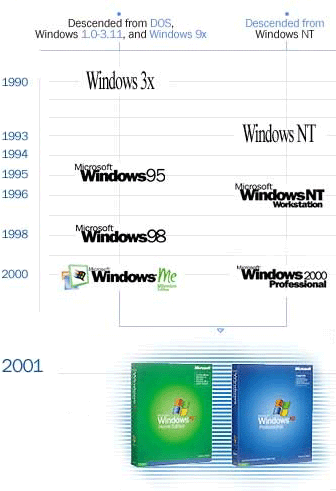
 Bill
Gates unveiled Microsoft's family of Windows 2000 client and server
software at an elaborate launch event in February 2000 that featured
dozens of companies demonstrating Windows 2000–compatible hardware
and software.
Bill
Gates unveiled Microsoft's family of Windows 2000 client and server
software at an elaborate launch event in February 2000 that featured
dozens of companies demonstrating Windows 2000–compatible hardware
and software.