SWORD OF VENGEANCE
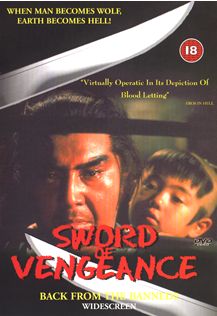
SWORD OF VENGEANCE is the first film in the
world-renowned LONE WOLF & CUB series. If you've never heard
of these films, then you've missed out on one of the greatest
cinematic series of all time. Actually, if you haven't ever seen
these films then that isn't really surprising - they've never
been available in the UK... until now, that is. Artsmagic, a new
UK DVD label, has already released the series on VHS in the UK,
and now they're releasing them to DVD too, through their
'Warrior' label. The first two episodes in the six part series
are available now.
Ogami Itto is the Shogun's official executioner.
He has killed many men for the Shogun, and is a powerful figure,
regarded with much jealousy by other clans, especially the
'Shadow Yagyu' clan. One night, ninja assassins are dispatched to
kill Itto, but they get his wife instead. He finds her dying, and
vows to avenge her. However, men arrive from the Shogun and ask
to see Itto's private shrine. It turns out that he has been
framed by the Shadow Yagyu and Itto is ordered to prepare to
commit 'seppuku' (suicide, by cutting a gash across one's
stomach). Itto offers his child, Daigoro, the choice between a
ball and a sword, fully intending to kill him should he make the
wrong (right?) choice. He chooses the sword, meaning that he must
join Itto on the Road to Hell. When the day of his judgement
arrives, Itto attacks the men sent to force him to commit
seppuku. It quickly becomes obvious that it will take more than a
few men to harm Ogami Itto. He fights lots more men, killing them
all, blood spurting everywhere. Eventually, the Yagyu's best
swordsman, Bizen, attacks Itto, but is killed by Itto's
"suiouryu" technique. Lord Retsudo, the chief of the
Shadow Yagyu, challenges Itto to a duel with his 'sentinel'. If
Itto wins, he goes free. If he loses, then he will be dead. The
duel takes place in a cornfield, the sun high in the sky. Lord
Retsudo thinks that his man will win, since Itto has the sun in
his eyes. However, at the last moment, Itto ducks, revealing his
son behind him. His son is wearing a reflective plate on his
head, which directs the sun into the sentinel's eyes. Itto
decapitiates him, and blood spurts high into the blue sky from
the neck of the dead man, Itto framed in the background.
All of the above is told in flashback during the first part of
the film, but is very necessary to follow the rest of the film,
and indeed the rest of the series. The film actually opens with
an assassin attacking Itto on the road. He runs towards Itto, who
slams his sword into the assassin's forehead. However, the
assassin holds it there, leaving Itto unarmed. "Daizen"
shouts the assassin. Another assassin appears from behind the
first, leaping over him into the air. Itto quickly pulls a spear
out of the 'baby cart' and impales the second assassin on it.
The rest of the film consists of Itto travelling along the Nikko
Road, having being hired to go to 'Gounomori' where a clan's
leader, Lord Noriyuki, is attending a meeting. A rival clan, led
by Chamberlain Sugito is lying in ambush there, with the 'Oyamada
Three', who are great assassins. In the end, Itto fights about 50
men, killing them all! However, the most important aspect of this
first episode is in setting the scene for the rest of the series,
explaining why Itto is banished, and why the Shadow Yagyu clan
are so intent on killing him. These elements will be brought into
the plot again and again as the series develops, in a
surprisingly coherent fashion, almost as if they had been planned
(which they surely hadn't been - the series only continued when
the first parts were very successful).
This series has a fascinating history; in 1972,
Shintaro Katsu (Katsu was the star of the very famous, very
successful and very long run (1962-1972)
'Zaitoichi the Blind Swordsman' series) decided to produce a new
series of 'chambara' (violent samurai films) which would star his
brother, Tomisaburo Wakayama. Kenji Misumi, a fairly famous
Japanese director (he did some of the Zaitoichi films amongst
other things) was brought on board, and Kazuo Koike, a famous
Japanese scriptwriter, was hired to write the screenplay. The
first film made was 'Kozure Ookami - Shinikaze ni Mukau
Ubagurama' (AKA 'Baby Cart to Hades', AKA 'Lupine Wolf').
However, the film was held up by censorship problems, so in the
mean time the team went ahead and made two further episodes in
what would come to be known as the 'Lone Wolf & Cub' (or
sometimes 'Baby Cart') series; 'Kosure Ookami - Kowokashi
Udekashi Tsukamatsuru' (AKA 'Sword of Vengeance', AKA 'Lightning
Swords of Death') and 'Kosure Ookami - Sanzu no Kawa no
Ubagurama' (AKA 'Baby Cart to the River Styx'). These two films,
released within months of each other, were an enormous success
and the first part was released as part 3 in the series. Part IV
- 'Kosure Ookami - Oya no Kokoro Kono Kokooro' (AKA 'Baby Cart in
Peril', AKA 'Heart of a Parent, Heart of a Child') was directed
by Buichi Saito, Part V - 'Kosure Ookami - Meifu Mado' (AKA 'Baby
Cart in the Land of Demons', AKA 'Tread Lightly On the Path to
Hell', AKA 'The Crossroads to Hell') saw Misumi return to the
series, and Part VI - 'Kosure Ookami - Jigoku e Iku Zo! Daigoro!'
(AKA 'White Heaven in Hell', AKA 'Daigoro! We're Going to Hell!')
was directed by Yoshiyuki Kuroda. As the series progressed the
films got more and more violent, and more and more outlandish!
The Baby Cart got guns, and Lone Wolf fought whole armies of men!
However, nothing could beat Part II of the series, which stands
as one of the great achievements of Samurai cinema, Japanese
cinema, and violent film in general. The whole series was
released in only three years (1972-1974), and was followed by
other similar chambara series involving the Lone Wolf
collaborators, most notably the two 'Shurayukihime' ('Lady
Snowblood') films and the 'Goyoukiba' ('Hanzo the Razor') series
(starring Katsu), as well as some unofficial follow-up films many
years later ('Lone Wolf & Cub: Final Conflict', 'Fugitive
Samurai' and 'Lone Wolf Cop: Sex Doll Case'). In 1980, Americans
Robert Houston and David Weisman bought the US rights to the
first two films in the series (Parts I and II) through Roger
Corman's New World film company. They took about 12 minutes of
footage from Part I ('Sword of Vengeance') and about 68 minutes
of footage from Part II ('Baby Cart to the River Styx'),
re-edited it, partly re-wrote the story, dubbed the voices and
added an electronic 'synthesiser' soundtrack by Mark Lindsay. The
resulting film was re-titled 'Shogun Assassin' and released
theatrically to some success. This later became an unofficial
'video nasty', but has now been re-released on DVD in the UK by
VIPCO, uncut.
The most surprising thing about the Lone Wolf
& Cub series is the sheer level of violence. As mentioned
above, there are many excellent chambara series from the 60's and
70's, but none come close to LW&C in terms of violence or
bodycount. The fights are extremely well choreographed, and very
unrealistic! No matter how many men Itto faces, they only attack
one at a time, and nobody ever attacks in an underhand manner.
Tomisaburo Wakayama plays the part of Ogami Itto with relish, and
is absolutely perfect in the role. Indeed, his presence is what
really makes the series work, and it is surprising that more
credit isn't given to him for the series' success. Massive
amounts of blood are on screen nearly all the time, and it's hard
not to think of Akira Kurosawa's famous 'blood fountain' scene in
SANJURO when watching the death scenes in this series. However,
some of the film's (and indeed the series') most impressive
moments come during the brief lulls between fights - we gradually
learn more and more about Itto as the series progresses, and
about his very strict life philosophy. Much of the scenery in the
films is very beautiful and compliments the fights very well.
Some people might find these thoughtful interludes boring, or may
think that they disturb the rhythm of the film, but really they
will be savoured by the discerning viewer. One thing is for sure
- LW&C provides a unique viewing experrience and is something
that you will never forget. In fact, you will more than likely be
hooked, and will want to see the rest of the series, joining the
ranks of the many Baby Cart lovers around the world!
One last thing I should probably mention is the
reason for the series often being referred to as the 'Baby Cart'
series. Before Itto sets off on his endless wanderings, he
fashions a cart for Daigoro from wood - this is never shown, or
explained, but the cart is an enduring feature of all the films.
However, it is no ordinary cart - the thing is fitted with all
sorts of weaponry, from spears at the sides to spikes at the
front, to machine guns (!!!) in later episodes. This strange
conceit is typical of Japanese chambara films - the hero always
has some sort of distinguishing feature for us to recognise,
whether it be blindness (Zaitoichi), One-Armedness ('The One
Armed Swordsman'), a huge penis (!!!) ('The Razor'), or a baby
cart!
 DVD Specification
Original year of release - 1972
Approximate running time - 83m 10s @ 26fps (packaging
states 85 min approx.)
Aspect ratio - Widescreen (~2.35:1)
System - PAL (colour)
Rating - 18 (UK)
Sound - Dolby Digital Stereo
DVD release - Warrior (Artsmagic)
Region Coding - Region 0 (code free)
DVD Extras
Trailers for all six Lone Wolf & Cub episodes
| MAIN
CAST |
|
| Tomisaburo
Wakayama |
"Ogami
Itto" (Lone Wolf) |
| Akihiro Tomikawa |
"Daigoro" |
| Yunosuke Ito |
|
| Fumio Watanabe |
|
| Shigeru Tsuyuguchi |
|
| Tomoko Mayama |
|
| MAIN
CREW |
|
| Director |
Kenji Misumi |
| Producers |
Shintaro Katsu & Hisaharu
Matsubara |
| Screenplay |
Kazuo Koike & Goseki Kojima |
| Music |
Hideaki Sakurai |
| Cinematography |
Chishi Makiura |
| Editing |
Toshio Taniguchi |
| Art Direction |
Akira Naito |
DVD Ratings (out of 5)
Picture - 4
Surprisingly good. I did not have high hopes for this disc,
seeing as how most UK releases from small companies of films that
aren't exactly going to make them rich tend to be rather poor.
However, Artsmagic have put in a more than credible effort with
their first DVD release. For a start, they've released the film
in its intended ratio (full scope, about 2.35:1). This is
essential, since the LONE WOLF series benefits from some of the
most stunning photography and compositions ever seen in Japanese
film. The blood-letting and killing is done in such a stylish
fashion, and in such a carefully composed manner, that to see the
films in any other ratio would be a crime. There is also some
lovely scenery and a few scenes in which much of the action
occurs in the far left/right of the image, meaning it would be
lost were the film to be cropped for 4:3 presentation. There is
no anamorphic enhancement, but to expect it would be most
unrealistic.
How much credit should be assigned
to Artsmagic is not easy to say - they have basically purchased
the UK rights to AnimEigo's original US transfers, and converted
them to PAL. Since AnimEigo had already done all of the work
involved in hunting down the best prints, cleaning up the image,
translating, subtitling, etc. Artsmagic were not really left with
a terribly difficult task. Still, it is cheering that a small
company in the UK has taken the time and effort required to make
the LONE WOLF series look as good as it should do, and hasn't
simply settled for half measures, like so many other small UK DVD
companies.
The UK DVD's seem to be almost
identical in terms of picture quality to the US laserdiscs,
suffering perhaps very slightly from the NTSC - PAL conversion.
The subtitles for the film are presented in the bottom matte bar,
meaning that widescreen TV owners like me won't be able to fully
blow the image up to fit their screen. Also, AnimEigo provide
useful supertitles from time-to-time, which explain unusual
Japanese terms for the viewer. Obviously, in order to see both
the top and bottom bars on a 16x9 TV, the image must not be too
blown up.
Sound - 3
Dolby Digital Stereo. Fine. Some slight hissing early on, but
otherwise perfectly clear. To be honest, the film doesn't make
all that much use of sound; there isn't even much music, so it
doesn't play too important a part in the proceedings. More than
adequate.
Extras - 2
Nothing much. A trailer for the film, plus trailers for all five
other films in the series. The trailers aren't the original
theatrical trailers, but are new ones cobbled together by
Artsmagic to promote their releases. AnimEigo's US laserdisc
releases did not contain trailers either, or indeed any other
extras, but did include very useful, thoroughly researched liner
notes. It would have been nice for us to have been given these,
as they really were very informative. However, it is possible to
download them from http://www.animeigo.com/SamLiner/
Overall Rating - 4
A seminal film is given an unexpectedly decent UK DVD release.
Sadly, the BBFC have chosen to trim 6 seconds from it, but still
for anyone who is in any way interested in Japanese film, or
Samurai film, this series is an essential purchase. Good A/V
presentation is slightly let down by poor extras (a poster
gallery would have been nice), but still holds its own against
the US laserdisc. If you've only ever seen this film as SHOGUN
ASSASSIN, or - Heaven forbid! - you haven't ever seen it at all,
then there is nothing to stop you from buying and enjoying this
DVD.
Film Tag Lines
When man becomes wolf, earth becomes hell! (DVD)
AKA
'Kosure Ookami - Ko Wo Kashi Ude Kashi Tsukamatsuru'
(Japanese title)
'Lightning Swords of Death' (USA)
Lone Wolf and Cub: Child and Expertise for Rent (literal
English title)
Lone Wolf and Cub: Sword of Vengeance (USA)
Alternative versions
Outside of Japan, the only official release of the series was in
the USA, where AnimEigo released all six parts through their
'Samurai Cinema' label. The films were released to both VHS and
laserdisc, and are rumoured to be coming to DVD next year.
The film SHOGUN ASSASSIN (1980) as already mentioned, consists of
about 10 minutes of this film, and the rest from Part II (BABY
CART TO THE RIVER STYX).
Movie Facts
Producer Shintaro Katsu was the star of such films
as the 'Zaitoichi - the Blind Swordsman' series and the
'Goyoukiba' ('Hanzo the Razor') series, and was the brother of
Tomisaburo Wakayama (who plays Ogami Itto in the LONE WOLF
films).