THE STENDHAL SYNDROME
THE
STENDHAL SYNDROME represented Argento's return to Italy, following his brief
period in the US (TWO EVIL EYES, TRAUMA). It is a film of re-acquaintances for
Argento - once again he was working with his daughter Asia. Once again he was
working with music maestro Ennio Morricone (who hadn't worked with Argento since
1972 on FOUR FLIES ON GREY VELVET). Once again he was working with Sergio
Stivaletti, his FX genius and budding protégé (Stivaetti was given the
directing reigns for THE WAX MASK by Argento when Lucio Fulci sadly passed
away). Once again he was working with Luigi Cozzi, his friend, FX assistant and
assistant director. And once again he was working with the great Franco Ferrini,
giallo writer extraordinaire! The film was given a much larger budget than is
usual for Argento, and was the first Italian film to feature CGI (computer
generated imagery) effects.
Asia plays Anna Manni, a police inspector on the
case of a serial killer/rapist. She goes to Florence, where she takes in the
sights and visits an art gallery (the Uffizi Gallery). Whilst looking at a
painting (The Fall of Icarus by Breugel), she experiences a severe
faint, imagining the painting coming to life. This is the titular 'Stendhal
Syndrome' (named after the French writer Stendhal, who suffered from the
syndrome and was the first to write of it) - a sufferer will faint when exposed
to beautiful works of art. The killer (called Alfredo Grossi) meets her whilst
she is ill, and befriends her. He rapes her later and rapes and kills a
prostitute. She returns to Rome, where she finds herself unable to return to a
normal life, and in an increasingly disturbed mental state. Meanwhile, another
girl, a prostitute, is killed. Alfredo captures Anna and rapes her once again,
and keeps her prisoner, tied to a bed. He leaves for a while, and when he
returns she fights back, in the most violent scenes of the film, stabbing his
neck, goring his eye out, kicking him, shooting him and beating him with the gun
butt, then finally kicking him down a hill, and over a cliff into a river far
below. However, is he really dead? The thought taunts Anna and she finds herself
even more confused. Her French boyfriend (called Marie) is killed, and she is
driven over the edge... To say more would spoil the twisty ending for anyone who
hasn't seen the film, so at this point I shall stop.
The story of STENDHAL is one of Argento's most
contrived (though it has to be pointed out that the source material was a novel
- La Sindrome di Stendhal by Grraziella Magherini), which is saying
quite a lot! The whole premise of the syndrome itself is somewhat unbelievable
and is almost irrelevant to the 'real' story, coming across more as a gimmick
than as an effective plot device. The twists in the story are in one way
effective, and in another way laughable. It's hard to decide whether or not the
film succeeds in walking the tightrope between these two extremes, but either
way it will keep you guessing (almost) to the end. Interestingly, the film is
not a giallo in the truest sense of the phrase - in a giallo, the murderer is
always unknown, and is only revealed at the end. However, in STENDHAL, we are
shown almost from the beginning exactly who the murderer is (though we still get
a rather silly scene from the killer's POV in which he stalks like the killer in
Fulci's NEW YORK RIPPER for no obvious reason!!!), although the film employs
enough giallo elements and twists to just about qualify.
The use of computer graphics in the film is a
real mistake. Argento's violent scenes have always succeeded very well using
traditional effects (even the rubber arm scene in TENEBRE still looks great to
me), and it's a bit of a shame that he felt the need to resort to CGI. His next
film, THE PHANTOM OF THE OPERA, made use of CGI to even worse effect. The first
use of CGI is quite effective, with Asia literally going into the painting,
diving below an ocean, and meeting a strange ugly fish which kisses her! I like
this scene a lot, but sadly the rest are a bit silly. There's a totally
pointless and very silly looking effect when Asia takes some pills which is
supposed to show them traveling down her throat. There's the much-touted effect
when Alfredo shoots a girl though the mouth (from one side to the other) in slow
motion - this is quite an effective shot, but still seems somehow out of place
and silly. There's a scene in which we see Alfredo's reflection in a bullet as
it's fired - again, this is quite effective, but just doesn't gel with the rest
of the film. A scene which really does stand out is the narrative-jumbling one
in which Asia walks through a door in her apartment wall which has appeared
where a painting was. She wanders through and out into a confused street scene,
with police running about. She interacts with her colleagues, despite being
dressed for bed and sees a murdered girl in a car. All the while, the open door
remains in the side of a building, light pouring out. This scene is hugely
confusing initially and only later does one realise that this was a flashback,
and explains her reasons for being at the gallery at the start of the film. This
is typical Argento - playing with the audience's expectations, and making the
viewer feel most disconcerted. Great stuff, and it's a shame that the rest of
the film doesn't keep this standard up.
At this point I should probably state that I am
in no way a fan of Asia Argento - I don't find her particularly attractive and I
think her acting stinks! Laying all that aside, I still feel that she is the
main problem in this film. She seems to just sleepwalk through scenes, giving
the impression of someone whose heart is not really in what they're doing. One
reviewer called her performance in the film 'catatonic' and I think this just
about sums it up for me too. I found her quite acceptable in TRAUMA, a film
which I seem to like better than most people. Since then, she just seems to go
downhill - awful in this film, and downright terrible in PHANTOM. Her
non-Argento performances seem to be much better - she was one of the only good
things about Ferrara's awful NEW ROSE HOTEL (Christopher Walken being the
other!), and was enjoyable in B MONKEY. For some reason she just seems to make
no effort in Argento's films. Some blame for her performance in this film must
lie on the fact that she was dubbed by another actress. The dubbing seems to
have been recorded with the actress speaking in a constant hissing whisper, and
this detracts from her even more. Thomas Kretschmann's turn as the psycho is
also not terribly gratifying - he fails to convince in the nastier scenes,
whilst seeming uncomfortable in the normal scenes. However, he doesn't really
get much screen time, and can't really get too much of the flak! Argento's
strong point has never been directing actors, but in this film more than any of
his others it is a problem.
The film is still much better than many critics
would have had you believe. I remember clearly some of the very strong reviews
that were written, condemning Argento in every possible way. I think that a lot
of the disappointment that people felt was related to their very high
expectations for Argento's return to Italy and the giallo (though TRAUMA is very
much a giallo, even if it is Americanised). Argento approaches a difficult
subject with some tact, and was undoubtedly very brave in casting his daughter
as the rape victim. The film does have its supporters, and seems to be gaining
more appreciation with time, but I still don't think anyone could honestly
compare it to TENEBRE or DEEP RED.
Overall then, the film must be considered a bit
of a failure - there are some glimpses of Argento's genius, yes, but sadly not
enough to make up for the bad acting, silly effects, dodgy contrived story and
poor ending. There are some plus points - Morricone's lovely score, some
attractive photography, some effective violence, but overall the negatives
outweigh the positives, in my opinion. I am a fully-blown Argento apologist, but
I still find this film, after several viewings over the past few years, to be
Argento's least effective work. I even prefer PHANTOM, and that's saying
something! I'm looking forward to I CAN'T SLEEP with great enthusiasm. Hopefully
Argento can give us a true return to the classic gialli for which he is known
and (rightly) revered.
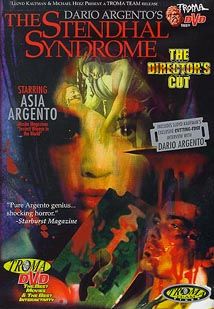 DVD Specification
Original year of release - 1996
Approximate running time - 113min.
Aspect ratio - Widescreen (1.66:1)
System - NTSC (colour)
Rating - Unrated
Sound - Dolby Digital Stereo (2.0)
DVD release - Troma
Region Coding - Region 0 (code free)
DVD Extras
Interview with Argento by Lloyd Kaufman
(Troma President)
Interview with Argento by Ronny Svensson
Interview with Sergio Stivaletti (FX)
Interview with Ruggero Deodato (!?)
Film bio's of Argento and Asia Argento
Troma extras (Troma Rap Feat. Julie Strain, Troma Studios Tour, TIT 2,
Tromaville.com, The Radiation March)
Theatrical trailers, including THE STENDHAL SYNDROME
Special introduction to the film, by Lloyd Kaufman
Liner notes about the film by Cliff McMillan
Picture gallery
| MAIN CAST |
|
| Asia Argento |
Anna Manni |
| Thomas Kretschmann |
Alfredo Grossi |
| Marco Leonardi |
Marco Longhi |
| Luigi Diberti |
Chief Inspector Manetti |
| Veronica Lazar |
Marie's Mother |
| MAIN CREW |
|
| Director |
Dario Argento |
| Producer |
Dario Argento, Guiseppe Colombo |
| Music |
Ennio Morricone |
| Cinematography |
Guiseppe Rotunno |
| Story |
Dario Argento, Franco Ferrini |
| Screenplay |
Dario Argento |
| Editor |
Angelo Nicoloni |
DVD Ratings (out of 5)
Picture - 3
This is a hard one to call. Firstly, there has been much debate over the
letterboxing of the film. The correct aspect ratio as I understand it is 1.66:1.
The French DVD (more about this below) is letterboxed at 1.85:1, whilst the
Japanese laserdisc was letterboxed at 1.66:1. This release is also presented at
1.66:1. However, there has been some suggestion that Troma could not obtain a
film print and had to work from an older panned-and-scanned print, which they
then masked off to give the appearance of letterboxing. This does not seem at
all likely to me. For a start, there are several points in the film when
imperfections are visible at the edges of the print. Had the print been matted
off, these would have been covered up. Also, I have compared it to the Japanese
laserdisc, and the amount of material visible both at the top and bottom and the
sides seems to be the same. The print used by Troma looks very similar to that
used for the laser, with similar tones and colours. Leaving all this aside, what
about the picture quality? Well, overall I was quite impressed by the disc. Many
people slagged the DVD off without actually having seen it (remind you of
anything?) and I think that they have been proven wrong. Yes, Troma aren't
exactly renowned for their quality, letterboxing or general attention to detail.
But, they seem to have made a real effort with this disc. Had Anchor Bay or a
similar company released it, we would probably have a better disc. However, the
presentation is more than adequate - the image is quite sharp. Colours are
well-defined. There isn't much grain, or noise in the print. If anything, the
main complaint one could level at the image is that it seems generally a bit
washed-out. However, to be more critical about the image would be without
grounds. Troma have done quite a good job with the film and have probably
provided the best quality transfer possible working with their resources and
manpower. I've given it a '3', mainly because the film is quite recent, and it's
not as if Troma have had to do a restoration job or anything. Really, when a
film is only a few years old it should be possible to get a better transfer than
this. However, as I've said before, one has to bear in mind Troma's limited
resources. Lack of anamorphic enhancement is also a minus point.
Sound - 3
2-channel stereo. Perhaps we could have expected more from a film as recent as
this, but the stereo track Troma give us is more than up to the job. Morricone's
excellent score (his best in some time) sounds fantastic. I'm very grateful that
Troma didn't put a mono track on the film (I wouldn't have put it past them!)
The track is clear, free from hiss and generally very good.
Extras - 3
There has been some bitching concerning the extras that Troma have dug up for
this release. I would not really agree with any of this as I feel Troma's extras
are more than up to the job. The interview by Kaufman is surprisingly revealing,
with Argento speaking very frankly about many issues. I've seen and read many
Argento interviews, but still found this one both interesting and educational.
Argento comes across very well, friendly, humorous and interesting, whilst
Kaufman, although undoubtedly annoying, is still quite engaging (though he does
insist on calling the film THE STONDHOL SYNDROME!!! Argento says some very
complimentary things about Troma, and says that he'd much rather his film got a
limited release in its intended form than that the film got a big release, but
was cut. He also says that he has no interest in making a Hollywood film
(hooray!) The Svensson interview is likewise very worthwhile, with Svensson
asking some intelligent searching questions, and Argento once again coming
across very well. The Stivaletti interview is quite good, not as good as the
Argento ones, but then that is probably only to be expected. Why there is a
Deodato interview on the disc is anyone's guess, but it's always nice to see
material like this. The interview is quite good, but the subtitles appear to
summarise a lot of dialogue in few words. The hidden Argento footage is probably
the worst extra, as it's poorly filmed, the sound isn't very good, and the
questions are more mundane. The film bio's are reasonable, though obviously most
people buying this disc won't need them. You also get lots of Troma extras for
your money. I can't say that I'm much of a Troma fan (an understatement
perhaps!), but it's still more extras. We also get the original trailer for the
film, plus trailers for other Troma films. The introduction to the film by Lloyd
Kaufman is the only bit of intrusive Tromabilia - quite why he chose to add this
is beyond me, but it adds nothing to the film, and its tone is quite
inappropriate for the (quite seriously themed) film that follows.
Overall Rating - 3.5
Troma have done a fair job of bringing one of Argento's lesser works to US DVD
in the form that its director intended (well, nearly!) Uncut Argento films are
always welcome, and this even more true when they're on DVD. A good package of
extras backs up the presentation, with some surprisingly revealing interviews.
The menu screens are nice, quite attractively designed, and very easy to
navigate. Chapter selections are animated and the whole disc seems well put
together. Packaging is also quite attractive, though it always seems strange to
see the Troma symbol next to Argento's name! The disc is particularly welcome
given the appalling state of the UK DVD - cut to bits and poorly packaged. The
French DVD is undoubtedly a good alternative but for anyone who doesn't like
having French sub's on the picture, or who is concerned about possible incorrect
framing (though that issue hasn't necessarily been resolved with this disc
either...) the Troma DVD is a solid buy. Also, it's very cheap ($17.50 from DVD
Express!) and provides good value for money. Sure, it's not an Anchor Bay
standard release, but it's leagues above the UK releases of Argento's films to
date, and is much better than one would have expected from Troma. A '3.5' would
probably be more appropriate, but I would round up to a '4' rather than down to
a '3'!
Film Tag Lines
"The colour of fear is... silver!" (original Italian tag line;
'Argento' means silver in Italian. Also, this is a play on words due to the fact
that the giallo is traditionally associated with the colour yellow)
AKA
LA SINDROME DI STENDHAL (Italian language title)
Alternative versions
Up until now, this has been a surprisingly difficult film to get hold of uncut
in the UK. GUILD released it on video in the UK a few years ago, but they
heavily cut it (to the tune of 2 minutes and 47 seconds!!!) before submitting it
to the BBFC, who passed it without further cuts. This was a pan-and-scan video.
Guild not only cut most of the violence but also seemingly edited the film at
will, removing any narrative coherence that was originally present.
The most common uncut version was the Japanese laserdisc released by Columbia
Video. This was letterboxed at about 1.66:1, but was taken from a poor quality,
dark print. The film was in English, with Japanese subtitles.
An uncut, pan-and-scan version was released in Italy by Medusa Video.
Last year, a UK company (Marquee Pictures) released the film to DVD. The
original release was completely uncut (the distributors having mistakenly
believed that the film had been passed uncut by the BBFC, and had therefore not
been cut previously), though pan-and-scan. It had a black-and-white picture on
the disc. This was hastily withdrawn and the butchered Guild release was issued
instead, which had a red picture on the disc.
A French DVD was released earlier this year by Pioneer. This was uncut, but letterboxed
at 1.85:1. This was also 16x9 enhanced. The print used was English language, but
the French subtitles are not removable (though apparently they don't show up on
certain players).
Movie Facts
The film not only stars Argento's younger daughter Asia, but also involved his
elder daughter Fiore (who played the girl killed at the beginning of PHENOMENA)
- she worked as line manager on the filmm.
Both Bridget Fonda and Jennifer Jason Leigh were first considered for the role
that Asia Argento finally won.
Easter Eggs
Keep pressing 'up' on the main menu till the razor blade above the options is
highlighted. Press ENTER. You will now see footage of Argento at a film festival
in Stockholm.
Awards
Nominated for the "Best Genre Home Video Release" by the Academy of
SF, Horror and Fantasy Films, USA.
Official Site
For
more info
on Argento
and his
films
visit DARK
DREAMS