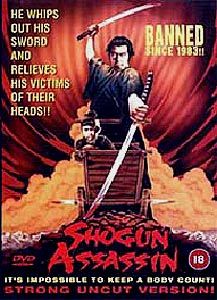
 DVD Specification
Original year of release - 1980
Approximate running time - 83 min. (at 26 fps)
Aspect ratio - Approx. 1.7:1
System - PAL (colour)
Rating - 18 (UK)
Sound - Dolby Digital (1.0)
DVD release - VIPCO
Region Coding - Region 0 (code free)
SHOGUN ASSASSIN
The film starts with 'Lone Wolf', a masterless samurai, traveling with his young son, Daigoro. Daigoro narrates the film, telling of how they are pursued by ninja. We are then told of their history; Lone Wolf was the chief executioner for the Shogun. His wife Azame was killed by the Shogun's ninja leading to a great fight between Lone Wolf and the Shogun's men. The Shogun offered Lone Wolf the chance to win his freedom by fighting a duel with one of his sons, Lord Kurando. Lone Wolf decapitated him in a corn field. Pursued by the Shogun's ninja, Lone Wolf constructs a 'baby cart' which looks like a wooden pram but features lots of built-in weapons (the best being blades that come out of the bottom sides of the cart, chopping ninja's feet off above the ankles!) Lone Wolf is hired to find and kill the Shogun's brother, who is travelling with the 'Masters of Death', three undefeatable warrior brothers, each of whom has his individual weapon; one has a club with nails sticking out of it; one has a glove with 'Freddy Kreuger' style claws; and one has studded gloves. Lone Wolf encounters them on a ship, which is set alight forcing him to abandon them for now. He follows them to a desert. Meanwhile, the men of the house that hired Lone Wolf and lying in wait in the desert (literally!) The Masters of Death are seen traveling through the desert, then they stop. The one with the clawed glove suddenly runs forward, plunging his claws into the desert sand. Blood wells up around the claws, and he drags a screaming warrior out from under the desert by his head. He then repeats this, before the other warriors rise up. A big fight ensues, but the Masters of Death kill them all. Lone Wolf arrives and dispatches all three Masters of Death, then beheads the Shogun's brother. Lone Wolf & Cub walk off over the dunes, and the straw hat of one of the Masters of Death is seen being gently blown along the desert surface...
This incredible film just about defies description as anyone reading the fractured plot summay above will probably have noticed! The film has a fascinating history; in 1972, Shintaro Katsu decided to produce a new series of violent samurai film (Katsu was the star of the very famous and very long run (1962-1972) 'Zatoichi the Blind Swordsman' series) which would star his brother, Tomisaburo Wakayama. Kenji Misumi, a fairly famous Japanese director (he did some of the Zaitochi films amongst other things) was brought on board, and Kazuo Koike, a famous Japanese scriptwriter, was hired to write the screenplay. The first film made was 'Kozure Ookami - Shinikaze ni Mukau Ubagurama' (AKA 'Baby Cart to Hades', AKA 'Lupine Wolf'). However, the film was held up by censorship problems, so in the mean time the team went ahead and made two further episodes in what would come to be known as the 'Lone Wolf & Cub' (or sometimes 'Baby Cart') series; 'Kosure Ookami - Ko Wo Kashi Ude Kashi Tsukamatsuru' (AKA 'Sword of Vengeance', AKA 'Lightning Swords of Death') and 'Kosure Ookami - Sanzu no Kawa no Ubagurama' (AKA 'Baby Cart to the River Styx'). These two films, released within months of each other, were an enormous success and the first part was released as part 3 in the series. Part IV - 'Kosure Ookami - Oya no Kokoro Kono Kokoro' (AKA 'Baby Cart in Peril', AKA 'Heart of a Parent, Heart of a Child') was directed by Buichi Saito, Part V - 'Kosure Ookami - Meifu Mado' (AKA 'Baby Cart in the Land of Demons', AKA 'Tread Lightly On the Path to Hell', AKA 'The Crossroads to Hell') saw Misumi return to the series, and Part VI - 'Kosure Ookami - Jigoku e Iku Zo! Daigoro!' (AKA 'White Heaven in Hell', AKA 'Daigoro! We're Going to Hell!') was directed by Yoshiyuki Kuroda. As the series progressed the films got more and more violent, and more and more outlandish! The Baby Cart got guns, and Lone Wolf fought whole armies of men! However, nothing could beat Part II of the series, which stands as one of the great achievements of Samurai cinema, Japanese cinema, and violent film in general. The whole series was released in only three years (1972-1974), and was followed by other similar series involving the Lone Wolf collaborators, most notably the two 'Shurayukihime' ('Lady Snowblood') films and the 'Goyoukiba' ('Hanzo the Razor') series (starring Katsu).
In 1980, Americans Robert Houston and David Weisman bought the US rights to the first two films in the series (Parts I and II) through Roger Corman's New World film company. They took about 12 minutes of footage from Part I ('Sword of Vengeance') and about 68 minutes of footage from Part II ('Baby Cart to the River Styx'), re-edited it, partly re-wrote the story, dubbed the voices and added an electronic 'synthesiser' soundtrack by Mark Lindsay (who was once singer with 'Paul Revere & the Raiders apparently!) The resulting film was re-titled 'Shogun Assassin' and released theatrically to some success. The story is changed quite a lot from the Japanese films, and many incidental details are altered (for example, the Shogun in this film is called 'Lord Retsudo' in the Japanese films, and is the head of the Shadow Yagyu Clan rather than being the Shogun himself), but the main parts remain the same. The dubbing of the film is pretty poor, although the adding of the narration by Daigoro (who never actually speaks, other than to say 'papa') works quite well, and helps explain the story to an audience that would probably have trouble following the convoluted storylines of the Japanese films, although some of the dialogue is somewhat silly (comments about the number of people his father has beheaded (116!) and killed (342 at one point!). The music is also an asset, a very catchy Japanese-flavoured synthesiser piece which suits the mood of the film well. Again though, the music Japanese used in the Japanese films is equally catchy (even if it does sound suspiciously like the theme tune to 'The Prisoner'!) so there isn't much to choose between the two.
The film features the typically Japanese style of fighting, with whole groups of men attacking Lone Wolf, but strictly one at a time! The fight scenes are highly stylised, and some of the bloodiest ever filmed. In the midst of a fight, Lone Wolf will kill someone and pause as they stand behind him, blood spurting out in slow motion, then the fight starts again! The blood is deep red in colour and there is a lot of it in this film. The colours used in the film are beautifully filmed, with the red, red blood spurting into the clear blue sky at every opportunity. There are some very surprising scenes in the film that have been allowed through by the BBFC. In the cornfield decapitation scene, after Lone Wolf has cut off Lord Kurando's head, his trunk still stands, jets of blood shooting up from his neck, as Lone Wolf stands impasively in the background, against a lovely sunset. The scenes with the Masters of Death are very violent, and the death of one of them is truly surreal, his neck having had a deep gash cut into it by Lone Wolf, he proceeds to tell us about how he had always wished to hear the sound ('The wailing of wintry wind') made by the blood escaping from his neck, before rolling down a sand dune. When he reaches the bottom a great jet of blood shoots out onto the desert, in a scene to rival the famous 'blood fountain' in Kurosawa's 'Sanjuro'. Another outstanding F/X scene occurs when Lone Wolf hacks his sword into a ninja's head. After he takes it out, the body is shown wavering slowly, before the head splits, blood spurting out. Lone Wolf is shown standing through the open head! The F/X shots used in the film are surprisingly effective and realistic, even if the violence itself is cartoonish. Those who've seen an episode of the afore-mentioned 'Goyoukiba' series will know how fake-looking the F/X used in those films are compared to this.
In conclusion, those who have only ever seen 'Shogun Assassin' should seek out the original Lone Wolf films, and those who have only seen the Japanese films should see this. The films complement each other well, and the more straightforward, Americanised feel of Shogun Assassin should appeal to most viewers, even traditionalist fans of the Japanese series.
DVD Specification
Original year of release - 1980
Approximate running time - 83 min. (at 26
fps)
Aspect ratio - Approx. 1.7:1
System - PAL (colour)
Rating - 18 (UK)
Sound - Dolby Digital (1.0)
DVD release - VIPCO
Region Coding - Region 0 (code free)
DVD Extras
Original Theatrical Trailer
Picture Gallery
| MAIN CAST | |
| Tomisaburo Wakayama | Ogami Itto (Lone Wolf) |
| Masahiro Tomikawa | Daigoro (Lone Wolf's son) |
| Kayo Matsuo | Sayaka (Leader of female ninja) |
| Minoru Ohki | Master of Death 1 |
| Shoji Kobayashi | Master of Death 2 |
| Shin Kishida | Master of Death 3 |
| MAIN CREW | |
| Director (Original Jap version) | Kenji Misumi |
| Director (American Version) | Robert Houston |
| Producer | David Weisman |
| Original Jap Story | Kazuo Koike & Goseki Kojima |
| Original Jap Screenplay | Kazuo Koike |
| American Screenplay | Robert Houston & David Weisman |
| Editor | Lee Percy |
| Japanese Producers |
Shintaro Katsu & Hisaharu Matsubara |
| Executive US Producer | Peter Shanaberg |
| Music | Mark Lindsay & W. Michael Lewis |
| Musical Overture | Robert Hosuton |
| Music Perfomed by | Wonderland Philharmonic Orchestra |
| Voice of Lone Wolf | Lamont Johnson |
| Voice of Daigoro | Gibran Evans |
DVD Ratings (out of 5)
Picture - 3
My initial reaction upon viewing the DVD was that the picture
quality was very impressive. However, as the film goes on, the
picture begins to suffer. Many scenes show print damage, with
some quite serious damage towards the final reels. The picture
itself is quite sharp, and the blacks are well defined. Various
lines and marks are clearly visible on some parts of the image,
and in the final desert scenes there is some real deterioration
of the image both in terms of colour sharpness and grain. The
image is incorrectly presented at about 1.7:1, and the framing is
wonky (on a 4:3 TV, you see a large black band at the top, small
one at the bottom). Some of the photography in the film is
outstanding and should really be seen in the original full scope,
so it's a shame that VIPCO couldn't find (or didn't want to
release) a print of the film in this format. As far as I know,
Shogun Assassin has never been released in full scope, so maybe
no print exists.
If I hadn't seen the original Lone Wolf prints released on laser
(see below) I'd give this a '4', but this print doesn't compare
very well. On the other hand, VIPCO could have released a much
worse print, and they appear to have tried to make the picture
quality better than the video release of the early 90's (and
succeeded). Compared to other low budget UK DVD releases
('Suspiria' anyone?) this stands up very well. I give it 3.5/5!
Sound - 3
Mono soundtrack, but what would you expect? Good, clear sound,
free from hissing and well defined. The great synth music sounds
impressive and you can hear all the swishes and cuts of Lone
Wolf's sword! Not bad at all.
Extras - 2
A trailer and a picture gallery. The trailer isn't too bad and is
framed slightly more correctly (at about 1.85:1) and less
wonkyily than the film itself - a shame a print in this format
could not have been utilised for the film itself. Quite good
picture/sound but not terribly impressive. The gallery is poor,
comprising shots from the film only - no promotional materials or
such like (it would have been nice to see a 'Redemption' type
gallery). Again though, at least the scene selection menus work
(unlike certain other UK releases) and everything is quite tidy.
Overall Rating - 4
It's great to see films like this being released to DVD in the UK
(a US release is forthcoming). The film itself is excellent, and
if you haven't seen it already then you will almost certianly
want a copy of this quite respectable DVD. The Lone Wolf &
Cub films themselves are better than Shogun Assassin, benefiting
from the original Japanese language (Wakayama's voice is much
more auited to the character, and dubbing is always an annoying
distraction) and more of a Japanese feel, which enhances the mood
of the films no end. The transfer is quite good and the film is a
must have for fans of gory films. The film has a really surreal
feel to it, with strange costumes, bizarre fights, and beautiful
scenery - it really is a one-of-a-kind film. Again, I would be
difficult and award it a 4.5/5, but failing that it gets a '4'!
Film Tag Lines
"He whips out his sword and relieves his victims of their
heads" (UK DVD)
"Adventures in Butchery Along a Trail of Gore" (US
video)
"Sword & Sorcery... With a Vengenace" (US poster)
"It's Impossible to Keep a Body Count" (UK DVD)
AKA
See the above comments on the various episodes in the Lone Wolf
series, and their various aliases.
Alternative versions
Again, see above comments on the versions available. All six
films in the series were recently released in their original
Japanese language, full scope prints by Samurai Cinema
(Anim-Eigo) in America on both VHS and laserdisc. The films are
subtitled in English, and feature extensive liner notes and extra
translations of Japanese terms (i.e. 'seppuku' or clan names
etc.) Rumors persist that they will be released on DVD in the
near(ish) future.
Shogun Assassin itself has a complex history in the UK. It was released to the cinemas in a cut 'X' print, and then to video in an uncut form. The VRA in 1984 meant that the film was withdrawn (though not officially 'banned' as stated on the DVD cover). It was re-released to video in the early 90's by VIPCO in a cut form (missing 27 seconds). The new release, which is available on video and DVD, is apparently uncut. The cover states "...this version, banned since 1983 (?!), is at long last available in its uncut uncensored form".
The original Lone Wolf & Cub episodes released in the US are being released to video here in the UK by ArtsMagic Ltd, who have released parts I & II to date. The other parts have all been passed by the BBFC, but most feature cuts. Part I has been cut by 6 seconds, Part II was 'passed uncut' by the BBFC, but is almost certain to have been pre-cut by the distributors as it features much of the BBFC's taboo imagery, Part III has been cut by 20 seconds, Parts IV, V & VI are all supposedly passed uncut, but there's no way that they will be. Part IV contains especially troublesome material for the BBFC and is certain to have been pre-cut.
The DVD is available as both a widescreen version, and as an (unseen) pan-and-scan version.
'Shogun Assassin' was broadcast a couple of times on the 'Bravo' satellite channel a few years ago. As far as I can see, the version shown was the same as this one (with the same wonky framing), rather than being the early 90's cut video release.
Movie Facts
The packaging for this DVD calls Daigoro 'Tizuro', despite both
the credits in the film and the dialogue in the film refering to
him by the correct name, Daigoro.
Proucer Shintaro Katsu was the star of such films as the 'Zaitoichi - the Blind Swordsman' series and the 'Goyoukiba' ('Hanzo the Razor') series.
'Shogun Assassin' is apparently banned in Norway.
Director Robert Houston played Bobby Carter in Wes Craven's classic 'The Hills Have Eyes' (and in the not-so-classic 'The Hills Have Eyes Part II'). He was also in 'Dead Kids' and 'Growing Pains'!