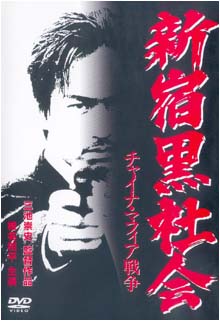
This relatively little-seen film (most commonly referred to as simply ‘Shinjuku Triad Society’) holds a very important place in Miike’s vast filmography – this was his first theatrical (35mm) feature, and the film that first brought him to the attention of a wider audience – he received a ‘Best New Director’ nomination from the Directors’ Guild of Japan for the film (though it would be another year until his career really took off with the release of FUDOH). The film is the first part in a loose trilogy (the ‘Kuroshakai’ trilogy), the other two parts being RAINY DOG (1997) and LEY LINES (1999).
The story concerns a vicious gang of Chinese mafia (‘Triads’, as opposed to the Japanese form, ‘yakuza’), led by a gay psycopath called Wan Tsumin. Wan killed his father, a drug addict and dealer, at the age of fourteen, in his home country of Taiwan. He then fled to Japan, where he built up his gang, the ‘Rontsua’. The gang become involved with a yakuza family called the Yamane, setting up an illegal organ trade. A detective called Tatsuhiko Kiriya is involved with the Yamane, and also with trying to wipe out Wan’s gang. However, things become much more personal when his brother, Yoshihito, becomes involved with Wan, through Wan’s lawyer, whom he was training under/involved with. Inevitably, Tatsuhiko ends up confronting the Rontsua in the midst of an increasingly violent and bloody gang war.
SHINJUKU TRIAD SOCIETY is an odd film, even by Miike’s standards. The first half veers from pitch black humour to gory violence, throwing in anal rape (of both sexes), gay sex, eyeball removal and a bewildering cast of secondary characters, whilst the second half becomes more serious in tone and increasingly violent. The film as a whole has a very sleazy atmosophere, especially in the first half. Directorially, it’s a very assured film and one can tell that Miike had a thorough grasp of his trade before making his overdue theatrical debut. Whilst there’s none of his trademark wobbly/sped up camerawork, there are all sorts of interesting camera set-ups and angles, none of which feel like Hollywood-esque empty stylistic gestures. There’s a gloomy synth score and a complex mix of dialogues, with quite a bit of subtitling for the Japanese audience (prefiguring the very confusing mix of dialects and subtitles in DOA: FINAL (2002)). Those who charge Miike with misogyny and homophobia (again evident in DOA: FINAL) will be pleased to know that both are in plentiful supply, even as early in his career as this film. Indeed, it’s difficult to know how to take the sexual aspect of this film – the only sex acts Miike shows involve either sodomy or (gay) oral sex, and are filmed in such a way as to make them look seedy and cold. The gay characters are the baddies, though Tatsuhiko isn’t married and doesn’t have ‘normal’ sexual relations with any women, as far as the audience is shown.
It could be argued that the two central themes to be found in the majority of Miike’s body of work are the complex relationships present in the family unit and the wider relationship between Japan and its immigrant population. Certainly, these provide the main narratorial thrust here, and are explored in as much detail as in any of Miike’s later work. The central character, Tatsuhiko, has severely divided loyalties – he’s a cop in the pay of the yakuza. His brother is the gay lover of the Chinese gang boss he’s trying to bring down. His father was one of the Japanese settlers in China who was forcibly re-patriated after WWII and his mother was Chinese, whilst Tatsuhiko has been brought up in Japan. He is trying his best to look after his parents (his dad is very ill) and his brother, but things just aren’t working out. The bad guy, Wan, also has certain conflicts in his nature – in addition to being a homosexual patricidal psycopath, he has paid for a hospital to be re-opened in his home village in Taiwan, and seems to genuinely care about his (very young) gay lover. Miike handles the various threads deftly, weaving a complex yet entertaining story, whilst continuing to throw in eccentric touches like a gang member’s nymphomaniac girlfriend (who, in typical Japanese fashion, is grateful to Tatsuhiko for raping her – “you’re the only one that’s ever made me come,” she tells him whilst saving him from the Chinese gang, “your dick’s too good to waste”), a bizarre confrontation in a brothel, a completely weird police interrogation, etc.
All-in-all, I would rate is as one of Miike's strongest films, certainly one of his strongest pre-DOA/AUDITION efforts. It will likely offend you, entertain you and bemuse you in about equal thirds, which I would say is true of all Miike's best films.
The film is currently only available on Japanese DVD (unsubtitled), but Tartan are apparently going to be releasing all three films in the trilogy in the UK… eventually.
Cast:
Takeshi Caesar
Ren Osugi
Kippei Shiina
Tomoroh Taguchi
Airi Yanagi
Kyosuke Izutsu
Crew:
Director – Takashi Miike
Screenplay – Ichiro Fujita
Producers – Tetsuya Ikeda, Toshiki Kimura, Tsutomu Tsuchikawa
Music – Atorie Shira
DP – Naosuke Imaizumi
Editor – Yasushi Shimamura
Production Design – Tatsuo Ozeki
Assistant Director – Hideyuki Yamamoto