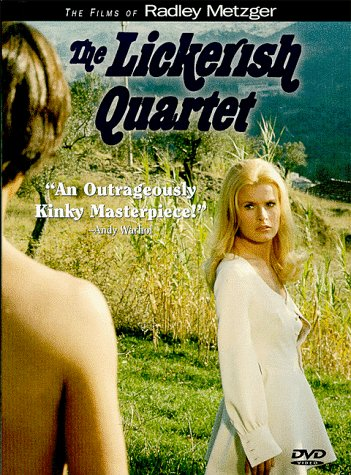
Several times during the past few years I have been tempted to sit down and write a review of Radley Metzger's marvellous adult film THE LICKERISH QUARTET (1970), but each time I have hesitated, out of fear that I would be able to communicate to a reader unfamiliar with the film, and Metzger's work in general, just what it is that makes it sparkle so. (I have a similar problem with Shozin Fukui's RUBBER'S LOVER, which I have started to write about more than twice, only to give up each time in frustration.)
The film takes place in and around the beautiful setting of the Castle of Balsorano in the Abruzzi Mountain range in Italy (the same setting was also utilised by Renato Polselli for THE REINCARNATION OF ISABEL (1972), as well as another film starring Mickey Hargitay, THE BLOODY PIT OF HORROR (1965, aka 'The Crimson Executioner'), and other Italian genre films). A dysfunctional family unit live there alone, comprising a man (Frank Wolff), his wife (Erika Remberg) and her son (Paolo Turco). The film opens with the three of them watching a grainy black and white film on a projector. This film is a typical late 60's adult 'loop', without sound and showing several sexual encounters between a beautiful blonde woman (Silvana Venturelli) and some other participants. The family bicker throughout, speaking in strange, disjointed sentences and eventually the son tells the adults that he is leaving. They follow and drive into town, where a carnival is in full swing. They watch a death-defying 'wall of death' motorcycle performance, featuring two men and a girl. When the act is over and the girl removes her helmet, they're amazed to see that she appears to be the same girl they've just been watching, albeit with dark hair.
The man persuades her to return to their castle with them, and the son puts on an impromptu magic act, which culminates in him making the girl disappear. After searching the castle for her, they find her back in the main room, with the son. The man puts on the film, but it's subtly different - the blond girl's face is obscured by objects or turned away from the camera. Eventually, he manages to find a part of the film where her face is visible, but it seems to be a different girl, and not the one from the carnival. She agrees to stay the night, and the next day when she reappears she is blonde, like the girl in the video - the dark hair was simply a (very effective it has to be said) wig. The girl then has intimate relations with each of the three family members - first the man, in the library, then the son, outside in the grounds, and finally the mother, back in the projector room. The girl disappears and it is no longer obvious quite what was real, and what fantasy. Whatever the case, the man and his wife seem to have been brought close together once more by the end of the film, whilst the son seems to be the most confused...
As is obvious from the above, the main thrust of this film isn't the plot, which exists only as a framing device about which Metzger drapes wonderful set-pieces and bizarre dialogue. Coming from almost any other director, this film simply wouldn't work. The dialogue is so arch and pretentious that it could be painful - yet, in Metzger's hands it transcends these dangers, hinting at strange, forbidden pleasures and secrets. This is an art/erotic film with a much greater emphasis on the former than the latter. Back in 1970, when the film was released, it was still possible to make an arty softcore porn film without it seeming cliched and naive. Viewed today, the erotic elements are surprisingly tame; rather than relying on plentiful nudity to arouse the audience (though there is a reasonable amount of nudity), Metzger uses sensual photography, elegant settings and evocative music to create a heady atmosphere of eroticism. The most memorable part of the film is the encounter between the girl and the husband in the castle's library. This is a wonderfully tacky, dated room, with a white floor covered in blown up dictionary definitions of words. As the actors roll about on this floor, the camera zooms in on words like 'phallus', 'copulate', and finally 'fuck'. It may not sound so clever on paper, but it works wonderfully well.
There's more to the film than the above though - what really distinguishes it from other arty erotic films of the period is the extremely confusing way in which Metzger intercuts footage from the black and white film, the film we're watching, and a third film, involving a soldier and a prostitute in World War II. These three films are from different time periods, but become more and more confused towards the end of the movie, with a final, inevitable outcome. The editing throughout is masterful (Metzger began his career as an editor) and reminds me strongly of Nicolas Roeg's early films and, to a lesser extent, Russ Meyer's later work. There are other distinguishing features too; as with all Metzger's major films, the music is excellent, fitting the ambience of the film perfectly. The photography is breath-taking and there are also some very idiosyncratic touches, such as the description of the son's vision of St Margaret, accompanied by close-ups of paintings depicting said event, or the lovely little touch involving rewinding the film, when the man comments on the girl's now blonde hair, to her regret.
The acting in the film is excellent, though Paolo Turco as the son is somewhat irritating, maybe due to his character being rather annoying. Silvana Venturelli is excellent in her part, being both beautiful and captivating (she can also be seen in Metzger's previous film CAMILLE 2000 (1969)), and Erika Remberg brings just the right air of severity and cultured European dame to her part. For me though, the real star of the show is Frank Wolff. Wolff will be familiar to nearly everyone, thanks to his role in Leone's ONCE UPON A TIME IN THE WEST (1968) as the pioneering Brett McBain, who Claudia Cardinale's character has married, thus bringing her to 'Sweet Water'. He also appeared in many other European productions during the 60's, featuring in many westerns, most notably as the Sheriff in Sergio Corbucci's THE GREAT SILENCE (1968). His other most notable roles are in Castellari's THE COLD EYES OF FEAR (1971) and Fernando di Leo's fantastic MILANO CALIBRO 9 (1972). I have always found him less than impressive in the films I've seen him in; he tends to play a humorous character and his strange features make him look slightly cartoonish and hard to take seriously. However, in THE LICKERISH QUARTET he is perfect - believable, human and dignified, he is like a completely different actor and it's clear that Metzger brought out the best in him, even although the role was completely different to anything else he did in his career. Sadly, Wolff committed suicide at the age of 43 in December 1971.
The dreamy mood of the film, and the questions it poses about the nature of identity and fantasy, are strongly reminiscent of several European classics, most notably Antonioni's BLOWUP (1966), Alain Resnais' LAST YEAR AT MARIENBAD (1960), Franco's SUCCUBUS (1968, aka 'Necronomicon') and Fellini's 8 1/2 (1963), and are more recently mirrored in David Lynch's LOST HIGHWAY (1997) and MULHOLLAND DRIVE (2001). Metzger's previous film was CAMILLE 2000, a film about the decadent life and loves of a drug addicted young woman. Many fans consider these two film his best work, but CAMILLE 2000 never clicked for me in the same way as THE LICKERISH QUARTET. Metzger made two more excellent erotic films, which incorporated stronger, near-hardcore sex in them (SCORE (1972) and THE IMAGE (1973, aka 'The Punishment of Anne')) before moving into the hardcore arena in 1975. He directed five highly acclaimed XXX films under the pseudonym 'Henry Paris', and also made several other films, both before and after his XXX work, but THE LICKERISH QUARTET has to be his crowning glory.
Cast:
Silvana Venturelli
Frank Wolff
Erika Remberg
Paolo Turco
Crew:
Director - Radley Metzger
Screenplay - Michael DeForrest & Radley Metzger
Director of Photography - Hans Jura
Art Direction & Costume Design - Enrico Sabbatini
Music - Stelvio Cipriani
(Originally posted at MHVF, 27/10/03)